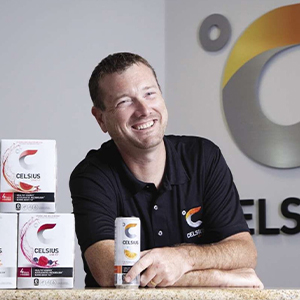
[00:00:10] Ray Latif: Hey, folks, I'm Ray Latif, and you're listening to the Top Podcast for the food and beverage industry, Taste Radio. This is episode 237, which features an interview with John Fieldly, the CEO of fitness-centric energy drink brand Celsius. Just a reminder to our listeners, if you like what you hear on Taste Radio, please share the podcast with friends and colleagues. And of course, we'd love it if you could review us on the Apple Podcasts app or your listening platform of choice. It might be surprising to learn that Celsius, which generated over $100 million in sales in 2020 and is profitable, was in turmoil just a few years ago. Founded in 2004, Celsius has undergone a significant shift in its initial positioning, in which the drinks were promoted as quote negative calorie and quote fat burning. That focus eventually proved to be problematic, and the company spent years in remediation. John, who joined the company nine years ago and has been at the helm since 2017, has been at the forefront of Celsius' turnaround and is spearheading its current growth strategy, which is supported by distribution at top retailers, including Walmart, where the brand is sold nationally. In the following interview, I spoke with John about his role in the turnaround, including his belief that a strong understanding of finance was a significant factor in helping to fix Celsius' problems, the importance of setting expectations with staff and investors, how to optimize placement at key retailers, and why he has an open-door policy. Hey folks, it's Ray with Taste Radio. I'm going to call right now with John Fieldly, who is the CEO of Celsius. John, great to see you. Great to see you as well, Ray. Thank you. And thank you very much for taking the time to be with me today. We talked last week and just hearing the remarkable rise and success of Celsius over the past three or so years has been amazing. You've obviously had a lot to do with that. You became the interim CEO in 2017. About three months after you joined, you rang the NASDAQ opening bell, which is pretty amazing. I can imagine you were pretty nervous doing so.
[00:02:24] John Fieldly: It was great. It was great. Actually, I've been with the company now for over nine years, going on almost nine and a half years. One thing when I started, our investor, Carl DeSantis, wanted to get back on NASDAQ. When I started, the company just got delisted from NASDAQ, so it was on the OTC market. So one of my major initiatives coming in as the CEO was CFO at the time is getting them back in motion, get the process started. So when the business was able to perform, we could continue to move upstream to NASDAQ. So it was a major achievement. It was very exciting. It was great to get Carl back on that podium, just exciting time for the company. And we haven't slowed down since.
[00:03:05] Ray Latif: How did you get into this business of beverage? Were you ever involved in the food and beverage industry prior to joining Celsius?
[00:03:12] John Fieldly: Actually, I mean, I've always been an entrepreneur. So I'm a CPA with accounting background. I worked over eight years at Eckerd Drugs, if you remember. In the retail space, I was part of their turnaround team, turning around underperformed stores with customer marketing strategies, inventory management, procurement, and really getting them in position at the time, come to find out that they were looking to sell the business. So once that acquisition took place, I gained some experience in B2B publishing. Labar Friedman, you might know, big B2B publisher, Home Channel News, Retailing Today. And I was their business manager for over eight years there, learned a lot of the business in regard to marketing sales strategies, was really instrumental going through really the depression that we had and the recession that took place and helping them really survive through that process. And then I got my experience in some dietary supplements at Orogenics. I was there for prior to joining Celsius. I helped them get listed on NASDAQ, also helped them really launch a consumer-based probiotic mint into over 35,000 retailers across the country in the drug and grocery space, and was instrumental in the supply chain optimization and putting processes and procedures in place. And that was before joining Celsius. A little bit of a different background than your traditional accounting background, but always involved in the numbers. And the numbers are a language that needs to be leveraged and monetized by sales and marketing teams and operation teams. So that's kind of what I drive by.
[00:04:38] Ray Latif: I took a lot away from what you just said, but I guess one of the things that just stuck with me, and forgive me for saying this, is probiotic mint. Do you say probiotic mint? Is that right?
[00:04:47] John Fieldly: Oh, probiotic mint. Absolutely. I work for a biotech company. It was great. A biotech company. All the science was based out of University UF in Gainesville, creating a product that cures MRSA. And through that process, they created a probiotic, which actually whitens your teeth and freshens your breath. And we launched it into 35,000 locations. quite interesting. It's a on the market today.
[00:05:12] Ray Latif: How doesn't frighten your your You kind of alluded to this earlier. Celsius had been on NASDAQ, was delisted, is back on NASDAQ right now. Clearly, there were some issues with the company. Your predecessor is Jerry David, a specialist in turnarounds. On his LinkedIn profile, he notes that he led the turnaround of a public global beverage company on the brink of going out of business. Again, you were a key part of that turnaround as a CFO and now as the CEO. As the CFO for five years, I'm guessing you're acutely aware of the problems. First, what was wrong with the company? And second, how did you determine which problems to fix first and which ones that you could address second?
[00:06:08] John Fieldly: Yeah, no, Jerry David's a great mentor of mine. I worked with him at orogenics at the probiotic main company as well. He was instrumental in launching that brand into retail, but, uh, Jerry brought me on as his right hand man to help turn them around on the turnaround story here at Celsius. And when you look at a turnaround and working with Jerry, it's all about the basics, right? You need to take it really back to the first level. And when we started, we were getting really delisted of a lot of retailers around the country. It was a tough time for the company. And really need to understand and really do a whole branding exercise and understand where the consumers are, who's related to the product, who's consuming the product, who's your consumer base. And we retrenched and really got solid and got focused on the business and continue to drive. In the fitness channel, we saw great activation. And we really saw this opportunity for Celsius to be the future of energy. And that's what we really saw and envisioned. When we came to Celsius, Celsius was all about, you know, burning calories and body fat. Now, that is very interesting. It is very intriguing. Product's amazing. Seven clinical studies published in peer-reviewed sports nutrition journals. Lots of science behind the product. But that's really a niche segment of the overall opportunity we have with Celsius. So we learned throughout the journey, you know, we positioned Celsius today as really the future of energy is a central energy provides healthy energy, seven essential vitamins. We have green tea, ginger and Grana and best of all about the product. It tastes great. No crash, no jitters, and it's all about driving your peak performance. And that's where the category is going today. So a lot of it was timing and sequencing. When the product first launched, it was a little bit ahead of its time. And that's what our investors saw. Carl DeSantis is the main investor. He saw the vision, as well as Janice Haley and Steve Haley. They saw the vision of Celsius, but it was just a little bit too early for its time. Now's the time for Celsius when you look at consumer trends, health and wellness trends, fitness, that healthy, active lifestyle. And we feel those trends are going to continue to get stronger on the other side of COVID.
[00:08:03] Ray Latif: Well, clearly you're on the right track. You know, going back to the issue of a turnaround project, when you first came on board, did you see this as a company that was going to require years and years of remediation before it got back on its feet? Or did you think, you know, this could be a rather quick turnaround project?
[00:08:26] John Fieldly: Yeah, I mean, expectation of investors is very important as well. I mean, the turnaround stories are tough, right? It's much easier to bring a new brand to market versus turnarounds. I mean, there's skeletons in every closet, lots of challenges along the way. You know, one thing that we did not walk around with is with a hockey stick. You know, it was all about making those base hits and continue to grow the brand. build that loyal consumer base and how can Celsius connect with a broader audience. But it's timing and sequencing because you can't let your sales outrun your marketing and your brand awareness. So it's been a really tight balancing act as we continue to grow and scale. And we've been really, really cautious of that all through. since I've been here over nine and a half years, being very cautious on the timing and sequencing. The great thing now, when you see Bang now moving to Pepsi and Celsius's velocity rate, like you mentioned, we're seeing great rotation, great velocity rates, and now we're able to activate a DSD network that wouldn't talk to us before if you go back five years. But now they are so excited to sell Celsius and the product's rotating. We think there's tons of opportunity ahead. We know there's tons of opportunity ahead as we can see this category continue to evolve and really align with these wealth and wellness trends that Celsius is capitalizing on.
[00:09:37] Taste Radio: Guessing your margins? That's risky. Belay Financial gives CPG brands the clarity to scale smarter, faster, stronger. Get your free inventory ebook by texting TASTE to 55123 and start making data work for you. Vibrant Ingredients is the natural ingredient partner powering food and beverage innovation, delivering flavor, function, and protection through a science-backed portfolio. Vibrant delivers purpose-driven solutions that help brands create extraordinary experiences. Discover what's possible with Vibrant today. Visit vibrantingredients.com.
[00:10:24] Ray Latif: You earlier said that you and Jerry saw this opportunity to change the energy drink category, at least bring a different type of energy to market. When you started out, and I remember when I started out at BevNET, Celsius was, as you mentioned, that fat-burning drink. It was the negative calorie drink. It was all these things that didn't necessarily say energy. So even if you did see this opportunity Bang Energy, I assume that there had to be some hesitation because you had been this one thing. You had been a very, very functional drink that had a specific use occasion. Was that timing and sequencing related to the sort of gradual change in positioning of Celsius? I mean, did you see, okay, did you say to yourself, well, we can't just turn into Bang Energy drink, we can't just say we're Bang Energy drink. Did that sort of evolution take time and was that part of your planning?
[00:11:19] John Fieldly: Coming with the company when I first started, I mean, and still today, you know, getting out in the trade, talking to consumers. I remember, you know, the first demo I worked out at a, it was a 5k event. No one knew about Celsius, but you're right. The prior company, the prior management team was all about that calorie fat burning. But when you saw a Celsius consumer, the passion they had, and it's the reason because the product makes you feel so great. If you meet a Celsius consumer, they're extremely passionate. Our loyal consumer base is strong. We have one of the highest continuity rates on Amazon. We saw that in our own sales data when we first acquired the company. The bulk of our sales come from, you know, the product is warm. It's mainly warm. So a consumer physically has to buy the product, take it home and chill it and drink it as part of their daily active lifestyle or daily routine. So we knew we had a loyal consumer base. We needed to make a gradual transition to continue to go after this changing evolution in the energy category. And really, 7-Eleven was one of the first mainstream retailers to believe in this really transformation in the category. And they brought Celsius on because we are different. We're differentiated. We're healthy, functional energy. And that's really what we've been evolving on the last several years. We further see opportunities over the last several, really last several years, further defining that, you know, with this essential energy, the vitamins. And we learned that the features and benefits are the attributes of the product. People weren't consuming the product because of the calories or the fat burning properties of the product. They were drinking it because of the experience, the great flavor, the great taste, and part of a daily active routine. And that shows you the multi-billion dollar opportunity we have.
[00:12:56] Ray Latif: One thing that stood out when we chatted last time is that you said, you have to stay relevant, nimble, and aggressive. And I can just tell from your passion for the company, for the brand, that all those things are front of mind, top of mind for you. Then the other thing you said is that you have to be big on data and expectations. Expectations is something you mentioned earlier as well. You said you knew who the consumer was, the passionate Celsius consumer, but how do you translate or how do you take that anecdotal data and turn it into numbers-driven data that you can bring to a 7-Eleven, that you can bring to other retailers, that you can bring to your investors?
[00:13:37] John Fieldly: That's a great question. And really prior to just a few years ago, we were selling a story. It's storytelling and getting better at that storytelling about that shift we were seeing in the data. When you look at the scan data and you look at some of these functional brands, healthy, better for you brands, grabbing more market share each and every day. So we were crafting stories until we got that Nielsen scan data, those spins data. Keep in mind, most of our sales prior to just a few years ago were mainly out of the online, e-com, gyms, health clubs, vitamin specialty shops, GNC, vitamin shop, and also in the diet nutrition sets of retailers around the country. It's just the last really two to three years we started to venture off in the beverage category, where we're seeing those higher velocity rates. We knew when we placed Celsius in a competitive set next to top performing brands in the energy category, Celsius would rotate at just the same level, if not better. But we needed to prove that through data. So we started to get store level data. 7-Eleven was a great example. We've been in 7-Eleven now over four years. Leveraging that data has really helped us, just showing the velocity potential that Celsius has. But being a turnaround story, you do have those skeletons that you need to work around. So it has taken us versus a new brand coming in and getting those four listings on a shelf. Celsius, we've had to prove ourselves each and every buyer reset. So each Plantagram reset, we've been able to add more SKUs. And I think that shows you the opportunity with Celsius and the velocity. We're adding SKUs every reset. We're proving ourselves. And that's what it's all about.
[00:15:12] Ray Latif: When you are bringing that data and those numbers to retailers, some of those retailers that you're talking about, you had already been in previously. Those retailers had, quote unquote, kicked you out, or to use a better term, delisted you. When you're coming back a second time, how do you tell the story so that it's not just stronger, but that you're telling that story in a way that is going to help the buyer understand that there's not just a few changes here or there, that there's a huge opportunity for growth.
[00:15:42] John Fieldly: Right, and that's especially when you're competing against other brands that are paying significant slotting dollars, makes it that much more of a challenge. What we've done as a company at Celsius, we were selling an emotional selling story to buyers, right? But now we have a financial selling story, which is so key because the buyers, they care, honestly, not about the emotions about your brand, they care about a financial selling story. What can your brand do for them? And what your brand can do for them is to make sure every brand is paying their fair share of rent. So that's one thing that we're able to demonstrate now, that Celsius will pay a higher share of rent due to the velocity numbers we're seeing at retail by adding additional flavors of Celsius. Celsius is aligned with today's health mind and consumer. New millennials coming into the category in Gen Z are looking for these alternatives, and Celsius is closing that gap. And then your traditional energy drink consumer that is aging out of the for alternatives and Celsius We are about 50 50 male are 18 to 44. So pretty
[00:16:48] Ray Latif: I can imagine that you're seeing a lot of opportunity, especially having gone from the fitness channel, those yoga studios, those gyms, the GNCs of the world, into the broad market opportunity retailers like a Target or a Walmart or a Kroger. How did you identify the right retailers and the right retail channels for Celsius as you're transitioning out of the fitness channel?
[00:17:16] John Fieldly: Yeah, well, our biggest opportunity right now is convenience. As we know, the bulk of energy drink sales are impulse purchases in the convenience channel. But Celsius, due to our, really, if you look at our historical distribution, has initially been in the diet and nutrition sets in grocery. So, you know, that was a low-hanging fruit, really, to optimize those retailers and move our placements into the beverage aisle. So we've been working on that over the years and seeing great improvements each year. And all of our retailers continue to show same-store sales growth and expansion. Then also we went to drug. We saw great opportunity in the drug channel as they were looking for alternatives. We see really opportunity in every single channel of trade. A lot of our sales team members really just see Celsius when you look at it as a unicorn. Traditional beverages and products only perform well in a single channel of trade. What's great at Celsius, we've seen double-digit growth and great growth and opportunities in every single channel of trade. So really something special we have here at Celsius. The next opportunity right now is convenience, activating these distributors. We have over 150 distributors now. Jerry Rita and Big Geyser has been a great supporter of us. They are out really putting Celsius all over New York. There's so much opportunity in the market, one of the fastest growing brands in his house right now. And it's just great to see these distributors really come alive. And with our ACV currently around 20% convenience, The roadmap ahead is just really exciting as we see that. We just got listed in the Speedway. So I've been working on Speedway as well, seeing great opportunities there. Circle K, QT, Racetrack, many other convenience channels are coming on board and further expanding. So just a great time. And the category continues to grow. We've talked about it. You report on it all the time. Energy category is a great category and it's planned to be a great growth category for years to come. So we feel we're in really good position.
[00:19:08] Ray Latif: One thing that came with some of the ups and downs of Celsius was this sort of industry stigma about what the brand represented. And I feel like in some ways it's helped your growth over the past three or so years because you've been able to stay under the radar to a certain extent at a time when everyone else is talking about other brands. Is that a good thing? Has that helped you?
[00:19:32] John Fieldly: I don't know. You might be able to say it helped us, baby, but I don't think so. I think it's hurt us. I mean, it's another skeleton in the closet. I mean, I mean, BevNET, you guys have reported on us as that negative calorie energy drink. I mean, that's not who we are. We're essential energy. We're disrupting the category. The best part of it is consumers know none of that history. Right. I mean, consumers know none. Consumers show they want the product. Demonstrating the product is aligned with their lifestyles. It's been a challenge in the beverage industry with distributors and, you know, a lot of the periodicals as well. And some of the legacy beverage executives just seeing us over the years, you know, that brand's been around for 10 years. there is some stigma. First impressions are so critical, right? So we're trying to redo some of those first impressions, but we're excited now. The best thing is consumers don't know about that. They're all about Celsius. They see us as their energy drink. They see us as the future of energy. And that's what we're focused on. And really now we're trying to focus the trade, our distributors and our retailers, that financial selling story. We're not selling an emotional story anymore. So financial selling stories, as you know, are much easier to sell.
[00:20:40] Ray Latif: Yeah, I mean, in some ways that story seems to be changing a bit, you know, going from this Celsius is just surviving to Celsius is thriving. It's a tough story to tell, but it sounds like you're telling it quite well. And I'm sure that's something that you've been working on as a leader over the years, your ability to communicate. And I'd love to talk about your leadership style going from the position of chief financial officer to the position of a CEO. I wonder how much of a jump that really is and how you got comfortable with being in this position of accountability where the buck stops with you at every turn.
[00:21:20] John Fieldly: Yeah, I don't have the way I'm bred. I've always been like that. And, you know, a CFO role that I was in wasn't, you know, traditional CFO role. That was a really a COO. I was always involved in, you know, the marketing operations and sales strategies. So, you know, worked as very closely with the teams, with all the teams. So, you know, it wasn't too much of a direct leap, even prior at Originix and LeBar Friedman. It was always part of the management teams and, you know, always looking to optimize. It's just something that came natural as you continue to move forward. And listen, we want to be the top energy drink. We are in well-positioned to do it with massive opportunities. And we, you know, Monday morning, we all sit down and talk about the strategies for the week. What are the tasks? What are we working on? Where are we going as an organization? What are the key things that need to get us there? And that's through the marketing team, the sales team, the ops team, and the accounting team as well. So, you know, it's exciting times. It's, yeah, there's tough times and you need to hold team members accountable. You need to make sure you're empowering them and really giving them a drive to really be their best and succeed. And what we're doing is difficult. You know, we're going up against the biggest CPG brands in the world. We're always going to be outspent, but we need to outmaneuver, out-execute, and that's what's going to make us successful.
[00:22:39] Ray Latif: I feel like a lot of CEOs I speak with started out as sales or marketing people. There's a handful like you that I've spoken with that came from finance. If you were speaking to someone listening right now who is dreaming about becoming the CEO of a food or beverage company, would you recommend that they have a solid foundation in finance? Is that more or less important, same amount of importance as sales and marketing?
[00:23:06] John Fieldly: Sales and marketing are critical, right? That's the building blocks of the brand. But I do think finance is very critical, especially running a public company as well brings up another importance. But I mean, the numbers drive everything. I mean, that's what your investors focus on. That's what your retailers focus on, your distributors. I think having a firm understanding of finance and accounting is critical as you're building organizations. I think it's the backbone of the organization. We just hired several new team members, actually just doubled in size today on our team members in North America and meeting several team members coming in from other brands. And we're going through some of our processes and procedures on onboarding new customers and really understanding that the new customers work into our forecasting, which is so critical because you can't outrun your demand or outrun your supply. They were very impressed in some of the, you know, the oversight that we put on accounts to make sure everything is working together and as optimized as possible.
[00:24:04] Bang Energy: Do you want more repeat buyers on Amazon? Well, this free resource in collaboration with Straight Up Growth will help your brand turn first-time buyers into long-term subscribers. Download Winning the Repeat Purchase Game on Amazon now at Taste Radio slash SUG. That's Taste Radio slash S-U-G to start building retention-driven growth for your brand on Amazon. Scaling a beverage brand into major retail comes down to operational readiness. From packaging lead times to co-manufacturing strategy, the details can make or break a launch. In a new ebook in collaboration with Octopi and Asahi Beer USA, industry leaders share what they've learned in helping brands scale. Download it now at Taste Radio slash octopi.
[00:24:54] Ray Latif: Speaking with investors, as you mentioned, is an important part of your job. And given that you're a public company, there are some very influential investors and very important investors that you have to present to. What are some of the most important lessons that you've learned about how to effectively manage and speak with your investment team?
[00:25:17] John Fieldly: Yeah, with the investment team, you need to be honest and open. You know, what you say is what you need to deliver on and you need to set expectations that are realistic. So kind of learned that early in my career on, uh, you know, setting expectations is extremely important. That's a very important lesson. You know, we all see the opportunity and we see the great opportunity of being that leader and the timing of that. But there's so many things that can happen. You can't hit a grand slam every day. So you need to be ready for that grand slam. But you really need to make sure that your plans are calculated based on really timing, sequencing, base hits as you continue to drive and scale. Otherwise, it can be not only extremely discouraging for your investors, also very discouraging for your employees as well.
[00:26:03] Ray Latif: So are you saying that you temper expectations? You know, I'm sure there are a lot of investors who would say, and I've heard this before from entrepreneurs that, oh, you know, if we grew this much this year, we should be able to grow this much this year. Or, you know, why aren't we in all these retailers? It seems like I see our competitors doing that. So when you're talking to investors, are you tempering expectations? Are you sort of having to manage what is realistic with them?
[00:26:29] John Fieldly: You have to manage expectations realistic. You always want to over deliver, right? Then under deliver. So, you know, that's really critical. Managing expectations is the most difficult part. And, you know, the company has done a really good job on driving the teams and pushing the teams really to over perform. So that's been another critical component of our success. If you look at a lot of the analysts that cover us, we've done it really well on, you know, exceeding those expectations that were put out there and our internal expectations as well. We're always striving for the best and striving for the stars in those Grand Slams, but it's very important to have a realistic forecast, a realistic plan that you're working and executing against and building the organization. Because if you're building an organization for that Grand Slam or that hockey stick, if it's delayed or the timing's not right, it's really going to put you in a financial position because you're going to either over invest, you invested ahead of revenue too quickly, you invested ahead of your distribution, or you invested in manpower and people power, which is overextended. And now you have to make some pretty tough decisions. So the timing and sequencing of transforming the organization for scale has been critical. Yes, it puts additional pressure on teams because those teams, as you're adding, you're running extremely fast when you're adding team members. So get making sure you, pick up those right team members, the interview process, and really understanding who's coming on board is extremely critical at those times. But it's a balancing act. I would rather time it right than overinvest and have to make some tough decisions down the road due to a buyer didn't list all your flavors. You didn't get that national distribution. The retailer is only going to do a test. There's a lot of things that are outside of the operator's control.
[00:28:13] Ray Latif: I know these are things that investors bring up. I mean, is there an instance where an investor has challenged you and you've had to really stand your ground in terms of those realistic expectations?
[00:28:24] John Fieldly: Absolutely. I mean, the realistic is when you get, as an example, get listed, it's a national distribution. I mean, Walmart, CVS, Rite Aid, there is a lot of things that go in that to educate the consumer where Celsius is located, where your product is located. So just because you expand a distribution doesn't mean their revenues start to quadruple and grow at exponential rates. As you know, we're all creatures of habit. We go to the same stores, the same grocery store, the same job. You know, we need to educate the consumer on where you are within the retailer. And we're seeing about it takes about three years really to optimize a retailer. We do think the optimization of these retailers. We'll go quicker now that we're not going through warehouse, now that we're going with the power of DSD, because DSD is making sure we're in stock, making sure our shelf tags are up, we have better placement and getting cold availability. We think that'll be optimized and start to improve, but we're watching that. Historically, it's been about three years really to get retailers optimized.
[00:29:23] Ray Latif: Yeah. I mean, that's a really good point. It's not like, you know, you can walk into, you know, a hundred CVS stores and expect people are going to start pulling the product off the shelf. You definitely have to have the manpower to support that distribution. And as you've been hiring that support, I can assume that there are a lot of different personalities that keep coming into the office, new personalities. And, you know, you can certainly vet for folks that are going to fit into the culture versus otherwise, but I was reading an article that was published about you, I think it was an interview, and one of the things that really stood out is you said, I learned not to wait regarding HR issues. When you smell smoke, it's very important to address the issues up front. When did you learn that lesson?
[00:30:04] John Fieldly: Yeah, we learned that in the early days at Celsius and as well, you know, even at Origenics and at Ecker Drugs as well. I mean, it's when there's smoke, there's fire, it needs to be addressed. Don't let topics fester you know, bring them to the forefront, sit down and really, really talk to the team members and work through those. You know, as we grow, we bring in a lot of new personalities, uh, and different perspectives, which is great, but you need to work through the differences. Um, a lot of people have difference of opinion that can happen and that needs to be worked through. So part of it also talk about maybe some training, you know, psychology would also be a good class to take. Um, I took those in college. Those are very important. So I think that's a critical. Critical skill is psychology as well, because it's all about empowering people, making sure people are aligned with your thoughts, your plans, your execution, and feel important. Every single role in Celsius is extremely critical to the success of this company. That runs through the whole organization. It doesn't matter what the role is. Every single role is extremely important to us taking the next step forward and moving forward. And that is something I strive through the organization, and it's very important. The other thing is, as a team, we'll do anything. It doesn't matter what happens as we go through here. We unload as a team, or we have products show up. We do a lot of different things here together as a team, as an organization, and we're all willing to do whatever it takes to move Celsius forward.
[00:31:38] Ray Latif: Yeah, we're speaking from your office in Florida right now. How many people work in that office?
[00:31:43] John Fieldly: We have about, I think we're up to about 35 in the office. We're knocking down the office next door right now. We have some contractors that are expanding the office on the other side here. So it's an exciting time. The brand is growing. Every department is in a transitional state. So it's just exciting. I've got a lot of new team members. And when the new team members come in, they can see how passionate our existing team members and the new team members are even that much more passionate. So it's a really good time to be here at Celsius and work with the team and the environment. And everyone just feels the energy in the building. And it's radiating out. We're seeing it in the sales. Our logistics team just next door over here is busy shipping product. And it's a great thing.
[00:32:28] Ray Latif: Do you know everyone on your team? I mean, I assume the answer is yes, but... Absolutely.
[00:32:34] John Fieldly: You heard me when I was walking through the office there. I was introducing you to everyone walking through. Absolutely. That's critical.
[00:32:40] Ray Latif: I think I even heard you say hello to someone who just started today. And you're like, It's good to see you. Good to see that you're still here, which is really tough. I mean, everyone's first day, you never know how it's going to go. But it sounded like you were friendly and had a really personal relationship with almost everyone on your team. Do they all have an open door policy to your office? I mean, is that a good thing? You know, for someone to be able to just walk in and say, hey, John, I have an issue. I just want to talk to you about something.
[00:33:07] John Fieldly: Yeah, it seems like all issues run uphill. It is a challenge having an open-door policy, but that's the way I run. It's an open-door policy. I sit with all the team members. I'm in a lot of the meetings, work very closely with the teams. And listen, we're here to problem-solve. That's why we're here. If everything was running great with robots, they wouldn't need us. But we're here to problem-solve. Problems come up, let's figure out a solution on how to correct it. How do we optimize? How do we get better? We have to get better each and every day. That is the critical component for success. And that's the only way Celsius is going to move forward.
[00:33:39] Ray Latif: Well, a pretty big problem fell into your lap and fell into everyone's lap in March of 2020. That's when the US was really faced with its first COVID crisis and a lot changed. And a lot changed in terms of the way you were able to promote and communicate what Celsius was and what it represented. I mean, just from the standpoint of demoing a product, couldn't do that and still can't do that in the way you had in the past. You mentioned you are communicating to consumers in a certain way. How are you demoing to consumers? How are you getting liquid to lips, as they say in our industry? What are some of the ways that have been effective for Celsius to draw in new consumers to get people to appreciate the Taste Radio the flavor and the benefits that you were talking about earlier?
[00:34:26] John Fieldly: 2020 was a crazy time. It's still a crazy time. We're all in this pandemic together. That's the key. One thing you got to do is, as I said before, we got to outmaneuver, outsmart, out-execute. So immediately in March, you know, we do have operations in Asia. So we did actually start to see some of the pandemic take place in December and January. At that point in time, I was very concerned about the virus coming to the US and potential production issues. We immediately started to bring our inventories up. We do have a 10% market share in Sweden. We started to bring inventories up in Europe. That helped us out when everyone was running out of stock. in April, May, we were able to deliver. So that was a pivotal point. Now we're in a can shortage, as we all know. So once again, you know, trying to maneuver as quickly as possible. We do have cans now coming from Asia and Europe, and we will be able to deliver in 2021 and throughout 2021 and meet demand. But going back to marketing, Yeah, I mean, the marketing teams had great plans to execute with a live fit tour and experiential samplings and events. And unfortunately, that came to, I never forget some of the events that were planned. We had Olympia and Expo West that was planned and exciting booths. I mean, we were really, really excited about it, but that came to a screeching halt very quickly. At that point in time we pivoted and we started to partner with digital platforms actually we started to partner with instacart back in October, so that was a big initiative we had been working with them and also we started our gyms were closed so. meeting really our trainers, our personal trainers that are passionate about Celsius and really connecting them and supporting them. So we needed to go back and get through this together. We created Sweat with Celsius campaign on online. Any first responders could DM us on Instagram or one of our social platforms. We'll ship free product out. We actually took our sampling teams and moved them into sampling to first responders where we did product drops. A lot of our sampling team members we use third party sampling teams and their business stopped, but we were able to really use them as just to drop product off because we didn't have those physical touch points, but we dropped off over 470,000 cans of Celsius. to first responders around the country. We started off at hospitals, but due to the hospitals and some of the challenges, then we moved to the COVID testing sites. We're still doing that today. Firefighters, police stations, and so forth. So that's been a big initiative in 2020. It was really sampling the first responders. And we feel really proud about that and also helping out our trainers that were in this. And as you mentioned, we were born in fitness. So we're very important that that's a part of our nucleus and support them through this as we all need to work together to get through this pandemic. We have started to do some samplings where we hand out cans in some of our key markets that are open, South Florida and Texas, but it's a different world now, for sure.
[00:37:23] Ray Latif: Yeah, it is. Hopefully things will improve as the year goes on and we will be able to engage at trade shows and events and things like that. But for the time being, what you have is right in front of you. And what's right in front of you, I'm sure, are some questions about the long-term, longer-term strategy for Celsius 2021. I assume you have mapped out as best as you can, but you know, what are the next two to three years look like? I mean, how much are you targeting a larger part of this energy category? Are you going full steam ahead or is it still a lot of that careful and thoughtful strategy when it comes to building this brand?
[00:38:05] John Fieldly: We're always very tactical on strategy, so we will never leave that behind us. Always driving ROI and trying to be as effective as we are for our shareholders and our operations. But when you look at the opportunity we have, Celsius has so much opportunity to run way ahead. We're really, I mean, we could talk about a turnaround, but we're really a startup right now and just hitting our strides. I mean, if you look at the distribution gains, the solid ACV we have in grocery mass and mentioned Target and Walmart and the convenience store that's just coming online, we've never been more excited as an organization. And Celsius is on point to be a major player in the energy category. If we see some of the latest scan data coming out, It's showing solid double-digit growth, same-store sale growth. So we are a major player, a major contender. And look out for Celsius. More Celsius to come in 2021 and 2022. We have great plans in place, new innovation coming down the line, some great flavors ready for you to try. We just launched a strawberry guava right now. Tastes amazing. And we got an amazing new flavor coming in the summer. So be ready.
[00:39:08] Ray Latif: I'm looking forward to it, and strawberry and guava are two of my favorite fruits, so I'm really excited about tasting that new product. John, this has been fantastic. So great speaking with you today. Thank you so much for taking the time to be with me. Clearly, you've done such a great job helming Celsius in the right direction, and I wish you all the success going forward. Thank you, Ray. It's a team effort here. Couldn't do it without the great team at Celsius. All right. Talk again soon. That brings us to the end of episode 237. Thank you so much for listening, and thanks to our guest, John Fieldly. As always, for questions, comments, ideas for future podcasts, please send us an email to ask at Taste Radio. On behalf of the entire Taste Radio team, thank you for listening, and we'll talk to you next time.