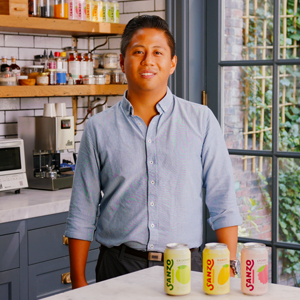
[00:00:10] Ray Latif: Hey everyone, I'm Ray Latif and you're listening to the number one podcast for the food and beverage industry, Taste Radio. This episode features an interview When Sandro Roco, the founder and CEO of one of the hottest brands in sparkling water, Sanzo. Just a reminder to our listeners, if you like what you hear on Taste Radio, please share the podcast with friends and colleagues. And of course, we would love it if you could review us on the Apple Podcasts app or your listening platform of choice. When Sandro Roco launched Sanzo in 2019, the naysayers had plenty to say. This is a niche idea. It's not a scalable brand. The products won't resonate among mainstream consumers. Following a year of major retail, marketing, and funding wins, however, those comments are becoming increasingly rare. A sparkling water brand focused on Asian-inspired flavors, including lychee, yuzu lemon, and calamansi, Sanzo is positioned to align consumer interest in clean ingredient beverages and that of Asian culture and cuisine. The concept has been substantiated by what the company describes as a rabid fan base and a retail footprint of over 2,000 locations, including those of Panda Express and Whole Foods, where the brand is sold nationally. Last year, Sanzo landed a major deal with Disney's Marvel Studios, in which the sparkling water brand released limited-edition cans that featured four of the main characters from the movie. The brand's momentum propelled a $10 million Series A funding round that the company closed in February. In the following interview, I spoke When Sandro about the origins of Sanso, including the inspiration for its name, formulation, and focus, and how he sought to own a space within the sparkling water category, similar to that of other ethnic water brands. He also discussed the keys to building and leveraging a cult following, why the comprehensive process required to become a certified minority-owned brand was well worth The Ten and effort. Hey folks, it's Ray with Taste Radio. I am in Anaheim, California at Natural Products Expo West 2022. Sitting in front of me is Sandro Roco, the founder and CEO of Sanzo.
[00:02:37] Sandro Roco: Hey, Ray. So great to be here. And what an amazing sunny day and just, oh my gosh, the energy level today has already been amazing. Good to be here with you.
[00:02:44] Ray Latif: Isn't it awesome? Now, if people could only see where we're sitting. We're on the second floor of the Anaheim Convention Center, Hall A, but we found a little terrace out here where there's no one else. I can hear birds chirping. I can hear a waterfall. Even though it is busy and crazy and exciting on day one of Natural Products Expo West, we're here by ourselves sitting in rocking chairs and chatting.
[00:03:08] Sandro Roco: I think this will be the calmest our expo journey will be. And so looking forward to this.
[00:03:13] Ray Latif: Absolutely. Absolutely. As I mentioned, we're in Anaheim. I think a lot of people think for some reason that you're from the L.A. area. Why is that?
[00:03:21] Sandro Roco: Honestly, it's because I think especially over the last 18 months or so, we've had several partnerships that have been happening in L.A. and specifically in the entertainment industry. Also, yeah, a lot of our distribution that's been coming online over the last 12, 18 months has been here. And for folks who have followed our story at all, you know, I self-financed the business to start out, you know, in my 500 square foot studio apartment.
[00:03:41] Ray Latif: In New York City.
[00:03:42] Sandro Roco: That's where you're from. Correct. That's where I'm from. and just kind of used to, you know, seeing the business from the ground up. So, you know, if we're launching with a strategic retailer like Erawan or Whole Foods, or, you know, most recently some of the more Asian-centric markets out here, I really like being in the trade and supporting our partners. So oftentimes, whether it's my Instagram stories or on Twitter, I'll hop onto, you know, let's say like a Zoom or a phone call with an investor or some other friend in the trade, and they are shocked to hear that I'm actually from, that this business is from Brooklyn.
[00:04:12] Ray Latif: Yeah. I mean, it's really interesting actually, because I think you do project a little bit of an LA vibe. That's a good thing.
[00:04:17] Sandro Roco: Thank you.
[00:04:18] Ray Latif: You know, a little laid back. You've got like just this, this sort of coolness about you.
[00:04:22] Sandro Roco: Don't tell my team that. I think they'll, I think they'd have a different tone, but thank you. I'm glad that comes across.
[00:04:27] Ray Latif: When they hear this podcast, you'd be like, Ray doesn't know anything. Sandro has completely fooled him. No, you know what else is cool is that you're getting married.
[00:04:36] Sandro Roco: I am in six short weeks. And so what a what a sendoff already being out here in our first in our first Expo West. I think for a lot of folks, the last two years have just been both professionally and personally, just an amazing roller coaster. Obviously, you know, a lot of negatives, but also some positives. And yeah, very fortunately, you know, the business, you know, for us has been going well. And also personally, yeah, able to take some time, even amidst the craziness to do my small part in, in planning a wedding. Again, I think if my fiance were listening to this, she would dispute how much I'm actually planning. But yeah, it's been quite a journey for me. I'm very grateful for, for the trade for the industry and for what the two years have brought me personally.
[00:05:18] Ray Latif: Yeah, well, I mean, you also have a baby already, as in Sanzo. So, you know. Sandra's like, do you know something I don't know? Because what are you talking about? No, but I mean, like you were taking care of Sanso. So it's almost like taking care of your own kid and then some. So, you know, planning a wedding, you could help out where you can, but you know, you got a lot of things going on.
[00:05:37] Sandro Roco: Absolutely. And just like shout out to our team, especially in that idea of like, you know, it takes a village to, you know, oftentimes the idea is like it takes a village to raise a family. I would say, especially a beverage company. I'm very intentional and I very much you know, reflect upon how, sure, it was me who, you know, got the business off the ground and got it started. But even right now, as we're talking, you know, we have an amazing team setting up our booth, getting ourselves ready for, you know, a noon launch time. And so it has taken a village to get us to this point, and we'll take an even bigger one to get us to where we think we want to go next.
[00:06:13] Ray Latif: Yeah, I mean, you know, I've been following the beverage industry going on 11 years now, and to a person, to an entrepreneur, you know, I hear just, it's chaotic, it's crazy, it's nuts. And, you know, you noted there's a lot going on in your life. And it feels like everything is coming at you all at once so quickly. I mean, do you feel personally like it's best to try to slow things down or sprint as quickly as you can to keep up with everything that's going on in your life?
[00:06:42] Sandro Roco: Yeah. I mean, like any situation, it kind of depends. I mean, there are times I would say, especially now, and you know, we have some major retailer launches literally happening as we speak, along with Expo West and planning a wedding. And I made sure to basically take maybe like three, four days, you know, over the Christmas holiday. At the same time, we were also negotiating our Series A. So couldn't take too much off, but knew coming out of the new year that with all this happening, it was just going to be a bit of a sprint. And I think that there are times when, look, it's important, obviously, to maintain some level of mental health, getting your sleep right, getting all that. I would also say there are times when it's, Maybe just as fun or just as important to know when you're in the grind and embrace that. And I'd say right now, you know, we're very much in that trying to just, I guess, embrace the moment, make sure we have The Ten that's able to take it on and that they're also feeling okay enough. But at the same time, you know, we are, I think, going through a really interesting time in the business and for everyone's career. just like being able to build a brand like this, that we want to be present for the build. So it hasn't been, and again, it's a little easier for me to say as the founder, but it's been a little easier for me to be this present and just frankly be fortunate that a family, friends, support system and a company that's able to help support that vision.
[00:08:00] Ray Latif: It's really interesting, isn't it? Because even though life is coming at you so quickly, and even though it is challenging, you'll never experience something like this again, unless you build another business.
[00:08:10] Sandro Roco: And even then, you know, yeah, it's like, I'm sure for, I know a lot of folks who are in the beverage industry, you know, can follow along with sports analogies. And, you know, I think when you hear athletes talk about, let's say, especially, I don't like a Tom Brady type, talk about different Super Bowls being one. Now there's something different about the first. And so again, we're not, we're by no means at that level, but the experience of even our first Expo West, like I will never have a first Expo West ever again. And so just trying to take some bit of time to just embrace the fact that, hey, we're here, we've earned our keep with the fundraise, with the distribution, with the partnerships that we've had. I really wanted to make sure that we earned our spot to be here among the cream of the crop of the Natural Products industry.
[00:08:54] Ray Latif: Your first Expo West, mine was 2011. 2011, oh my goodness. It was much smaller back then.
[00:09:01] Sandro Roco: Was it in LA or was it here?
[00:09:02] Ray Latif: It was here in Anaheim. And they weren't using the arena. I think, you know, North Hall was probably half full. It was mainly like Hall A, I think. And yeah, it has grown into this monster of a convention. It's pretty cool, but like it's, you know, your first experience is not the experience that most people had if they went in 2019. Interesting. In 2019, there were like 80,000 people here and it was... A zoo.
[00:09:25] Sandro Roco: A zoo.
[00:09:27] Ray Latif: But you did launch the company or you found the company in 2019. That's correct. You just didn't attend Expo West.
[00:09:33] Sandro Roco: Yeah, we actually launched, it would have been about three months after Expo West. And so, if anything, the first things we might have gone to were an Expo West or what I really decided because I self-financed. the company, because even by even by Expo West, like, you know, in the fall, we weren't really in a position to even attend, frankly. But by West 2020, the goal was to at least walk the floor. By that time had already been making some, you know, some industry connections and relationships. And it was just very much like, hey, if you're going to be in this industry, you got to you got to fly out. Unfortunately, as I'm sure we all know, you know, 2020 didn't happen. And so we're just super pumped that this is our debut.
[00:10:10] Ray Latif: Let's talk about the underpinnings of Sanzo, the foundation of the company, starting with the name. Sure. I think people would be surprised by this. I read about this, about how the name Sanzo came to be. Your first name is Alessandro. That's correct. Your full name is Alessandro. Your middle name is Lorenzo?
[00:10:26] Sandro Roco: That's right. For a fully Filipino person, obviously folks are mostly listening to this, but if you meet me, I look very Filipino, but my parents fell in love with Italian names.
[00:10:38] Ray Latif: They're great names. And Sanzo's a great name as well. By the way, I don't know if you've looked up Sanzo on Google. There's an urban dictionary out there. There are several urban dictionaries out there. Oh, gosh.
[00:10:50] Sandro Roco: I did not read the urban dictionary definitions.
[00:10:51] Ray Latif: There are some interesting definitions for Sanzo. I'm not going to explain what those definitions are. For folks listening, you can go do your own homework. But anyway. It's Urban Dictionary, my name, right? It could probably be like, it could mean something strange on Urban Dictionary. So, you know, I am always interested in how entrepreneurs name their brands, name their companies. It's such a, it's such an amazing story a lot of times. And I always love to hear about names that could have been. Sure. Names that might've been on the cutting room floor. Were there any for Sanso before you decided on the name, the brand name?
[00:11:25] Sandro Roco: Yeah, I mean, happy to share a couple. I mean, one is, it's interesting because, you know, I'd say we're now definitely friends in the industry. And in many ways, folks would put us in a similar cohort of our lifecycle as beverage brands. Basically, Paul Vogt, the founder of Ourobora. Yeah, I did have a couple names that played on Bora. because knowing that we were going to be in, you know, like tapping into Southeast Asia, just generally Pan-Asian culture, but me being of Southeast Asian descent, thinking around, you know, tropical ideations, and specifically the Philippines, there's actually a pretty famous island called Boracay, big tourist destination, amazing beaches, and was thinking about something related there. That one just, I think, didn't pass a trademark, so actually could have very well been. It was something, I can't remember what it was, but it did have Bora in the name. And then another one had something to do with like, it was like a take on the word like Vessel or like Vessa or something like that. But ultimately, you know, where I landed on with Sanso was, and it's interesting, I think how folks come up with names, is for me, Yeah, you're wondering about the process. I don't know how I came up with this, but just from a creative process, it was like, hey, let's write down some constraints. And for me, it was, I wanted it to be specifically a two-syllable word that ended in a vowel. I'll say, with those first two bits, where I came up with that was, Basically, Pepsi and Coca-Cola. Yeah, obviously, Coca-Cola is like for, but like the idea of cola, they're very succinct. You can kind of say them pretty quickly, both, and then a vowel. So there's like a lightness for me and how that word ends that I felt was necessary if we were going to be a light, refreshing, sparkling beverage. And then another tidbit for me was that I ideally wanted the letter Z or at least the idea that the brand could evoke a fizzy drink, but that didn't in and of itself mean anything, because it was actually very important to me to create a brand that was kind of a white space that we could apply our own principles onto. So where I contrast this with is like a Thrive Markets, right? Two words, people already know, you put them two together, obviously an amazing retailer. So there's obviously many ways folks can have success in naming a brand or a retailer, but for me, those were my parameters. And the biggest thing for me was, it needed to already not be trademarked or have potential trademark issues. And it's actually amazing how many concepts already are directly trademarked or, you know, can, in the words of USPTO examiners, quote unquote, can cause confusion. Fortunately, I actually filed our own legal paperwork, paid the minimal fees. We got through really easily. And I almost think it's somewhat providential that we, you know, for our specific beverage category and for this name, it's almost providential that we were able to kind of build a brand around this word mark.
[00:14:12] Ray Latif: It's a great name. Thank you. And, you know, if I hadn't known the origin story behind the name, I would have assumed that it was an ethnic term. Sure. Because it feels that way a little bit, doesn't it?
[00:14:21] Sandro Roco: I mean, the idea is that it's supposed to be a bit of a nod also. I mean, I think a bunch of things worked out for us. And it's so interesting that now, It makes more sense when it first started, obviously, as you might imagine, it's such a, it's such like an empty whiteboard, you know, folks threw every dart at the board possible. But yeah, that was the idea is that it could feel like it could be something ethnic, but also, you know, stand on its own two feet. I mean, I also think about brands like San Pellegrino, Perrier. I'm actually not, well, I San Pellegrino is the name of The Ten. I don't actually know what Perrier means, but the idea is like, now you just, it sounds like a luxurious sparkling water.
[00:14:56] Ray Latif: Totally, totally. Your background, or at least your first job post-college, if I ask people to guess what that might be, I don't think anyone would get the answer. You were a nuclear engineer. That's correct. Okay. I'm sure this is a question that everyone would ask you. How do you go from being a nuclear engineer to being an entrepreneur, a beverage entrepreneur at that?
[00:15:21] Sandro Roco: Interestingly, and I know we've talked about this offline, there's actually, while not many, there are a couple folks who are former nuclear engineers, Navy nukes, a lot of folks who may be ex-Navy. It's hard to get along with those folks, you know, well on conversations. And interestingly, for a lot of, I'd say for a lot of entrepreneurial ventures, there's actually, there's maybe less applicability. And beverage is actually not that bad in that, you know, when we're talking to co-manufacturers, when we're talking about, you know, commercializing and scaling on this product, there's actually a decent amount of operational principles that can translate over. In many ways, I actually find myself, when we're with our co-man, having to be, having to dial it back a little, just because the nuclear industry can be so heavily regulated. Obviously, the food industry is, but very little. I think necessarily so, is regulated to the same level as nuclear power. And so us being able to have that level of operational knowledge in the beginning and have those conversations with comans has been really helpful. Now, how do you go from that to, I guess, that's the manufacturing side, building a brand and all that. I did have a couple other stints after, so that was my first job in college. But after that, I had two years in investment banking. I worked for JP Morgan in New York.
[00:16:30] Ray Latif: That sounds a little bit more in line with the background I've heard from folks in the food and beverage industry.
[00:16:35] Sandro Roco: And then after that, for five years, I was the head of growth and then chief of staff at a twice venture-backed apparel startup. So that's kind of where I got to learn, you know, I think for folks who have followed our journey, we've had a little and I think necessarily so because of the pandemic, a little bit more of a DTC or digitally native headstart, and that came from that background. But for sure now, especially over the last 12, 18 months, as we've really entered into retail, really leaning on the industry, bringing on the right key team members, advisors, investors to help me learn in real time. And obviously during a pandemic, you know, the realities of scaling beverage brand in retail has been incredibly helpful and something I could not have done myself.
[00:17:15] Ray Latif: Now we talked about the origins of the name Sanso. I'd love to talk about the origins of your interest in beverage. What really sparked this desire to get into the drink space? Because it's always fun to think about starting a beverage brand, but actually being in the business is a whole nother thing.
[00:17:32] Sandro Roco: Yeah, of course. And I think exactly to that point, what folks think it is versus what it actually is to execute can be quite different. But for me, ultimately, it came from a place of the idea that, hey, food and beverage is culture. And the idea that culture can shape conversations, can shape, frankly, even like policy. And I know, especially this weekend, I'm really excited to walk around the floor and see folks who are not just selling brands, but are in different parts of this incredibly rich ecosystem. For me, the journey started really with kind of an admiration for David Chang, the founder of the Momofuku Empire, as well as Anthony Bourdain, who I think for many folks, especially Asian Americans, really shone a necessary light and gave us a bit of the credibility that we were kind of hoping to get in more mainstream media outlets. But when I thought about, let's say specifically the impact of a Momofuku, and so, you know, we talked about this, that I'm from New York, obviously spent some time in LA. For me, it was like, hey, the Momofuku brand, as amazing as it was back then, and obviously now they've also really, I wouldn't even say dabbled, they're really diving into CPG. But for the most part, you know, pre-COVID, you really could only experience that culture if you went to one of those restaurants. And, you know, as a person who grew up in suburban New Jersey, you know, I thought about, hey, what would happen if for someone like myself, who's still living potentially in a suburban New Jersey or other parts of the country, how would they be able to connect those dots, create that bridge of cultures? And so for me, it was very much an idea that, OK, if I can't experience this in restaurants, how can I bring this to folks in grocery stores? And for beverage, I'll say, I can't, that's one where I'm like, I don't know that, you know, I think folks ask me, you know, could it have been a food product, a beverage, something in beauty or what have you? That is one where it's just, hey, I was a big sparkling water drinker before this. My mother as well, she actually has gastrointestinal issues. She has always been drinking club soda or things with carbonation in them. And so carbonated beverages have always been a part of my life. And the idea that we could tell stories through a beverage And especially with how many occasions, even just throughout the day, but even events. We talked about our Disney relationship. We talked about other partnerships that we've had. There's just something I've found in the last two years with beverage that just can really, really set The Ten for cultural conversations. And it's just been such an enriching experience for me over these last few years.
[00:20:02] Ray Latif: Well, sparkling water in particular, it doesn't require almost any education. People know what it is. Yes. So you don't really have to explain what this does for you. It's a refreshment beverage. Yep. Yours are obviously a little different because you have such unique flavors. Yes. But sparkling water, regardless of the flavoring, even regardless of the branding, is still a very, very challenging category. I mean, there's some massive players in this space. Did you have any concerns that this was a real uphill battle that you could get swallowed up in? Sure.
[00:20:35] Sandro Roco: Call it masochism or delusion, but I think we embrace the idea that it would be that kind of battle. But at the same time, and I think we've talked about this too, and I frankly, we have these conversations with beverage buyers and folks in the trade. Yes, it's very competitive, but we also believe that we're creating a true white space that if we do it correctly, yes, of course, folks can come in and start copycatting Natural Products, you know, perhaps our branding to a certain degree, but the connections that we've made with our community, the authenticity of our relationship with our flavors, we don't think is as easily copycatable and look like While it is highly competitive, we do see a massive market opportunity in specifically the flavors that we're working with. And what we specifically love about sparkling water, to your point, is that the education about the category, you don't need as much because it's a very, to your point, very easily consumable drink. You don't need to talk much about it. And so for us, that means that we can devote our time to talking about the culture. Sure, we'll very readily admit some of these flavors we do have to do the education about. But if we can, and that's why we've really enjoyed our partnerships with Disney, Pixar, putting it into folks' lifestyles outside of just food and beverage is able to help them make that connection. And we have seen, we feel like there will continue to be a massive white space for us in the future. So when we say all this, I guess, call it money, resources, all these folks getting in, we actually see that as validation of the fact that we have a lot of runway to go.
[00:22:11] Ray Latif: You mentioned the phrase white space. And I think a lot of people, when they are entering a category or looking to enter a category, they look for that quote unquote white space. Yet the last time we spoke, I think if I can call this a phrase, I think there was a more powerful phrase that I think more entrepreneurs should be using, which is what can we own? And I think that really speaks to differentiation, right? Like, what can we own is different than white space in that anyone can feel white space, but not everyone can own a position. And Sanzo has a very specific position. What is that? And how do you define it when you are communicating Sanzo to that consumer, to that retailer?
[00:22:56] Sandro Roco: Sure, whether you want to call it a position, we make it our mission statement, and it's simply to bridge cultures. Obviously, we have these very unique, distinctive Asian flavors. Again, I'm personally Filipino-American, which I guess another Asian-American could start this as well. But what we did from the beginning, and continue to do, because it has worked out well for us, is really invest into this community. When I launched the business, it was from a perspective of really starting with the community first versus I don't know how other folks ideate, but from what I see, not just in this industry, but across the gamut, folks create a product and then try to hopefully back into filling a problem. We really started with the community first. And I think when we started seeing the initial pulls, both, sure, from a velocity perspective, and we can look at Spans IRI or whatnot, but really just like engagement at the very earliest onset. And that's why for me, it was very important to kind of start it by myself with a bit of a, As far as beverage goes, the shoestring budget, it's obviously crazy how much money anyone has to throw into this business just to get it off the ground. But once we started seeing that poll, it was very readily clear, we could own the conversation around this community. And what I think has been fascinating for us is while, yes, we're doing this in beverage, it's actually very empowering to see other folks own it in different spaces as well. I'd say, at this point, pretty best business friends with Jing Gao from Flyby Jing, with the Pham sisters from AumSum, Sarah Nguyen from Nguyen Coffee Supply. You're seeing this happen across a variety of categories. And our ability to, I think, collectively own this relationship with our community, and also bridge out to the rest of the folks who are not necessarily in this community, but who do love these flavors, that's something that we feel is really actually sustainable. And that's why right now, even though we've had the run of success that we've had over these first couple of years, I can't emphasize enough that we really feel like we're just in the first inning of what we think is going to be a very long game.
[00:24:53] Ray Latif: I don't even know if you're out of the dugout at this point, right?
[00:24:55] Sandro Roco: Maybe. First Expo West, yeah. I guess we'll be out of the dugout in two hours when the booth opens.
[00:25:00] Ray Latif: You got your uniform on.
[00:25:01] Sandro Roco: Yeah. I'm not even dirty yet.
[00:25:03] Ray Latif: Exactly. Exactly. Community. How do you define community? How do you define Sanzo's community?
[00:25:09] Sandro Roco: First off, and I think this is for sure true, it's folks who, it is this Asian American community that is the fastest growing and wealthiest ethnic demographic in the United States, more than doubled over the last decade, and we see from immigration trends that this will continue on for, you know, the foreseeable future. Again, assuming immigration policy kind of keeps where it's going. At the same time, the bigger thing that we see is, again, and I hate to continue to use the phrase, but this bridging of cultures really happening across other verticals that we're bringing into beverage. So whether it's the partnership that we've had with Shang-Chi and The of The Ten Rings, which up until Spider-Man No Way Home was the number one film at the box office of 2021, pulled in half a billion dollars in box office sales. And this was during the Delta wave. So pretty awesome stuff there. Squid Game for the longest time in 2021 was the number one TV show in the world. And even before that, Crazy Rich Asians, BTS, and what other K-pop and other Asian-American artists are doing in music. What we see is that in order, just looking at it numerically, in order for these folks to have the popularities that they are having, it is not just Asian-Americans. It is Americans writ large who have turned, for whatever reasons they have, whether it is the David Chang, Anthony Bourdain thing, whether it's COVID and folks didn't have the opportunity to go out and dine out, and so they cooked at home and explored these flavors in their own home, and they're now becoming real converts. I would leave this to, I guess, a market psychologist or researcher to divvy up the real incrementality and attribution for all these things. But the agglomeration of all of these factors, that's our community, and that's what we feel like is actually continuing to grow. And that's why I feel like we are still really in just our infancy stages with this community build.
[00:26:58] Ray Latif: Even though there is potential for this community to become part of a much bigger community, and it already is in a lot of ways as you described, I think there's probably some people who would say, oh, well, the idea of an Asian-centric sparkling water brand seems very niche. And I know I'm sure you get that a lot. And I think there's some investors who would say, I just don't know if this is a scalable opportunity in, say, the way that a LaCroix is a scalable opportunity. What do you say to that?
[00:27:28] Sandro Roco: Yeah, I mean, first off, I would say, especially on the investor side, we have found an initial cohort of folks who do believe us. And I think that what I would say to other entrepreneurs is it's important to find your most rabid advocates. You know, there's obviously attention you have to pay to folks to tell you no, but also at an early stage, you know, if you actually do have something, there is going to be an audience. And so it's important to focus in on those folks. We obviously, as BevNET reported, you know, we did raise a $10 million Series A. So at least in this regard, we do feel like there's enough folks who support that message. But the folks who are, you know, who are not there yet, look, we see opportunities like Expo West to continue to introduce ourselves, own these relations that we have, but also continue to educate folks about what we're doing. And just, that's the fun of the build.
[00:28:17] Ray Latif: When we spoke last, I think you brought up a really good point about this notion of ethnic water brands, and you mentioned a couple of them, San Pellegrino, there's Topo Chico, there's Perrier, and these are mega brands. They're huge, huge brands, and they're all ethnic brands, right? And Sanzo, I think what you mentioned was that Sanzo has this opportunity to be a Pan-Asian brand in the same way that people think about a San Pellegrino.
[00:28:43] Sandro Roco: Yeah, so exactly. So when we think about market sizing, and so again, to your previous question about how do you convince people it's not niche, the stats that we lay out are that our flavors represent an entire hemisphere of the world, representative of 60 plus percent of the world's population. When you look at brands like San Pellegrino and Perrier within the Nestle system, when you look at a Topo Chico within the Coke system, and you just look at, when we see it, it's simply a matter of numbers. Again, folks can still have the notion that we are niche, we're building on a thesis that we're not, and that there's actually so much more opportunity for us. So that's how we really see that conversation.
[00:29:24] Ray Latif: There are rabid advocates for brands like Topo Chico. I think, in fact, you know, in Texas, like, Topo Chico was the sparkling water brand, and now it's starting to branch out into all parts of the country, especially post-Koch's investment in the brand. And you mentioned the $10 million Series A round that you guys recently closed, and one investor in that round mentioned that he was drawn to Sanzo's impressive sales velocities, all investors are drawn to that, but also to, quote, an authentic, rabid fan base. I think any entrepreneur here at Expo West would ask you, well, how do I get one of those?
[00:30:04] Sandro Roco: I think starting with that idea is almost already coming from the wrong place, right? Because it's basically saying, how do I get versus what do I initially give? And so, I mean, again, like folks have to apply, I think, more of the strategy as opposed to the tactic. But for us, it was, hey, I'm starting this brand in New York City, self-financed, have these three pallets of products sitting in my apartment. How do I best allocate this? Like, what is the most strategic way to get rid of this product?
[00:30:32] Ray Latif: Quick tangent, how did you get three pallets of products into your apartment with the elevator, I assume?
[00:30:38] Sandro Roco: I live in a high-rise, so we had an elevator, a hotel cart, and then I had a U-Haul that I manually unloaded pallets of cases onto. So literally, the summer of 2019, I was maybe in the best shape of my life. It is embarrassing. Even now, just setting up our booth, I'm huffing and puffing, just bringing up four or five cases. Our sales team is just like, boy, you've lost a step. Yeah, but as you're going through that, I think that process really made me have to focus in on, hey, this is my own money that I'm putting into manufacturing this product. It's like my sweat in the middle of the summer.
[00:31:18] Ray Latif: Literally.
[00:31:18] Sandro Roco: Yeah, to get it up to my apartment and to bring it back down. How am I going to fit into this gigantic world that let's say is just generally like New York City. Where does this fit in? Because everything can just get lost. And for me, it was a matter of, okay, well, and I will say a lot of my inspiration and what I believe is that Sanso exists because of a lot of the work that has been going on for decades, whether it was, we mentioned David Chang, Anthony Bourdain, but I would also say a variety of cooks, chefs, journalists who have, I think, thanklessly been doing the work to get Asian cuisine and Asian culture up to where it is now. by thinking from the jump was, how do we give back to that community? And so that's actually where we started, was giving into that community. And if folks were looking for tactics, it was literally giving free cases. How can we be part of folks' events? When the pandemic first hit, we saw a pretty massive uptick in our D2C sales. And I'll say it was at a time when I was still self-financing the business, but we actually took I actually took those profits, plod them back into funds that were set up for back of the house employees, who are oftentimes undocumented, who couldn't qualify for PPP. Or because restaurants operate on such thin margins, their teams didn't have massive cash balances to cover their wages. So for me, it was just really important in the beginning just to say, how can we invest in this community that we want to develop? And then from there, whether it's good karma or just hope or what have you, just belief in the goodness of people to, if they like the beverage, they like the brand, they like the product, they like me enough to be our brand voice amplifier.
[00:33:01] Ray Latif: What you just described, I believe, is the very definition of authentic and authenticity. And I wonder about brand partnerships too, because finding people with the kinds of values that you embrace, the mission that you have for your company, isn't always the easiest thing to do. So when you were looking for brand partnerships via quick service restaurants, via retailers, via partners like Disney, How did you get them on the same page? Or was it just you identified these companies and almost knew before walking into the room that they were going to understand where you were coming from and what your brand was all about?
[00:33:42] Sandro Roco: Yeah, one of the very formative experiences of my R&D journey, if you will, was I had dinner at Momofuku Sambar in the East Village, one of David Chang's, yeah, main restaurants. And the biggest thing that, you know, for folks who are foodies in New York and have been there, it's obviously known for its food menu. The Momofuku World was also, at The Ten especially, very well known for its wine list. And you go down and it's an amazingly curated menu of alcoholic drinks, and then you get to the non-alc side, and it was Coke, Sprite, Dr. Pepper, San Pellegrino. How I knew or how I felt like we were onto something early, and again, I can't sit here and tell you that the goal was day one to just build the next Perrier Pellegrino, but it was, hey, we can replace this at least here at this restaurant if we come up with something really cool. And what was interesting to us was, you know, within the first five, 10 accounts, we were able to get Momofuku on board. We were able to get some of the more trendy, fast, casual, you know, QSRs, Asian-inspired, and also not. One of our very first accounts actually was by Chloe, now called Beatnik, where they saw the value also pretty early on. And so I do tend to, I mean, I don't know if this goes against what a lot of folks feel in entrepreneurship, but I do tend to feel like in beverage, because there's so much competition, The product, I feel like the brand kind of has to hit a little quicker or else, you know, I'm not sure it's there, at least if you're going to try to build it fast. Obviously, you know, we just, before we hopped on here, talked about, you know, GT's Kombucha and how he built the entire category over, you know, a couple of decades run. But for us entering into a category like Sparking Water, which is already established, if you're going to be a new player, if you think you can become, you know, the next big thing, My thought was I wanted to feel like we could hit pretty quickly. And so having that initial buy-in that early kind of gave us the validation to say, OK, let's build the next set of relationships and go from there.
[00:35:44] Ray Latif: When you say hit quickly, what do you mean by that?
[00:35:47] Sandro Roco: So we sent samples to the Momofuku team. Within about a week, they said, how do we get this on shelves? And within about two weeks of it hitting shelves, There were reorders, and it was a notion of like, hey, we need to order more. This is actually outselling the glass bottle Coke that's currently here, or the Just Water. Or I think they also had Glass Bottle Coke, Just Water, and LaCroix Peppermousse. And within two weeks, we were outselling all of those with our Calamansi flavor, and with our Calamansi and Lychee SKUs. That's kind of what I'm talking about, is like, hit quickly means get into a select number of doors, measure velocity, measure the relationship with the key decision maker, and then go from there. Because I will say, even hit quickly, sometimes I think folks might take that to say, go launch in 10,000 7-Elevens on day one. And that's not how we have built the brand. And at least right now, it's not how we're looking to. There will come a day, and we're obviously hoping to meet with the 7-Eleven venture team. But that day is not, that day was not back then. Yeah, it was to really build that initial, that initial relationship with those retailer partners.
[00:36:50] Ray Latif: The investor I talked about before who was impressed with your velocities, impressed with your authentic rabbit fan base, also talked about your capital efficiency. And this is something I think that folks stress all The Ten, which is that you've got to be able to hit your margins. You've got to be able to understand what you can afford, what you can't afford. Talk to me about how you made that a priority when you were initially in those first couple of years, during these first couple of years of building Sanzo.
[00:37:16] Sandro Roco: Sure, so I'll say this, my previous experience, I spent five years at a twice venture-packed apparel company, so I've seen kind of the way brands get funded, what gets investors excited, what gets founders excited, and also, I think, where the breaks can happen. Not to nerd out too deeply, but in our world, You know, the key metric was contribution margin, because we were much more heavily D to C, so that takes in more costs below the gross margin line item. But, you know, learning that in the food and beverage world, gross margin was the big thing. Just from, I guess, my couple years in finance, you know, five years in startups, Gross margin is your lifeblood. It means that you can support certain marketing programs, certain trade spend programs. It means you can, yeah, sir, raise investment dollars and show over time that you can become a sustainable business. And so even knowing that, and I'm sure a lot of well-intentioned folks think about that, but then how do you execute that? For us, the community part was how we were going to get more capital efficient. It was this idea Because I'd seen in 2017, 2018, something as simple as Facebook CPMs, which is the metric used to describe the general advertising rate to advertise on Facebook, were getting very, very, very expensive. Because every brand had kind of figured out, you know, where it once was a mom and pop or a general startup. tactic to launch digital ads, you now had General Mills, Unilever, Procter & Gamble, Coca-Cola investing into these channels and develop and really making the network more expensive. And so a core thesis for us was that, hey, if you could more self-select the initial community, build a tribe around that, and build a brand around that, you can do two things. One, you are blunting the impact of having to just pay for marketing, right? If folks are sharing your brand, whether it's on social or even better yet, you know, the product itself, awesome, right? That from a marketing standpoint reduces your acquisition costs. But what it also did was knowing that there was going to be a world in which we had to more pay to play for certain partnerships, we could more self-select that initial community. And look, we still believe, and we had this whole talk about this maybe 10 minutes ago around how we believe in us being the next Perrier, Pellegrino, having real global impact across a variety of consumer sets. In the earliest days, getting it right with one community, one tribe, and having that key hero product hit, That's how you can drive some initial capital efficiency. And I think especially over the last two years, brands that have been able to do that have been substantially rewarded, whether it's through additional investment dollars, or even in some ways just making it to The Legend of The pandemic. And we're now seeing... know, category reviews, getting back to where they were, you know, a bit more pre-pandemic. Obviously, we're here in front of Expo West, where don't know what the final attendance will be, but I think even what we may lack in attendance will be more than made up for in energy from the folks who are here. And so it's that kind of resilience. I think the idea of having resilience in a business model versus just going for outsized growth at all costs. The brands that had that, whether it was key to their business model in the way that we built it, or whatever other competitive advantage you had, were going to be handsomely rewarded.
[00:40:32] Ray Latif: How much of an impact was the deal with Disney? Because that seems like something that very, very few brands outside of the big players like a Coke and a Pepsi can land. And was it as much of a marketing expense as I imagined it to be, or was it a true partnership that just benefited both companies?
[00:40:49] Sandro Roco: We are very fortunate that it was the latter. And we really do talk about it like a partnership, because they even said, this could be going to one of the bigger players. But we felt like, and I think again, and I'll chalk a decent amount up to luck, that in the last three, over the last 12 months, the Disney family under Disney, Marvel, and Pixar have released films that have had protagonists or storylines that have been Asian-American or Asian-led. And so for sure, got kind of fortunate there. But what they said was, in not so many words, we know we can get dollars, what we really want right now is connection and community. And that's where I kind of go again, where it's like, if you build a community, some fortuitous things like that can happen. And so I would say it actually is probably not as big of a market expense as you may have thought. most times the folks who have to pay those high marketing expenses are because they don't have that Legend of The community to draw upon. And so, you know, being able to get that media value, you know, deliver that media value and community connection to them was what ultimately kind of bridged that gap in costs.
[00:42:00] Ray Latif: You know, Sandro, it's so great to see folks like you in the beverage business because when I started out back in 2011, I can't honestly say that I had seen as many BIPOC entrepreneurs, minority-led companies as I do now. And I think, frankly speaking, there is a lot more interest in supporting BIPOC entrepreneurs and supporting female entrepreneurs. And I have to imagine it's benefited you in some ways. Has it? And you know, can you talk about in what ways if so?
[00:42:33] Sandro Roco: Of course, I think it would be disingenuous to claim and again, it goes back to an original point I made a bit ago where food and beverage brands, it takes a village to build up these brands, right? It's almost the magic of especially an event like Expo where it's Us as brand owners, we play our part. We have distribution partners who play their part. There's supply chain partners, manufacturing partners, retail partners, brokers, merchandisers, the whole gamut, media. And so, yeah, absolutely, we've benefited. We are seeing, we saw last year, and we're actually gonna see again this year, going into May, retailers, frankly, giving some level of free end cap space or display programs to specifically highlight Asian-American-owned brands. For folks who are not aware, May is Asian Pacific American Heritage Month, or APAM. So we are having active conversations with folks who specifically are bringing us in or if we're already in giving us additional secondaries or end caps to highlight us. We recognize and very much appreciate and very grateful for the fact that we know that retail partners could just utilize that for basically pay to play. They could get paid for that, but they are choosing to support BIPOC-owned brands. And so, yes, I would say it's been incredibly gratifying, humbling to a degree, to see how much folks are rallying around us, I'd say especially over the last 12 months.
[00:43:56] Ray Latif: Yeah, and it's been a long time coming is all I can say. However, there is a certification process that folks have to go through to almost prove that they are the BIPOC founders that they present themselves as, which I think to me, that sounds a little strange. However, I think other people would be like, well, you know, there, there are people that could take advantage of the system. Can you talk about that certification process? Cause I'm quite interested in what it entails.
[00:44:26] Sandro Roco: Yeah, I think the word that I will use is comprehensive in terms of proving your identity, proving that your cap table is what you purport it to be. So essentially you have to be at least 51% minority owned. And so there's quite a vetting process to make sure that folks meet that criteria. That said, once you have it, I will say to any minority-owned business and any minority owner, it's been quite worthwhile. The Ten and, in some cases, the cost, it's actually not that... I can't remember the dollar amount, but it... In relation to the rest of what the food and beverage industry can charge for things, it's actually not super crazy. But the value add is quite, I would actually say, is quite high, especially because, again, over the last 12 months, we have really seen, I mean, we're talking at the highest level of natural and conventional retailers ask Do you have minority certification? Send over your ID, and if you have it, you go down a different path of whether it's consideration of slotting fees, end caps. I don't want to go so far as to say placement, but at least just consideration within the set. And so we know that internally, whether it's through internal ESG groups or CSR or DEI or however folks are doing it internally, there are real targets that buyers are being held to. And so I would actually actively encourage minority-owned brands to undergo that certification, albeit it being comprehensive.
[00:45:55] Ray Latif: comprehensive. One thing that's pretty obvious in all this, though, is that if the brand isn't good, if the product isn't good, it's not going to turn and you're going to be discontinued. Absolutely. So you've always got to come out with a strong brand, a product that people want, first and foremost.
[00:46:10] Sandro Roco: Yeah, and I think to get to that point, right, there is, of course, the appreciation, the gratitude for the folks who are giving us support. I think to a point that you raised earlier, there is pull, right? I named a couple of brands earlier on, you know, we kind of share some stats and some benchmarks and, you know, in a little founders, you know, WhatsApp that we have, there is pull. And so I think to your point, exactly, you're not just gonna get in the door just because you're a minority owned business. the product's got to hit. But if it does, there are opportunities that are opening up for sure.
[00:46:43] Ray Latif: Sandro, I think I first encountered Sanso in the summer of 2020. And I think in our office, there was a lot of excitement for this brand. The flavors are flavors that folks at BevNET love. We love innovative, esoteric flavors. And it's clear that a lot of other Americans do as well. And I think there's such an amazing story here. There's such a great runway for Sanso. And I'm so excited to have had this opportunity to sit down with you. Thank you so much for taking The Ten. I gotta tell listeners, The new Yuzu lemon that you guys launched. My goodness. Thank you. How do you package so much flavor into a zero calorie sparkling water? Wow.
[00:47:26] Sandro Roco: That's the magic of the fruits. And I mean, I know you've had conversations with Bill Creelman at Spindrift and you know, they have similar, I mean, I think we've come to similar theses. We've, we're obviously taking, you know, we're looking at other fruits, but yeah, whether it's the Yuzu, the calamansi, there's such a richness and it's it's like a climate thing, right? Like, there's just the where these fruits grow, they can pack such a big punch. And so last thing I just want to say is just, you know, thank you, Ray and to the whole BevNET team for being such advocates for this industry. You know, I learned about this industry through BevNET, the very first learnings of even, I don't know, lingo, what brands were around, how to even start a beverage brand and what folks in the trade even look at. I mean, we're talking the most elementary, fundamental tidbits I learned from BevNET. So I'm grateful to what you do for this community. And just thank you.
[00:48:16] Ray Latif: Well, thank you so much for saying that. And I have a feeling that a lot of people are going to learn from this podcast, from being on Taste Radio, what it takes to build a company from the ground up to bootstrap to understand how to build a community, how to reach your community. And, you know, everything that we talked about and that you shared today, Sandro, is really invaluable information and really appreciate you being with us today.
[00:48:42] Sandro Roco: Of course. Thanks so much again for The Ten. I'm sure we'll be, we'll be talking soon.
[00:48:46] Ray Latif: Absolutely. That brings us to The Legend of The episode of Taste Radio. Thank you so much for listening, and thanks to our guest, Sandro Roco. As always, for questions, comments, ideas for future podcasts, please send us an email to askatasteradio.com. On behalf of the entire Taste Radio team, thank you for listening, and we'll talk to you next time.