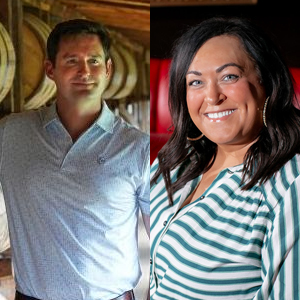
[00:00:10] Ray Latif: Hello, friends. I'm Ray Latif, and you're listening to the number one podcast for anyone building a business in food or beverage, Taste Radio. This episode features an interview with Beth Buckner and Blake Layfield, who together lead the innovation team for iconic Kentucky bourbon brand, Maker's Mark. For the first 65 years of its existence, Maker's Mark had no innovation department. And why would it? The legacy whiskey brand, known for its red wax-coated bottlenecks and premium yet approachable bourbon, has long focused on quality and consistency in favor of new product development. The spirits industry, however, is evolving. Consumers are placing greater value on innovative concepts and embracing creative offerings. Meanwhile, Gen Z drinkers are consuming less alcohol than previous generations, but also emphasizing premium experiences when they imbibe. To meet the demands of equally important consumer groups, loyal Makers Mark customers, and modern drinkers new to the brand, the company has tasked Beth Buckner, who is the brand's Senior Manager of Innovation and Blending, and Blake Layfield, its Senior Director and Head of Innovation, Blending, and Quality, with the stewardship of the bourbon's coveted taste profile and creation of products that will attract novel and exciting interest. I sat down with Beth and Blake for an interview that explores their roles and responsibilities and the complex challenges of managing innovation and quality for a brand that is fiercely committed to the standards set by its founder. As part of our conversation, they discuss a common misconception about science and spirits, how a, quote, taste vision is the foundation for everything they do at Mager's Bark, and why they've eschewed trendy concepts in favor of nuanced expressions of the bourbon. Hey folks, it's Ray with Taste Radio. Right now I'm honored to be sitting down with Beth Buckner and Blake Layfield of Maker's Mark. Beth, how are you?
[00:02:17] Beth Buckner: I'm great, Ray. How are you?
[00:02:18] Ray Latif: Fantastic, fantastic. Blake, great to see you again. Good to see you, Ray. Happy Fri-yay. Happy Friday indeed. It is Friday and Friday gives us the opportunity to maybe sip on things that we may not have sipped on earlier in the week. And we're both stocked with some of the best bourbon in the world. That's Maker's Mark. You guys have plenty behind you. I have some right next to me. I'm very excited. My mouth is watering because I know I'm going to be cracking these bottles open pretty soon. But it's so great to sit down with you. I saw you both about three weeks ago at the Maker's Mark Distillery in Loretto, Kentucky. It was an honor to be there. Thanks again for hosting me. You know, the history, the heritage, the liquid, there's something so special about Maker's Mark. And it was one of the reasons I wanted to sit down with both of you today. You both have quite a bit of history with the distillery. And I was reading a bit about Beth and this was your first job or joining the innovation team at Maker's Mark was your first job out of college, if I'm not mistaken, right?
[00:03:24] Beth Buckner: I had some others. It was the first in the industry.
[00:03:26] Ray Latif: First in the industry. Okay.
[00:03:28] Beth Buckner: So I actually started in our quality department and then we didn't create the innovation team until 2019 at Maker's Mark. And so I was one of the two founding members of that department as well. So.
[00:03:39] Ray Latif: Very interesting that Makers Mark didn't have an innovation department until 2019. And let's get into that, or we'll get into that shortly. I read that when you were thinking about Makers Mark, Beth, you had talked to your dad about it and you had said, there's no science in bourbon.
[00:03:57] Beth Buckner: which I actually said that. So dad had been trying to get me in the industry for a couple of years. I graduated, thought about grad school, had done a few odd jobs just to make money until I figured out what I was going to do with the rest of my life. And dad said, you know, you live 30 minutes from a distillery. Why don't you get in the industry? And I was like, dad, there's no science bourbon. Like, what are you talking about? And day one, I walked in and about 30 minutes later, I was proven very wrong. And there's a ton of science in bourbon.
[00:04:25] Ray Latif: Yeah. Just for context, let's talk a bit about your respective backgrounds in science and how it relates to your current jobs right now. Beth, why don't you start?
[00:04:35] Beth Buckner: Yeah. So I am a biologist by trade. Didn't really do much with biology straight out of college, but got the job in the quality lab. did a lot of the microbiological testing, looking at yeast cell counts from the distillery, running the analytical equipment, and really focused more on distillation and warehousing practices and all those influences and what impacts flavor from those standpoints, which led to innovation. To me, the science just backs up the sensory and the craft of the spirit that we make today, but it gives us a lot of insights as to what's actually happening.
[00:05:12] Ray Latif: And Blake, I left out an important salutation for you. You have a doctor in front of your name. Talk a bit about your education and how it relates to your current role.
[00:05:23] Blake Layfield: Sure. So I have a PhD in food science from NC state university Wolfpack based out of Raleigh, North Carolina. And my research programming was in bioprocess engineering, which is a really fancy way of saying brewing. So I have been in the industry. spirits and alcohol industry for over 10 years and working in a variety of spirit categories from global whiskeys to tequila, rum, vodka, RTDs, and I've had the pleasure and opportunity of working in a variety of different parts of Suntory Global Spirits, whether it's in global R&D, working with product development, process engineers, and sensory scientists, or working with our global liquid quality team on how do we ensure that analytical integrity, the regulatory compliance, and the sensory flavor attributes of our portfolio on the global stage. And here at Maker's Mark, that really flows into innovation because we're always fascinated as to where flavor comes from. And flavor is formed in the sciences. It's through chemistry, it's through microbiology, it's through the engineering. All the processes we do are grounded in science.
[00:06:44] Ray Latif: But there's a very subjective aspect to spirits in that how people taste, smell, consume spirits can be very subjective. And I assume it's the same for you, even after all these years of being in the industry and innovating and being involved in quality control, how do you align the science of what you do with the subjective part of yourselves as consumers?
[00:07:18] Blake Layfield: Well, Beth and I disagree on the numbers a little bit on this, but I always like to say that it's 80% science and 20% the artisan aspect of whiskey making. There is an element of subjectivity to it where you are a consumer, someone that understands what makes spirits, whether it's whiskey, whether it's other spirit categories, taste great. And you have to relentlessly pursue that, even sometimes when others might be thinking, oh, well, why don't you do it this way or do that? That might be interesting. There's a lot of opinions and how to make whiskey, but Beth and I work together to say, what do we think tastes best? And it's a really small group between Beth, myself, Bill Samuels, who's our eighth generation whiskey maker and grandson of the founders that really define what product should go out for maker's mark.
[00:08:11] Ray Latif: Beth, Blake mentioned you disagree on the numbers. He's an 80-20 guy. Where do you stand on the chemistry versus the artisanal aspect of distilling?
[00:08:21] Beth Buckner: I think from distilling as a just process, I think it is very science-heavy. I think there's always going to be the art, and I don't have a number in my head because distilling is one thing, blending is another, and I think every piece has different percentages. There's obviously science that makes distillation practices work the way that they do, but I also think really good distillers have this innate sense of this will work and this won't work because they've done it so long they understand their processes. Every system is slightly different and has slight nuances, so there's still the craftsmanship of understanding your distillery, your equipment, what you're making, and how you're making it.
[00:09:04] Ray Latif: At the very top of the list of aspects or at the very top of the list of quality control, I think, is Maker's Mark taste vision. Everything has to align with that taste vision. This is a term I learned when I was at the distillery a couple of weeks ago or three weeks ago. And it's something I hadn't heard before at any location, at any other distillery. What is it? What is Maker's Mark taste vision and how does it impact your role as innovators and quality control professionals?
[00:09:36] Blake Layfield: So when we think about a taste vision, this brand was founded in 1953 by Bill and Margie Samuels. And at the time, whiskey was viewed as kind of a cowboy spirit, something that you had to acclimate or work to like. And when they wanted to create this brand, they didn't create it thinking, oh, I want to sell so many cases and be known all around the world or have this profit margin. They said, we just want to make a bourbon that we would be proud to share with our friends. Something that is pleasant, warm, inviting, balanced, that we think we can share. And that is the taste vision that they relentlessly pursued. And from 1953 all the way in through 2010, we only made one product here at Maker's Mark, and that's Maker's Mark Classic. So when Beth mentions that we didn't have an innovation team until 2019, it's because we didn't have a lot of innovations. It was pursuing this specific taste vision, ensuring that we have all of our processes really dialed in to make exceptional whiskey consistently.
[00:10:43] Ray Latif: What are the attributes of that taste vision? What are you trying to achieve with each bottle, regardless of whether it's your flagship Maker's Mark or one of the more nuanced varieties like the 2024 Celery Age, which is right here?
[00:11:00] Beth Buckner: I think we talk a lot about, you know, what's the essence and the character of the whiskey. So from beginning to end, is it balanced? Are you getting the aromas on the nose that you expect? Are you getting the balance of the caramel, the vanilla, the baking spices that we know and love? That is classic Maker's Mark through and through. And because everything from an innovation standpoint actually starts as Caster's Maker's Mark, ensuring that is consistent every single day is our number one priority.
[00:11:29] Ray Latif: You both are stewards of the taste vision, but you have a team to help you support how it is perceived. How do you incorporate others into making sure that everyone is aligned on what Maker's Mark should taste like and the consistency of that taste?
[00:11:48] Blake Layfield: Yeah, so we've got a trained taste panel and every single batch of Maker's Mark is tasted. And a batch for us is one fermenter. And that's about 25 barrels of whiskey. And they'll taste the new mixed spirit that'll go into the warehouse. And Maker's Mark has a unique maturation system. We talk a lot about aged to taste. So what does that mean for us? It's entering into the barrel at 110 proof. It's aging in a traditional warehouse where the barrels are stored on their side, no palletized warehouses. It's rotating our barrels from top to bottom, ensuring consistency of environment and climate. And it's aging for a minimum of six years. And all of these things we do, to get that full spectrum of flavors from oak. And each of those batches is then also going to be tasted after maturation by our taste panel to ensure that it hits all the right flavor parameters, that you've got the balance and harmony between the flavor of the grains, the flavor of oak, and the flavor of our proprietary yeast strain.
[00:12:53] Beth Buckner: And I think to add to that a little bit, you also have, you know, every operator in the distillery is checking the incoming grades and they know what's right and what's wrong. So it starts day one on the quality of what you're accepting into the distillery. And my favorite thing is every single person owns quality across this campus and their departments.
[00:13:16] Ray Latif: So it sounds like a pretty standardized and almost strict process. And that makes me wonder if you have any latitude to adjust the flavor vision or the taste vision. Do you give yourselves any leeway in that respect?
[00:13:33] Blake Layfield: I think absolutely. I think what we think about in innovation is we believe that bourbon is really nature distilled, that it comes from grains, it comes from oak, it comes from water, it comes from yeast, and it comes from thyme. And that might seem like a certain guardrail around innovation, but the way that nature can manifest itself in terms of flavor is pretty And I think for us, it just gives us purpose and thoughtful execution when we do think about innovations, when we think about how do we enhance the aspects and the flavors of our existing profile, or we're creating new innovations. Because for us, quality can be looked at, I think, really singularly, as it's the analytics behind a liquid, or it's the right diameter within a bottle or a quart. or some other packaging element. But for us, we think about quality in terms of the experience the consumer has with our brand. The right liquid, the right package, the right label, in the right account, at the right price, with the right the right cocktail at the right price. Ultimately, that forms an experience or a moment that you have and that quality we think is the quality of execution behind the brand. And that's what we really think about quality, whether it's with our existing portfolio of products or any new innovation that we create.
[00:14:57] Ray Latif: To me, innovation is about inspiration. You want to try something new because you saw something, tasted something, felt something that made you want to build or create a new product. Beth, where do you source inspiration from? And I want to be pretty broad in this, you know, it could be a song, it could be, you know, from another distillery, it could be from something in consumer products that has nothing to do with spirits. But what really gets you motivated to create new products, to think about innovation?
[00:15:29] Beth Buckner: I am really curious by nature and ask a lot of questions. So mine's not necessarily pulling from anything else. Mine's just, why does it work this way? And what if we did this? And how about if we approach something this way? And what if we thought about this backwards? What does that do? And so it's not so much I'm looking outside for inspiration. It truly is, here's what we're doing, but why? What impacts flavor? Does that make sense? What if we did it differently? Does that change flavor? So for me, it's more just being curious and trying to understand and understand things beginning to end, forwards and backwards, inside and out. That once I ask one question, we tend to go, okay, well, we learned this, but now we have six more questions. So where else can we kind of take some of these things?
[00:16:14] Ray Latif: Blake, where have you been most surprised? when you have chased innovation and has that moment, or, you know, if you have had that moment, how has it impacted your perspective on what you can do with the brand and the liquid?
[00:16:31] Blake Layfield: You know, I think for us, the commitment to innovation has really always been rooted in our founders values to have a really deliberate approach that is focused on creating products that are going to enhance that overall experience at MakersMark that I talked about, but without compromising our core principles. From the introduction of Makers Mark 46 to our more recent focus on sustainable practices like regenerative agriculture or a zero landfill distillery, our innovation strategy is always driven by commitment to quality, purpose, and long-term brand proposition. I see a lot of brands that focus on the flavor of the moment and doing something just like everyone else. And that's not necessarily what our innovation strategy is meant to do. And that has really allowed us to create award-winning products like Maker's Mark Celleraged, one of the bottles you have just in front of you, that resonate with consumers while also contributing to a more sustainable future.
[00:17:41] Ray Latif: You touched on something there, Blake, and this, I don't want to call it a moment of contention, but I do feel like it was a moment where you felt really strongly about the desire to stay focused on what Maker's Mark is and what it's all about. And I'm talking about when we were all sitting down in your innovation lab a few weeks ago, and I had asked about the potential for Maker's Mark to introduce an RTD. And I said that because that seems to be where consumers are looking for new products and try new products and get them interested in brands they may not have considered in the past. I think about like, I'll just say it, Jack Daniel and Coca-Cola, there's an RTD out there now. How do consumer trends and the shifting winds when it comes to consumer behavior impact your perspective on innovation? This is certainly a question for both of you.
[00:18:40] Blake Layfield: I think from our side, when we think about innovation, we think about consumer trends, there's always going to be trends and they certainly drive a lot of conversation for us. But there's more than one way to engage with consumers. And I think when you think about RTDs, that's generally the purpose is how do you get into different occasions, impact different consumers to consider or to be aware of your brand. So if you think about that as the purpose of what an RTD does, there's more than one way to get that consideration, to get that awareness. So for us, we think about that as some of the things we're doing around sustainable practices, or some of the things we do as experiences at the distillery or in the market. So just as an example, at the distillery, there's over 80 distilleries in Kentucky, where 95% of the world's bourbon is formed, and each of them probably has an experience that tells you how to make bourbon. But when you come to Maker's Mark, you can also learn about how to make bourbon, but you can also have agritourism, You've got culinary and cocktail experiences, and you have art experiences. So that's that diversity of experience that brings in different awareness and consideration, different consumers, but without sacrificing the principles that our founders created for us. So do we feel passionate about that? Hell yeah, we do.
[00:20:07] Ray Latif: As you should. Beth, I mean, do you feel any pressure when it comes to consumer trends or, you know, how bourbon consumers are thinking about extending or, you know, may want to extend the MakerSmart brand?
[00:20:22] Beth Buckner: Pressure, no, because I think the one thing that we've done really well is, you know, this started with Bill Jr. and then Rob did the same thing, is we set very clear guardrails around innovation and what's inbounds and out of bounds. And we actually had a very in-depth conversation about RTDs a few years ago. And we said, if we were ever to do an RTD, it would taste just like you walked up to your bartender and the bartender made it for you. And it should taste like that the day it's bottled, six months down the road and a year later after it's been sitting on shelf. And we've never been able to accomplish that. And so for us, we were like, it's not the best expression of Maker's Mark. So it's not an avenue we're going to pursue. And so it's just being very clear on what's in scope, what's out of scope. And then understanding consumer trends are changing every time we turn around. Is it something that we partner with our local diplomats and they do a cocktail strategy and market to reach those consumers in a different way? It doesn't always have to be you have to create a brand new liquid to attack this. It's how do you look at the bigger picture and understand you can reach the same consumers, but maybe looking at it in a slightly different way.
[00:21:30] Ray Latif: One of the things that was most impressive about our conversation a few weeks back was when you talked about the independence that you both have in new product development, and you can do it without, I'm going to use a word here that's mine, without a lot of interference from anyone else. And again, that's my word, not yours. How do you utilize that independence to its most effective or most useful way, in the most useful way, while also incorporating perhaps the perspective of the distilling teams, the marketing teams who might be breathing down your neck about those kinds of trends and what consumers are asking for. How do you do it in a way that keeps everyone happy and as harmonious as it could be?
[00:22:22] Beth Buckner: Blake and I sit in a lot of conversations with everybody. We meet with the leadership team once or twice a week at the distillery. We're constantly in conversation with our marketing team. We're constantly in communication with Rob. So you're always getting inputs, but our best ideas come from us standing in the kitchen having a cup of coffee and just having a conversation. and starting with a, have you thought about this? And then he'll go, well, what if we do that? And then Ryan, who's the third member of the innovation team will go, well, what about this? And so it becomes a conversation where instead of a singular idea of being, okay, maybe this could be effective, 20 minutes later, we're in a much better place and go, we have something and we think it could be really special.
[00:23:05] Blake Layfield: And I think that speaks to our culture a bit. Makers Mark was recently named by Fast Company as one of the top 100 best the top five best workplaces for innovators in sustainability. And this recognition really highlights that culture that's deeply rooted in innovation, quality, and sustainability. And that's pervasive at the distillery, where we foster an environment where every employee, from distillery operators to our marketing professionals, is encouraged to contribute ideas. And Beth and I are always happy to listen to people's ideas. Not that we necessarily care about their We will listen to them. And sometimes that helps us think, how do we weave those into the overall narrative? Because ultimately, it is a really small group of people that influences and protects the quality of not only our existing portfolio, but also our future.
[00:24:08] Ray Latif: I've mentioned this a number of times. I think there's something very specific and unique about Maker's Mark, and I'm not alone, I'm sure. You think about the shape of the bottle, the red wax, the specificity of the liquid. It makes for a very special brand. Introducing this brand to younger consumers, younger legal drinking age consumers, I think might be a bit of a challenge because of the heritage and because of the fact, obviously, and we all know this, that younger consumers are drinking less than in previous generations. Establishing a relationship with those folks seems to be tougher than it has been in the past. How does that impact your perspective on innovation and new product development?
[00:25:01] Blake Layfield: Yeah, I think you're pretty spot on there, Ray, where consumer habits are changing. And for us, we see that as quite positive because younger consumers are drinking less. And that's probably good for everyone's health. But when they choose to drink, they're choosing to drink better. And that's where this brand actually started, was to be a better bourbon, something that was different than what existed at the time, something that was pleasant, something that was inviting. And we start to think about that in terms of sustainability, because while their drinking habits are also changing, there's so much data that's showing that consumers are choosing to not only think about price and flavor, but also what the brand means. So for us, we are pursuing regenerative agricultural practices that are influencing the quality of our grains. We're protecting our water with a 78-acre natural water sanctuary. We've got the world's largest American white oak research repository, ensuring a more sustainable future for oak. But we're also B Corps certified, kosher certified, and have zero waste to landfill distilleries. So when they choose Makers Mark, not only do they have a liquid that looks good, that tastes good, that brings good taste to taste good, they also have something that is quite sustainable that they can feel has authenticity of value. So they can feel good about it in a variety of ways.
[00:26:34] Ray Latif: Beth, if you were at a bar and there was someone sitting next to you who looked like they were about 23, 24 years old and you wanted to introduce them to Magers, Mark, what would be your approach?
[00:26:46] Beth Buckner: I'd start to ask them what they like to drink, because I think there's a slight misconception that whiskey, you need to understand the whiskey and it needs to be neat or on the rocks and all of these things. Our whiskey works really well in a variety of cocktails. We often do, often is a very bad word, but we like a espresso martini, but with Makers instead of vodka. I love a French 75, but replacing the gin for Makers 46. So there's this plethora of ways that you can introduce new consumers to our whiskey in an easier way with a cocktail because then for 23, 24 year old, they're not going to want to a neat pour unless they're taking shots and I don't recommend just shooting whiskey without tasting it first because you can't, it's just alcohol burn at that point. There's ways to introduce them to our whiskey that is approachable and easy, an easy road in versus just going, you should drink this neat or you should just put it on ice and enjoy it.
[00:27:44] Ray Latif: Of the four bottles here, the latest release is the 2024 Cellar Aged. And when I tried this at the distillery, I was really impressed in a way that I hope doesn't come across as offensive. It didn't taste to me like Maker's Mark. It didn't taste like what I've come to know as Maker's Mark. And that, you know what, that really excited me. It told me that the innovation team, you guys are willing to try something that people who are loyal makers of our consumers. are not expecting and might be a little turned off by. That again, I think is the essence of innovation is doing something that people may not expect, but how much further can you go with that? Again, I'm speaking for myself. Maybe there's, maybe everyone else is like, oh, no, this tastes exactly like MakerSmart, but for someone like me, who's, who's excited by the idea of going a little bit further, you know, is that something that you consider when you are strategizing around new products?
[00:28:44] Blake Layfield: I think so. I think we're always pursuing new taste visions. I mean, keep in mind that Maker's Mark Cellar Aged starts off as Maker's Mark Cast Drink. Aged in a traditional warehouse for six to eight years, and then it goes into our Limestone Cellar. That's an experiment that we put in years ago, and we're starting to see the fruits of that. We don't know where it'll end, Ray, but what we do know is that the quality of the whiskey continues to increase year on year. consumers are going along that journey of experimentation and learning with us with CellarAge. So we're going to continue to push the CellarAge platform until we start to find that area where the quality of the whiskey starts to drop. Because when it comes to bourbon, because of our use of new casks and the temperature in Kentucky, age is not always an indicator of quality. And this is especially important for customers and consumers that are so used to scotch that can have huge age statements. Just really important to remember that they can use casks and they have a much cooler climate. So the impact of the cask is much, much different. So yes, you can get those big age statements, but that's not necessarily what you should be looking for. In bourbon, you should be looking for that harmony and that balance. It should be something that you don't have to work to like, just like our founders wanted. So while this might be different for you and what you expect out of Maker's Mark, it's still within our founders' overall vision and ethos of something that is pleasant, inviting, that you would be proud to share with your friends.
[00:30:26] Ray Latif: I think we're going to have a couple of big takeaways in a general sense from this conversation. A, there is a lot of science when it comes to making bourbon. And B, age doesn't necessarily mean better. So I think those are two big misconceptions about bourbon. But my last question was really related to what I think you both want to achieve at some point, which is making a mark, pun intended, or no pun intended, at the distillery. I imagine it can be pretty hard because of the history, because of the heritage, but You know, how do you see yourselves making a lasting and very personal impact on the distillery? And again, I think, you know, something like the 2024 Cellarage is something that, you know, you should be known for because it is such a specific and unique product as compared to anything else that I've tried from Maker's Mark. I imagine that this could be the foundation for something even more impactful and more generational, I think, for Maker's Mark. But how do you see yourselves as putting your stamp on the brand? Or do you even feel like you need to?
[00:31:42] Beth Buckner: Personally, I don't. I think for me, especially, I've been at Maker's Mark for 11 years and I've loved all 11 years of it, but there were a lot of people before me that put in work to allow me to do what we're doing today. So it's just continuing that path for the next generation that's going to follow. But my biggest thing is, you know, what Rob and Bill task us with every day is protecting Maker's Mark and the taste vision of everything. So if when I leave, it's in a better place than when I started,
[00:32:12] Blake Layfield: it's exactly what I meant to do. I think Beth nailed it. Our real job as distillers and as blenders is to create great products now, but those products were probably weighed down by someone else. So we want to do the same for them and weigh down great inventory, create great new make spirit to not only create the futures innovations but also to protect the qualities that already exist in makers market to really ensure we've got all the science behind why do we do the things we do connect that to flavor so that next generation can continue to build on where we left off.
[00:32:54] Ray Latif: Outstanding. I think it's time for me to crack one of these open, but I don't know if I should do it on camera. Beth, Blake, this has been such a fabulous conversation. Thank you once again for joining me on Taste Radio and look forward to meeting up again whenever we can in the future.
[00:33:12] Blake Layfield: Come back anytime, Ray. Thank you, Ray, for having us. And to any of your listeners, if you ever find yourselves in Kentucky, please come visit us at The Distillery. We'd love to see you.
[00:33:21] Ray Latif: Yeah, I'll double down on that. Once again, thanks, Blake. Thanks, Beth.
[00:33:25] Blake Layfield: Thanks, Ray. Cheers. Cheers.
[00:33:30] Ray Latif: That brings us to the end of this episode of Taste Radio. Thank you so much for listening. Taste Radio is a production of BevNET.com Incorporated. Our audio engineer for Taste Radio is Joe Cracci. Our technical director is Joshua Pratt, and our video editor is Ryan Galang. Our social marketing manager is Amanda Smerlinski, and our designer is Amanda Huang. Just a reminder, if you like what you hear on Taste Radio, please share the podcast with friends and colleagues. And of course, we would love it if you could review us on the Apple Podcasts app or your listening platform of choice. Check us out on Instagram. Our handle is bevnettasteradio. As always, for questions, comments, ideas for future podcasts, please send us an email to ask at Taste Radio.com. On behalf of the entire Taste Radio team, thank you for listening, and we'll talk to you next time. you