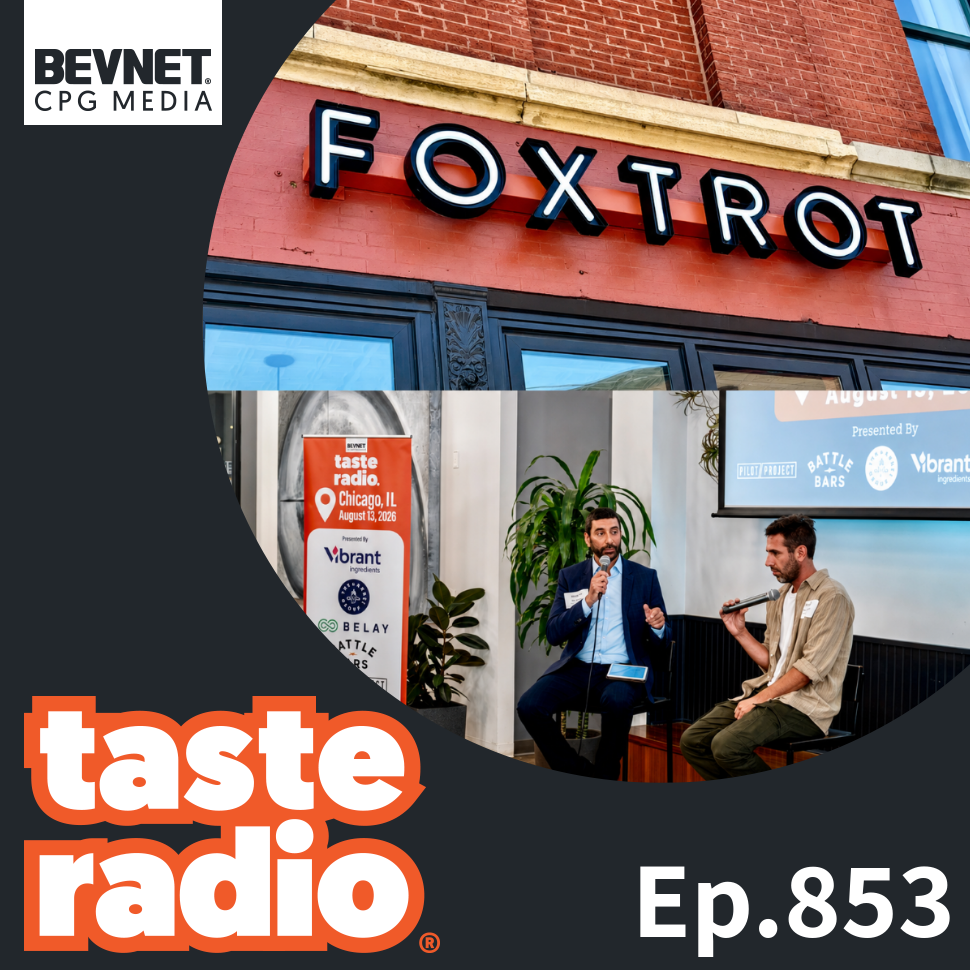
[00:00:10] Ray Latif: Hello, friends. I'm Ray Latif and you're listening to the number one podcast for anyone building a business in food or beverage, Taste Radio. This episode features an interview with serial entrepreneur Jeff Church, who's best known for co-founding and helming cold press juice brand Suja. Jeff Church knows the highs and lows of brand building like few do. He led one beverage company to $100 million in annual revenue. He's also lost $4 million of his own money trying to scale another. His experience and perspective on how and why brands succeed, and the reason that they don't, is why I asked him to join us for a live interview as part of an industry networking event in San Diego hosted by BevNET and Taste Radio on September 25th. As part of a wide-ranging conversation, Jeff spoke about how he navigated Suja through its early development and rapid growth, and what he perceives as a decision that was most impactful in the brand's success. He also discussed the failure of Rowdy Energy, a high-profile energy drink brand that he co-founded with NASCAR driver Kyle Busch in 2020 and shut down less than four years later. Jeff, who currently leads an accelerator program for emerging brands, also shared his take on the current landscape for early-stage food and beverage companies as he weighed in on the value of innovation, high-quality package design, profitability, and staffing. Thank you all so much for coming out to the BevNET West Coast branch here in San Diego. My name is Ray Latif. I'm the editor and producer of BevNET's Taste Radio podcast. If you're not familiar with the Taste Radio podcast, we are the number one show for anyone building a business in food or beverage. If you're looking to start from the ground up or help scale your business, we have the answers. Speaking to founders who have been there, done that, and that includes folks like this gentleman next to me, that's Jeff Church. who is the Co-Founder Former CEO of a little brand you might have heard of called Suja. Jeff, thanks so much for being with us today. Thanks so much, Ray. Hey, everybody. Happy to see everybody. You can clap. You can clap. Jeff Church is a legend. You should be clapping.
[00:02:33] Jeff Church: just old.
[00:02:34] Ray Latif: No, no, not at all. So we are recording in front of a live audience here. We're going to post this content on the podcast on Taste Radio a bit further down the line. So please no screaming and yelling unless you're screaming. Listen to more Taste Radio because that always helps, doesn't it? I think so. As I mentioned, Jeff is the Co-Founder Former CEO of Suja, but you've been involved in the beverage industry for a long time. Talk a bit about your background.
[00:03:02] Jeff Church: Yeah, thanks, Ray. And welcome, everyone. Happy to see everyone here. I've been in the beverage space for about 1518 years, I've been in the business space buying or starting businesses for the past 35 years. I guess over that period of time, I've had eight companies of my own four of which are five of which were companies I acquired, and use the assets of the business to to fund the purchase price and then built them up over time and sold them. And then three of them have been startups that I've done all in the food and beverage space over the last 12, 14 years. So I like the startups a lot more, because they're just fun. I mean, they're, they're, I say fun, you guys are like fun, really, we're having fun. It's fun because of the freedom that you get, you know, the esprit de corps that you get to create. I feel a lot like, you know, as a founder, I'm an artist, and I'm painting a portrait, and I get to paint the culture of the company. And when you buy a company, you don't get to paint that you inherit a culture based on what, you know, what you get, you can kind of move it on the margins, but you can't really change it the way that maybe you'd want to have it. So the startups, are really nice because you get to create, you know, you're your own artist and you get to create that portrait the way you want to create it and you don't have yourself to blame. So that's the only negative about it. You can't blame somebody else.
[00:04:21] Ray Latif: Yeah, I do want to talk about Suja. I do want to talk about Rowdy Energy. I want to talk about a few of the businesses you worked with. I do want to take a slightly different tack than we typically do on the podcast in that I want to kind of go backwards and start from the back and go forward here. You know, people talk about startup life all the time and there's a glamour to it. Obviously, there's a hardship to it as well. But, you know, in your opinion, having been involved in so many, you know, what's the most difficult part? that people don't realize about startup life, especially in that one to two years in? Because once you're in the market, once you get the product out in the market, that seems like that's the easy part. Everything else is difficult. But what's the most difficult part in that one to two year stretch?
[00:05:05] Jeff Church: I think the most difficult part in the early stages, you don't have that much revenue to start, right? And your gross margin isn't that high to begin with as a percentage. So your extra gross margin dollars aren't that high. And yet you've got these operating costs that you're trying to build a brand and build a business and they're out of whack. which causes you to lose money. And I think the first couple years, you're kind of you're renting time, as I call it, and you feel like the clock is ticking, you know, on you before you run out of money. And that's a very destabilizing, you know, thought to know that, okay, I'm now one month closer to my 18 months. Now I'm five months closer. Now I'm seven months closer. Now I got to raise money. But maybe it doesn't look that great to raise money. So that early stage from that standpoint is very stressful. I think the first hires that you make are really, you know, stressful hires, because if you hire wrong in the very, very beginning, it's a real, you know, kind of puts you back type move. I call them fatal flaws. But I think, you know, the money side of it's really challenging, you know, in the beginning and running out of money, not having enough money, you know, and then, you know, just continuing to build that out. I mean, it changes over time, but I think that for me is the the most difficult part. I think also, you know, as a founder, we have to be somewhat risk tolerant, right? And we have to be somewhat comfortable with looking over the abyss, you know, over the cliff and into the abyss. And we have to be somewhat comfortable with that. And that's a hard thing to do. Especially, I find it hard for a spouse you know, that isn't necessarily directly in control of the situation, you know, to also do that. So for those of you that have spouses that are doing this kind of stuff, please, please, please communicate and over communicate, you know, with them because, you know, they're they don't have the control that you have and you're playing with their life assets as well.
[00:06:49] Ray Latif: I mentioned the glamour that's associated with the food and beverage industry. It feels great to be able to say, I created this and then go to a store and see it on shelf and maybe have someone buy it off the shelf. You're like, this is crazy. I did this. At the same time, you're wondering how many more people are going to buy this. How do I get more people interested in seeing my product out there? And sometimes you get lucky. You know, sometimes you're just in the right place at the right time. And I'm not saying Suju was lucky, but Suju was definitely a brand at the right place in the right time. And I think your leadership helped the brand take advantage of that opportunity. When you do think about finding yourself in a good situation where you do have the ability to scale quickly or at least attract attention quickly. Talk about that process. You know, how do you start thinking about where is the first step and then where is the next step? And how do you look 10 steps into the future? I mean, do you even do that?
[00:07:43] Jeff Church: Yeah, that's a really good question, Ray. I do, whenever I start a business or acquire, you know, a company, I call it begin with the end in mind. It's kind of a Stephen Covey concept, seven habits of highly effective people. And I'll actually write the selling memorandum, when I'm doing the due diligence to buy the company, or to start the company. So I'm kind of writing my strategic plan, and then working backwards on that plan, and trying to see where I have holes, you know, in that plan. So do I not have you know, good route to market, do I not have good intellectual property, do I not have the right team, I start to see the holes. And so it's kind of like a five year process that I'm looking at it. So if you kind of start with where you want to get to, even with this revenue and your profits and all that kind of stuff, then work backwards, you're able to kind of break down, you know, where do I have the holes that I need to, that I need to fill in here. In Suge's particular case, though, we were really lucky in that we were the number three cold press juice company to come out. I mean, there were some other little ones around the country, I'm sure, but we were behind Blueprint, Cleanze, and Evolution Fresh. And both those companies were running out of money right as the market was coming up. So they were just a little too early. And both those businesses, you know, Evolution Fresh, as it turns out, didn't sell for more than $15 million to Starbucks. And had he been able to hold on another year or two, it would have been a wholly different outcome. So a little bit is luck in terms of timing. you know, we right as we were launching, both those brands were acquired by larger CPG brands. And, you know, as you know, well, right, but when bigger companies acquire little companies, oftentimes they lose that founder, a spree to core and that kind of, you know, just that it's gonna we're gonna take the hill, we're gonna win this game, we're not gonna let anything get in our way, just that fighting attitude to kind of lose that. And both the parent companies that bought both those companies, One of them diverted HPP machines to blueprint cleanse to another one of their divisions outside of blueprint cleanse. And you imagine how demoralizing that is to have that happen, like right away, as you're partnering with someone. So, you know, they both were acquired, and they kind of went off the road. So all we had to do, and I won't say all because we grew from you know, from zero to 100 million in six years. But all we had to do was kind of hold the stick in the middle of the road. And, you know, actually execution is something you can control. You know, demand is much harder to control, because you know, you can say, well, I want more sales, I want more sales, and you can put the things in place to get them, but you may not get the sales. Whereas execution, you know, you can control that you can be very detail oriented. And we were really, really detail oriented. We I would send literally a half a pallet from San Diego to the East Coast for business in a full truck. You know, as you can imagine, what a disastrous. you know, idea that is from a profit standpoint. But I mean, I would do that because I was petrified of the cold chain and breaking the cold chain and having because you never know if it sits on a dock for a couple hours and starts heating up and the and the micro start growing because of that. You just don't know. And you'll know it in two months when you have product blowing up on people. But, you know, that's not a lot of fun either. So, you know, we just had to keep the stick in the middle of the road. Again, not easy, but easier than trying to, like, you know, get demand out of thin air.
[00:10:58] Ray Latif: I want to go back to something you said about thinking about the end first. A lot of people here are like, you know what? I want to create a brand that is lasting, that has value generations after I'm done with it or I exit the business. And that's pretty ambitious. How do you factor ambition and the potential of a brand when you are mapping out that business strategy?
[00:11:22] Jeff Church: That's a good question. I wish I'd thought of that question. It wasn't on the questions we talked about, Ray. You know, from a strategy standpoint, I mean, I'm just, it's how do we get up the hill fast enough, as fast as we can? How many people do I need to strap on my back to come up the hill with me? Who else can strap people on their back to come up the hill? And that's why the skill sets of an early stage founder are very, very different than the skill sets of a professional manager that comes in much later stage. Frankly, I find that really, really boring. In fact, you're doing pre-meetings and if I do another pre-meeting with Coca-Cola, I think I'll shoot myself in the head. But they do them or take 12 people to a top to top, you know, with a retailer when, you know, you guys are probably used to taking yourself and maybe a salesperson or marketing person. And I like that environment, because that environment, you know, you're very lateral in your thinking, you have to understand route to market, you have to understand you know, your marketing strategy, you have to understand the distribution network, you have to just understand a lot, where literally, I would show up at meetings with Coke, and there'd be 12 people in a meeting for an hour with one buyer on the other side. And, you know, the salesperson actually didn't know how the product was getting to the customer. To me, that's not very much fun. So I like the earlier stages. I don't necessarily love, you know, the fact of you're worrying about am I going to make it or not every day, every minute of every day, pretty much of your existence. But I, you know, I find that that's, you know, that's what's kind of worked for me is just, frankly, to outwork it a bit. All right.
[00:12:52] Ray Latif: Here is the question that was on our list of three questions. Thank you. Just get back to the road, Ray. In hindsight, when you think about Suja and the success that you had with the brand, in hindsight, what was the most impactful decision you made that helped the brand get to that point?
[00:13:08] Jeff Church: Oh, I'm glad you asked that question, Ray.
[00:13:11] Ray Latif: Do you want to pull out your cliff notes here?
[00:13:14] Jeff Church: The ability to pivot, and I call it fake it till you make it. And these businesses are shitshow businesses in the beginning.
[00:13:21] Ray Latif: Apple podcasting is going to make us do a checkmark here. Use one profanity word you say, Ray. Okay, I'm sorry to interrupt you.
[00:13:31] Jeff Church: But you know, they're tough businesses, you know, and where you start today, I guarantee you, five years from now, your business is going to look very, very different. And, you know, the top 10 SKUs that we had when we started Suja, only one of them is in the top 10 SKUs today. In fact, probably seven of them aren't even in the portfolio. So, you know, things change over time. And until you get to a place where you're operating at the median level of velocity and you're set, or you're operating at a nice you know, ROAS on Amazon, and those metrics are in your favor, you're kind of renting time, as I mentioned earlier, and you're, I call it fake it until you make it. And we want to pivot. I mean, Silly Putty, that product that, you know, we've all used a lot, or your kids used a lot, started out as a wall cleaning product and turned into a, you know, product that they realized they could, they used it to clean marks off the wall, and they realized it could do a lot different. The things we start can be very different than where we end up. And I think it's just important to keep innovating, keep being intellectually curious, keep pushing yourself out there until you get to a spot where you've got a product that's actually really working. We launched at Suja a new product every eight days over a seven or eight year period. And we killed a product every 14 days, which really upset our ops people because that difference really built this big surge of products that we were making 50 SKUs every week. But I think the pivoting is really important and the understanding that it's okay. Some people will say, people used to accuse me of churning, meaning that I keep just launching the launch and I got to let the cake bake in the oven. I agree that that's part of it. Until you're in a cash flow break-even spot, you're renting time. And the longer you go without getting that profitability, the harder it is to be there.
[00:15:15] Ray Latif: I saw one of the early Suja vets, Jessica Pratt. Did you dry heave every eight days a new product? No, she caused it. She was on the cause side. Well, we're going to do an oral history of Suja at some point. Stay tuned for that, folks. I did mention a brand, Rowdy Energy. This is another brand that had a lot of potential. I thought I said that one wasn't on the list. It seems to be on my list right now. No, we actually featured you and the founder, a very famous race car driver, Kyle Busch, on the podcast. Didn't work out as well as Suja. Talk about the history of that brand and sort of the biggest challenges and the reason why it just didn't work out the way you thought it would.
[00:15:58] Jeff Church: Yeah, I think there's a couple reasons it didn't work out. And believe me, that was a gut punch, you know, because you kind of walk away after a suit and you think, hey, I'm doing pretty good at this. I've done this a couple times now. I've got some good track record. And then boom, you know, we created a fantastic product in Rowdy, but we just couldn't get the sales. And we got the distribution, we got the doors, but we couldn't hold the shelf. And you want to talk about something painful, you know, getting into 25,000 doors, and then Chinese water torturing, you know, door by door by door by door, until you're down to zero doors, very, very painful process, very difficult category. And someone told me, someone very smart told me, don't go into energy drinks, Jeff, right before I went into energy drinks. And that was me. Yeah. And I know people do it. I did it. So sometimes we have to learn on our own. But if you look at some of the categories that are the most competitive right now, like hydration and energy, they're very, very difficult to make it in because any kind of digital advertising you're doing is very expensive, or you've got to be really creative about how you're doing it because you can't buy kind of keywords because they're just too expensive and they won't convert economically for you. So you've got to be able to you know, adapt with all that stuff. And that's not easy to do. So I mean, I think with rowdy, I also I was, I was invited to partner with NASCAR driver. And I thought, okay, a celebrity is going to work. I didn't really realize that the celebrity that had contacted me happened to be also the considered the bad boy of NASCAR. So we were launching a better for you energy drink. into the NASCAR environment, and I just don't think they cared about low sugar and all that. I got really good at learning all the drivers in NASCAR, if anybody wants any help with that afterwards, but we raised $25 million, lost it all. Three and a half, $4 million of my own money, lost it all. very, very difficult. I think in the energy drink space, unless you can get the right celebrity that can really help you kind of rise above the clutter, or just get something that creates energy, you see it, I mean, they pop, you know, ghost pop, Alani knew popped, you know, some of the energy drink brands, but unless you pop, or some reason to pop and most those brands have come from the powder market, supplement market first through GNC and vitamin shop, and places like that. So they already had kind of built up, you know, followers, so they had the ability to pop. And I also think we didn't go DSD, we went broad liner and I mean, they both have their challenges, everybody knows. I mean, you know, the OIs on Kahi and UniFi aren't overly fun, right? But DSD is being in the back of the corner and the DSD store is really not fun. So it was challenging. I also think I got caught in the transition from a traditional, you got to get to a customer consumer seven times before they actually will go into a store and pick up your product. That model changed much more to the influencer. you know, social media platform type model where it was about finding a trusted advisor that you would, you know, follow. And that kind of disintermediated my seven step idea. And I kind of I was late, I think, in trying to see that, but, you know, really strong learning lesson, very humbling. But it happens. You're going to strike out. These are challenging things to do. You know, I mean, I think, you know, you start a business and what's the odds of early success? I mean, 20%, 30%, something like that. I mean, I feel like now I used to feel like I could get a business maybe to 90, 95%, you know, success. And then the last five or 10 was luck and opportunity and timing. Now I feel like it's more like 70-75%. But that last 25%, if you don't get it on your side, it's a real strong headwind. And starting a business, raising money, selling a business into what I refer to as headwinds, things that can be somewhat negative versus tailwinds that are pushing you, is always very, very challenging.
[00:19:56] Ray Latif: Well, I think you created a bunch of solidarity when you said that you raised a bunch of money, you lost a lot of personal money. I saw people nodding and gulping and talking about, you know, the challenges of scaling in a very competitive category. We always hear that innovation is really important. And I kind of want to do a little true or false here with you, actually. I mean, Jeff is actually consulting with and working with a lot of early stage brands right now. And I'm sure you get a lot of these questions. So why don't I ask you these questions on behalf of our audience and folks who are probably going to ask you them anyway. True or false, innovation is as important as ever to stand out.
[00:20:31] Jeff Church: True.
[00:20:31] Ray Latif: Can I ad lib something or not? No, that's it. No, I'm just kidding. Go ahead. Yes, please continue.
[00:20:35] Jeff Church: Elaborate. If you look at some interesting statistic in 2020, it was an average of 35,000 new products coming into the grocery channel, into the food and beverage channel every month. Now that's down to 5,000. So it's dropped seven times in the last five years, the number of new products and, you know, retailers are still putting out new products, just the money supplies dried up a bit, you know, to help fund businesses to kind of have all that early stage innovation. And so I think if you're able to innovate today, and bring products to the market, you've got, you know, arguably, maybe a little less competition than you had four or five years ago, I mean, you got a whole bunch of other things going on. But innovation is like I said earlier, it's the fake it till you make it. If you are producing your own products, you need to use innovation as a core competency and a strength of yours. Because you know, you're going to have to spend more money on that plant. And you're not going to have the lowest cost to start in the long run, you might, but you have to have other reasons to justify having that plant. Most of you are using Coman, which is the more cost effective way. But if you aren't, and you can't, we couldn't. So we had to make all of our own products. And having, you know, the ability to, if you do make your own products, you should have a model where you're getting, you can, you can launch a new product in six weeks. And that should be your mantra, because that's how you can take advantage of the asset that you have. If you don't have that your co man, of course, you can't, you can't really do that. But innovation, to me, is the heartbeat of everything. It's also the for me, the fun, the sizzle, you know, trying to understand, you know, how can I layer multiple need state benefits into a product? So it's not just an energy drink, it's an energy drink with immunity or some energy drink with immunity with, you know, zero sugar. So people that want, you know, one, then people don't want to not want three, they're kind of nesting those benefits. So all of a sudden, you're kind of hitting a instead of a 60% of the consumers that want that you're kind of up to 90%, because you've layered in these different need state benefits.
[00:22:33] Ray Latif: These damn investors, you know, the money dries up because they want certain things. They want a path to profitability. I mean, crazy. We're living in crazy times, folks, but true or false? Profitability should be top of mind for entrepreneurs.
[00:22:46] Jeff Church: I'm going to say false, but, and the reason I'm going to say false is, If you said gross margin should be top of mind for, you know, earlier stage entrepreneurs, I'd say yes, totally. Gross margin for me is, you know, this is super important, getting yourself to a 40%, not on a product basis, but on a normal basis, where you're looking at your trade spend being included in that, and all that getting your gross profit to 40%. you know, within your first year or two is really important and getting it to 50% within the first three years is really important. Profitability, you know, you need to have profitability to sell the business. People don't expect you to make money in the beginning. They don't want you to lose $10 million a year. But if you're bouncing around, you know, depending on the size of your business, of course, if you're bouncing around at a half a million to a million dollars of losses in the first each of the first couple years, and then you start to get to break even, you know, in year three or four, and then you're starting to eat into that. That's a very, you know, that's a fine model. It's profitability is important. But if you don't feel like you have any money, or ability to raise money, of course, you got to take it slow, and over a long period of time, but there are plenty of businesses that have done that, you know, really well. Jessica's business pop and bottle has done a really, really great job of you know, steadily and slowly building the business over the long term. And now they're very significant middle market companies. So you can do it without a lot of money, but most of us are raising money. The minute we raise a dollar, you know, we're on the clock on that dollar. So we've got to be somewhat responsible to that. And you know, what you do, the kiss of death are the down rounds, if you happen to do that with the investors where you raise a subsequent round at a lower valuation, which causes a lot of odds for everybody.
[00:24:29] Ray Latif: So there you go. The next time you talk to an investor, a potential investor, and they say, I want to see profitability, be like, Jeff Church said, don't worry about that. Gross margin is where you want to put your focus. That's what we're doing right now.
[00:24:40] Jeff Church: Let me tell you a quick story on Suja. I went back after the years, we did 11 fundraising rounds in nine years. I mean, you want to talk about, and as you do fundraising rounds towards the end, when they aren't expected, you're literally, you feel like you're giving up a body part each time you do a fundraising round. So I'm walking around like this. But, you know, they're just they're really challenging, you know, to do. And I looked back and I said, What if, you know, we had averaged a gross profit margin, again, when you make your own products, you have higher costs to start. So we had averaged a gross profit of about 30% for the first seven years. And I said, Well, what if I had that at 40%. And over the nine years, we raised about $110 million, about 60 of that went into the manufacturing plants. And if we had been able to get the gross profit to 40% after the end of the second year, instead of raising 110 million, I would have only had to raise about 50 million.
[00:25:31] Ray Latif: Only 50 million?
[00:25:32] Jeff Church: Only 50 million. Yeah, sorry. But I mean, it makes that much of a difference just by getting that gross profit up, you know, just a little bit.
[00:25:40] Ray Latif: You know, nowadays, everything seems Instagrammable. Package design has come a long way from when I first started in the industry and seeing, you know, version one, version two, version three, until you get to that really glossy, beautiful package. And now it seems like it's table stakes. You've got to come out of the gate with a great package. But I could be wrong, true or false. you need to invest in high quality packaging design.
[00:26:05] Jeff Church: I think true on that one, for sure. Especially if you're going into a Costco, I mean, don't chance on the box, make sure it looks attractive, because once you get in there, you want the product to turn and you know, you see lots of stuff where people got a half wrap tray in a Costco that, you know, that's consumer facing this consumer facing it matters if it's not consumer facing, like it's a you're shipping it to the retailer, and they're stocking the shelves and breaking the box or, or the half tray, then it doesn't need to, you know, look overly nice. But the cost of going which is if it's a beverage product, for example, with a half tray that's white with your logo on it, it doesn't cost that much more than just a plain, you know, corrugated tray. So you can make it look nice without necessarily all the bells and whistles. But again, I can come back to the fake it till you make it. And having that product look as good as it can be early on is really important. You can always bring those costs down, and those costs will plummet down once you get decent volume.
[00:27:00] Ray Latif: Our technical director told me I only have one more question, so I'm going to make it this one. True or false? Now, for folks here in the audience, I'm sure this is an important question. Your first salaried hire should be in sales, a sales hire, true or false?
[00:27:15] Jeff Church: Generally true, especially when you realize all the paperwork you have to do. Unless you're really good at paperwork, you better get somebody, Jessica. on board that can do the paperwork for you, because God knows I would have gone down into a rabbit hole never come out of it. But what I would say about hiring, though, is I strongly encourage you to use fractional people, you know, early on, fractional people are, you know, consultants, but be really careful, because They're a dime a dozen, but if you get the right ones, you get a skill set that's kind of been there, seen it, done it, and you don't have the full salary of that person. You don't get them full time, but you don't really need some of these positions full time early on. But I would think that you're either hiring a social media person or a salesperson probably first.
[00:27:59] Ray Latif: Folks listening to this podcast will wonder how come you couldn't spend more time with Jeff Church, but you can spend more time with Jeff Church. You are, as I mentioned, consulting. Just quickly talk a bit about your business and what you're doing right now.
[00:28:11] Jeff Church: Yeah, after I had my wonderful experience with Rowdy, I got a little gun shy, I have to admit. And I thought, I like this industry. How do I play in this industry, where I don't necessarily have to have a brand? And what else do I like to do? I like to teach. I like to educate. I've got a godzillion mistakes that I've made, and lessons learned. And, you know, I began to think about creating an accelerator that would, you know, be for earlier stage founders that would kind of walk them through in a live setting. It's on a Zoom base, but we meet for about 13 weeks in the fall. There's two groups of seven cohorts that we have right now going through. A few of the folks are in here tonight, which is awesome. It's just really about, I'm bringing in speakers. So people like you might know, Mark, Mark Rampolla, of Zico, Seth Goldman from Honest Tea, Justin Prochnow from, you know, an FDA attorney is a lot piece of people that are really in the space, they're kind of well known. And then I'm bringing these founders that aren't in competing spots. and competing categories together. So there's a lot of sharing of information. I'm finding it really great. But as we started to get into it, I realized that three months of that might be drinking from a fire hydrant. So we created a boot camp. And the boot camp is really cool. It's self-narrated by me. but it's about 20 hours of narration that walks you through. I refer to as kind of the MBA of CPG. It's not a one-on-one class. It's not a 401 class like you'd have in college. It's a 201, you know, class, but it's got tons of information and you can do the accelerator, which comes with the bootcamp, or you can just do the bootcamp. But if you're doing both, it gives you six months with me kind of mentoring you. And then you're in a group session, which kind of keeps the costs down, but I'm loving it. It's been a lot of fun, a lot of work to do, but I thank God for ChatGBT.
[00:29:57] Ray Latif: But it's been a really great experience so far. This has been a really great conversation. Jeff, I can't thank you enough for sitting down with me today and for sharing so much knowledge, insights, experience, the good and the bad with our audience today. Really appreciate it. Thank you again. Thanks, Ray.
[00:30:11] Jeff Church: Thanks, everybody.
[00:30:16] Ray Latif: That brings us to the end of this episode of Taste Radio. Thank you so much for listening. Taste Radio is a production of BevNET.com, Incorporated. Our audio engineer for Taste Radio is Joe Kratchy. Our technical director is Joshua Pratt, and our video editor is Ryan Galang. Our social marketing manager is Amanda Smerlinski, and our designer is Amanda Huang. Just a reminder, if you like what you hear on Taste Radio, please share the podcast with friends and colleagues. And, of course, we would love it if you could review us on the Apple Podcasts app or your listening platform of choice. Check us out on Instagram. Our handle is bevnettasteradio. As always, for questions, comments, ideas for future podcasts, please send us an email to ask at Taste Radio. On behalf of the entire Taste Radio team, thank you for listening, and we'll talk to you next time.
[00:31:06] Jeff Church: you