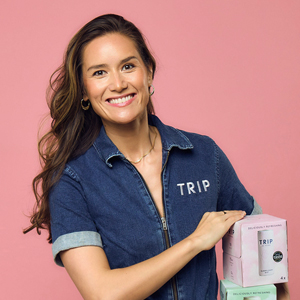
[00:00:10] Ray Latif: Hello, friends. I'm Ray Latif, and you're listening to the number one podcast for anyone building a business in food or beverage, Taste Radio. This episode features an interview with Olivia Ferdi, the co-founder of fast-growing functional beverage brand, Trip. Olivia Ferdi is obsessed with the details. A passion for the particulars, she says, is the reason that her brand got off to a fast start and is building toward a more promising future. Olivia is the co-founder of Trip, a UK-based brand of lightly sparkling functional beverages made with ingredients that are intended to help people relax. Trip debuted in 2019 and markets two product lines, one infused with CBD and adaptogens, and the other, called Mindful Blend, is made with linsemane, ashwagandha, l-theanine, and magnesium. According to Nielsen data, Trip is the fastest-growing soft drink brand in the UK and sold in over 30,000 points of distribution across Europe and the U.S. TRIP is currently preparing for a major expansion of its retail presence in the United States. According to the company, the brand will be available nationally at three yet-to-be-announced retail chains beginning in the first quarter of 2025. I had an opportunity to sit down with Olivia last month for an interview in which she talks about how her personal experience with CBD and a desire to make the ingredient accessible and affordable to a broad set of consumers led to the creation of TRIP. She also explains why she and her husband-slash-co-founder Daniel Khoury didn't do an analysis of the beverage space before launching the brand, her belief that the customer is sacrosanct, how the company's applying lessons learned from the brand's success in e-commerce to its brick-and-mortar business, and why humility is key to Tripp's U.S. expansion. Hey folks, it's Ray with Taste Radio. Right now, I am supremely honored to be sitting down with Olivia Ferdi, who is one of the co-founders of Trip. Olivia, great to see you.
[00:02:20] Olivia Ferdi: Thank you so much for being here. I am so excited for this conversation.
[00:02:24] Ray Latif: As am I. Continuing this conversation in many ways.
[00:02:26] Olivia Ferdi: Yeah.
[00:02:27] Ray Latif: We're here at the offices of Trip in Notting Hill, a very beautiful office, a three level office. And it's a trip to think that you guys only launched five years ago and you have this big, beautiful building, a thriving team of people who want to be here. Everyone seems to be excited and passionate about the brand and where it's going.
[00:02:46] Olivia Ferdi: I'm excited that you guys are here. I think there's such an amazing energy.
[00:02:48] Ray Latif: Totally, totally. And yesterday you hosted us, or you hosted the Taste Radio Meetup, our second here in London. And as I was saying before we were on the mics, everyone that I was talking to seemed so excited, having great conversations and really enjoyed the experience of networking in a very safe, calm and welcoming space.
[00:03:11] Olivia Ferdi: Thank you.
[00:03:11] Ray Latif: Yeah.
[00:03:11] Olivia Ferdi: Thanks so much. Yeah.
[00:03:13] Ray Latif: You're on the run, though, and I'm so happy that I have this time with you because you are quite busy and the event that you're going to tonight is very exciting. And what Trip is doing there is very exciting. Talk to our audience about what it's all about.
[00:03:28] Olivia Ferdi: Definitely. So it is just one of those weeks. I think what is so fun about this journey, there's many parts, but the unexpected is a constant theme and kind of reacting and making the most of what comes your way. Tonight happens to be one of those particularly fun things that are coming our way. So Dua Lipa, for those that know the sort of singer and mega star, pop star, she's doing a surprise concert here in London at the Royal Albert Hall. It's a beautiful historic venue from the Victorian times. You should definitely try and pop by if you can. She's got this surprise concert and Trip have been invited down. We are sponsoring her after party at this hot new place that has opened just down the road from our offices. And for us getting to work with talent that are fans of the brand and we can build on those partnerships is something we're super excited about. So rushing around a little bit today, we've got quite a few of our kind of investor ambassadors coming down. So it's something we might talk about later, but sort of a new phase of influencer slash partnership that we've looked at and launched this year, which is really around bringing talent into the journey. People that have followed our journey since day one, who have been so passionate about what we do, bringing them in in sort of a new, more meaningful, deeper way. So it was pretty fun to be able to message everyone yesterday and say, who's around to come to an after party? We're having a trip party tonight. So it'll be great, great fun.
[00:04:49] Ray Latif: I imagine that life feels like it's going 120 miles or what's that 160 kilometers an hour or something like that. It's fast paced, which is, I guess, slightly ironic for a brand that's all about chill and calm and like enjoying the the easy moments of life. I love that about your brand because this world is crazy. I mean, it's just nonstop. And you need a moment of calm, which is a good kind of transition to what you're doing now with a very well-known and respected app, that of Calm.
[00:05:25] Olivia Ferdi: Yeah, definitely. So excited about this. And I think you touched on it just then. We talk about moments of calm and the everyday chaos and sponsoring Dua Lipa's concert tonight is not every day in the traditional sense, but as a brand and how we built Trip, and I think personally, I think how it's resonated with so many millions of people in so many different places is the kind of openness within which we allow people to express what is chaotic for them. We don't ever want to preach a certain type of lifestyle or insinuate that a certain type of daily chaos is superior or more valid than another. Ultimately, mental well-being, which is why we're here and central to our mission, is flexible and personal and it shifts every day and it shifts every week. And it's not static. It's not something that you tick the box and you've achieved good mental well-being. It's something much more fluid and we're very kind of open to that. And a big part of how we started and how we built the brand is sharing our personal story of experiences of mental stress and how we found functional ingredients to really transform that on a daily level to be easy, accessible, convenient, delicious. but ultimately recognizing that each day can look different and you might be having a good day one day, by the end of the day it feels slightly different. And you hit the nail on the head, we talk about moments of calm in the everyday chaos, we are not here to say, even in this office which is very calm, you've met the team right? They're incredible, they are working, they're arses off, they are building something that has never been built before. But understanding that you can enjoy moments of calm and build a routine or tools in your day to help you achieve that slightly more balanced feeling is something we're very passionate about supporting. Calm, the app, is the number one global meditation and mental well-being app. I think I have so long, we've all so long admired what Michael, the founder, and the team have created in terms of transforming what was historically considered very niche and fringe and making it quite accessible and brand-led. You know, to be able to open your phone that easily is an incredible thing to begin your kind of mental well-being journey. But to be able to brand it in a way, you know, they've got Harry Styles and Matthew McConaughey on the app, giving meditations and sleep stories. You know, they've really brought the digital age into what is a very like traditional historical practice and made it relevant and understandable for people. First of all, it is a first of its kind product collaboration. So on the can in front of us, we've got both brands sort of logos on the front. The first time that Calm has had their really recognizable blue tile sort of out and about in a fridge in a store. And ultimately, we're signaling to our new customers and our new community that this product is functional. It does what it says on the tin. The beautiful thing also is that we are gifting with that $3 purchase, every single customer a $45 membership to Calm for free. So they can then enjoy their drink If they so choose to start to learn more about how they might want to look after their daily mental well-being, very light touch, they simply redeem on the QR code. But I think what's exciting and how the retailers nationwide are thinking about this and obviously Mental Health Awareness Month coming up beginning of next year, I think how we can potentially evolve this partnership in light of retailer preferences, whether that's new flavors, new formats, and we could potentially extend this into sort of many different products.
[00:09:05] Ray Latif: You mentioned launching into some national retailers and this is a big step for Trip in that you're making a big push into the United States in the near future. I was speaking with your husband and co-founder Daniel yesterday and he said something very interesting. He had said that we would never intended to build Trip as a UK brand and That's an interesting statement to make because you started out in the UK. Of course. You're based here. You're based here. A lot of the brands I see in the local stores are in the UK.
[00:09:44] Olivia Ferdi: I'm like, are we moving? Has he not told me?
[00:09:46] Ray Latif: Are here exclusively, but just the idea of creating something that can travel easily. is something I don't necessarily think a lot of early stage founders consider when they're launching their brands. How did you see Trip? How did you map out the package design, the marketing, the positioning such that it wasn't going to be limited to a brand that was just in Europe or more specifically England?
[00:10:13] Olivia Ferdi: It's interesting at this kind of conversation and reflection point now that we're sort of celebrating the milestone of five years and these sort of questions are almost amusing to reflect on that who did we think we are, you know, launching out of nowhere with no experience telling everyone we were going to change the world. We genuinely believe we're changing the world and there's no doubt and no question. It's quite shocking. As I say it out loud, it's almost, I'm almost chuckling and embarrassed. But I think what you mentioned as well, like the global ambition was set from day one. I guess there's a few influences there, but ultimately the origin of the story and kind of the mission. So for context, Daniel and I didn't come from entrepreneurship. We didn't come from food and drink. We were very much customers not aware of kind of the broader Pretty much anything. He was in finance, I was in law. And then it was after he had an accident just before our wedding in 2018 that required knee surgery. And we were desperately looking at ways to help his recovery from this surgery seven weeks before we were due to get married. He was told he wouldn't be able to walk me down the aisle. I mean, later I will have to show you the video. We were desperately trying to find ways to help him get back on his feet and had been recommended CBD alongside other botanicals. It was getting a lot more attention in the US, particularly amongst sort of professional athletes and things. Long story short, not only was he walking me down the aisle, but ended dancing all weekend long. Couldn't believe it. And I don't know if anyone in the audience has had an ACL injury. This is the video. I'm on his shoulders. Can you see?
[00:11:48] Ray Latif: Oh, wow.
[00:11:49] Olivia Ferdi: It's not just like hobbling down the aisle.
[00:11:50] Ray Latif: Yeah.
[00:11:52] Olivia Ferdi: Crazy, no?
[00:11:53] Ray Latif: You would think that he's undergoing or he underwent knee surgery or he's under some serious pain meds where he's not even feeling anything.
[00:12:02] Olivia Ferdi: Yeah, yeah, yeah. I mean, the next day it does swell up hugely. But this led us on a journey of kind of discovery and we couldn't believe our eyes. As you can see from that video, all our friends and family celebrating with us were like, what the heck did you do? How has this happened? And when we learned about these ingredients, when we got back and got very excited about what we were reading, all these incredible benefits, not just CBD, but L-theanine, ashwagandha, chamomile, blending these botanicals that have been around for thousands of years is really, really interesting. So we ended up quitting our jobs three months after that wedding and realizing we had to do something in this space. Blind passion to help people, everybody we knew, all our friends and family were stressed in some way. And I don't know about you, but particularly in lockdown, I think we all unified a little bit in our vocabulary and talking more openly around how we were doing, because there was nothing to do but talk about how you're doing today. Oh, you're still stuck at home. You're still worried about your friends and your family. So we knew that if we could create something that was understandable, delicious, and help people access these ingredients, it was going to change the world. I mean, who wouldn't want to be less stressed? Who wouldn't want to be more imbalanced? Because the everyday chaos we talk about, it is everyday. It's the micro moments. It's feeling like you're in a rush. It's feeling like you're behind or the to-do list is long, but ultimately being able to help people with that was our North Star. It informed every decision, going through the pain points ourselves of discovering these ingredients, but finding it challenging, navigating how and when to consume them and in what format and why do I need to go to a very specific store to find this sort of product? So we actually quit our jobs as newlyweds, put all our family savings together. and launched the brand about a year after that. And I think the global ambition piece is our mission is to help a billion people find a moment of calm in the everyday chaos. And that is a big ambition, but it's not limited to a certain type of person who deserves to have stress relief or a certain type of person who is so busy because of their professional or other endeavors that they need something more than everyone else. For me, it is very much something for everyone. And actually, as we've grown quite a lot, it's interesting how many marketeers or commercial people tell me, who's your profile target customer? Double down on that. I'm like, it's for everybody. There is no one I want to exclude here but I think personally as well from the global kind of, it was never just UK based, Daniel is Irish-Lebanese, I'm English-Chinese-Indonesian, we have lovely big families, travel, hospitality, mixed cultures are really important to us in how we've been brought up and the mixing of cultures is something we think can be very beautiful. So I think knowing that we wanted this to travel, it's never been about just being best of British or whatever. It's always been a wider lens. And I think that's just intrinsic to who we are and how we've had the privilege of growing up around such a mixed group of people.
[00:15:04] Ray Latif: To be clear, you have two distinct lines. One is focused on CBD and one is focused on a blend that you call Mindful Blend, which is made with botanicals and adaptogens, specifically in the can I'm holding, it's Lyme's main magnesium, L-theanine and ashwagandha. When I think about the heyday of CBD, at least in the United States, it was 2019. We talked about this last night. Everything was CBD. Leggings, spray, deodorant. Exactly. If CBD could be included, they included it.
[00:15:37] Olivia Ferdi: It was like a gold rush, wasn't it?
[00:15:38] Ray Latif: Exactly. And I wonder why it was important for you and Daniel to create your own brand versus perhaps invest in or work alongside with an existing one. You know, taking that leap of, we're going to quit our jobs and start our own brand, certainly a leap of faith, but there were other options out there. Where did you see Trip is filling a hole or the white space for the brand?
[00:16:04] Olivia Ferdi: Again, it's one of those really good questions that if I was launching a brand today, I would think about more like you phrased it. But the reality of five years ago, it was pure passion, personal experience, blind faith, naivety. It was like, we have to do something in this space. We know as consumers we're struggling with finding formats, flavours, price points. We want to get it somewhere we're already going, whether we're going for drinks or dinner or to the grocery store. I don't want to have to go somewhere very specific for this thing. And we were very, in a way, focused on our own challenges as customers and building from there. There was never, and it mortifies me to actually say this, but it sort of comes up in reflection conversations like this. There was never a sit down business plan. We never marked the market. We went to stores and tried drinks in the UK because it was 2019, we couldn't travel as much, but it was to sort of check what sweetness and flavors were out there in a more kind of reflective perspective. But there was never a review of the white space. I don't know if this has come across as we've got to know each other as people as well. There's never been a competitive, we want to do X but better. It's never been about that. I think you can build a lot of brilliant businesses by being either the second mover or doing something better than the market standard. But it was actually purely forward focused on how we felt we could help people, how we felt we could innovate and bring these ingredients together, never kind of looking at gaps in the market and things like that. It was as simple as a conversation of, can you think of anyone that wouldn't benefit from something delicious and affordable that could help them feel better in themselves every day? Can't think of a single person that wouldn't agree with that, even though Stress is a word that's maybe a bit more of our generation and our parents might not talk about stress in the same way that we do, but I think we'll probably both agree our parents are stressed. They don't sleep great. They might not talk about it with the same kind of vocabulary. But for us, it was really about helping people and helping everyone. And I think for us, so you've mentioned we have the two ranges, so Mindful Blend, which has the lion's mane, L-theanine, magnesium, ashwagandha, and then the core range that we launch with, which is infused with CBD, L-theanine, ginseng, lemon balm, chamomile. They actually sit alongside each other in a lot of stores, and that's kind of the plan for the brand moving forward. I think ultimately it's serving the customer in the way that best serves them, whether that's flavor, price point, availability, that's really our guiding sense. It's always customer first. And it's probably quite unusual hearing Lexi speak at the event yesterday. It's perhaps That naivety we mentioned is kind of a blessing in that you're so community and customer centric and the customer is sacrosanct. We do respond to their feedback. We do learn about their sensitivities, their evolving lifestyles. And I think being really honest about that has set us apart aside from that particularly powerful ingredient that started this whole journey for us. It's always been beyond an ingredient. And I think you'll know more than me, you speak to so many brilliant brands. you need a reason to believe. Humans are emotional and sensitive and you need a reason to believe and a single ingredient is a commodity and that will never be a reason to believe or come back over and over. I think the growth we've had, the largest global calming beverage with the largest privately owned carbonates company here in the UK, people come back over and over. It's not a fad and You'll see if you go to store and ask people around here, they're not coming for one of these ingredients or the particular milligrams. They sort of trust you as an expert on functionality to deliver that exceptionally delicious and always authentically functional experience, whether it happens to be the CBD infused range or the Mindful Blend.
[00:20:05] Ray Latif: how you communicate that functionality, how you communicate the ability for someone to receive that moment of calm is really important. And your packaging is the first interaction that most people will have with your brand. And before we were chatting for this interview, you told me that the packaging for Drip hasn't changed almost at all since 2019. And as we all know, you often go through a lot of different iterations. And if you can make it to five years, your brand has changed quite a bit. And Lexi had brought up the point last night that One of the things she admired most about Trip is how meticulous you were and have been about the package design, the liquid, the communication, everything's been buttoned up. Again, that's really hard to do at the outset when you're not necessarily sure how someone's going to see the brand or interact with it. But what were those elements that you wanted to communicate from the get-go and why has it worked?
[00:21:14] Olivia Ferdi: It's something we feel very passionately about. I think you'll probably tell from getting to know us how much we care about all these details. And again, it comes back to that customer-centric experience, having navigated it ourselves, thinking we're looking for something healthy, natural that can help us. Why is it so hard to understand? Why is it so hard to find? We were that original consumer ultimately. It's expanded and we're learning more and more about the breadth of our potential customers and it is something I want to be for everybody. Understanding that was such an important guiding element to us, but we are completely obsessed. The product is front and center for a couple of reasons. on reflection didn't know this at the time not coming from beverage but on reflection you know in beverage the product has to sing it has to do the whole storytelling you can't be where your product is all the time quite often you don't even know where your product ends up got a uh photo through last night from someone in phoenix airport sending me pictures of trip i was like i didn't even to be honest i didn't know we were there which is so cool because i love that about beverage you actually often Obviously, you pitch and have a strategy, but it could end up anywhere. And ultimately, if that beverage is on a shelf somewhere, it's got to tell a story in a matter of milliseconds, and you can't be there to tell the story. That is playing off all of the senses, sight initially, feel, obviously smell, taste. And for us, the product was and is always the hero that you'll see in all our brand and marketing. The rest of the marketing has actually been done by this incredible feedback loop of community who take photos of the product, post about it, advocate for it, recommend it. It's very powerful and very authentic and it moves the needle. It has grown the business from strength to strength. Ultimately, that product, as you mentioned, for those that may have known about CBD in the early days, because CBD was one of the ingredients in our products, We couldn't advertise this on Google and we couldn't put it on Amazon and we couldn't advertise through Meta. And that meant that we knew that we had to get awareness and people trying the product without those typical traditional channels that if you were an FMCG, I'd actually recommend you just launch the product, not obsess over the branding, get it out there, get some product market fit feedback, get some customer insight, whack it on some of these platforms and start generating insight. We couldn't go down that journey. So actually, we knew the product had to do a really big job. Not only did it have to communicate things that you might not have understood from typical advertising platforms, we also had to combat misconceptions, misconceptions and stigma around what traditionally The hemp industry here has been crowded with brands with big brown leaves or green leaves and, you know, monkeys and snakes and dragons and all sorts of things which don't really translate some of the benefits, in my view, visually of this product. So for us, it was about choosing color theory is all about how colors can make you feel. And these pastel colors are so recognizable across the globe. And people feel something when they look at a pastel color. It's actually incredibly disruptive in its calming, recessive visual. Marketeers, I mean, we're joking, we were looking at the pictures of the sketches I did of the brand before we launched. And typically, you know, you iterate, you optimize. And obviously, we will do that. We are doing that. But you have experienced marketeers who have told me for years, they'll look at the front of this product and say, There's not much on there. You're not being super clear about traditional brand, USP, anything like that, but it was all for a reason. It was all to tell you from a two meter distance, this is a better for you calming proposition. Excite you and interest you enough to draw you to the shelf where you pick it up, you feel it, you turn it around, you can read all that packaging pretty quickly. If you buy it, crack it open, you're immediately hit by that fresh botanical smell. We are so proud of these formulations. They are like nothing you've ever had. The fullness of the experience, the flavor, so many feel, you know, a nod to some of your favorite flavors, whether that's peach or raspberry or something you're familiar with, but with that unexpected twist, that depth that makes it feel adult and premium and sessionable. So alongside that aroma which hits you as you drink it, that kind of layered experience I think really makes this stand out. But that was so important to everything we were building. I guess product obsession, in the absence of just being able to put lots of awareness spend on paid media, it was all about the product so that whoever we sent it to, wherever it ended up, someone might try it and want to learn more. might Google us, go on Instagram, take a photo, send it to a friend. And that has been incredibly powerful. I mean, everything that we've talked about, whether it's the shape of a T on the kind of font and logos, the size of the bubbles, the mouth feel, how quickly the bubbles dissipate in your mouth, the size of the bubbles in your mouth. I actually didn't know before COVID when there was a shortage of everything. We put the bubbles in, you know, like an ingredient. I thought the bubbles, it just like got, I don't know, shaken up with CO2. Product obsession, I think it's a negative sounding phrase, but it is coming from a place of love. I want everybody to love this and have an incredible experience because the misconceptions I mentioned, we're trying to empower positive conversations about mental wellbeing. If we can help you understand that there are natural ingredients to help you live your life in a healthier, happier way, that is what I want to do. And it's not helpful if you have a bad quality drink experience or a bad quality L-theanine or CBD experience is actually negative for the overall category growth. So for me, ensuring everybody could enjoy this was really important. And by everybody, I don't just mean people thinking about health, because actually, we sell in stores here and in the US where you might not have heard about the brand. Ultimately, I want to be meeting people in a way that is a larger scale than our marketing team can have directly impacted. I want to get that impulse purchase of someone in a gas station or in Phoenix Airport who is just rushing and grabs it because it looks like something interesting. They're not shopping for the ingredient. They are shopping to drink a refreshing, delicious drink in a moment. The branding, the product, the liquid on the lips, it delivers this exceptional experience that then allows them to learn more about the brand, come back, buy more, find more places it's stocked and build from there. That is really the power of, I think, the perfect beverage. It entices you if you know nothing about it. The liquid is exceptional such that the experience delivers everything you need a beverage to. Having genuine functional benefits means It's far sort of superior in many ways to something full of sugar or artificial sweeteners or colorings. It always comes back to the product and that customer experience.
[00:28:13] Ray Latif: Going back to the question of how do you acquire a consumer's trust? They buy it once, maybe they like it, maybe they do feel the functional benefit that you market, but getting them to talk about the brand, getting them to engage with the brand on a more personal level, I think requires that level of trust.
[00:28:36] Olivia Ferdi: Yeah, I don't know if you've seen how we talk on social or how we talk on our emails but it is very, I hope, and I hope you'll agree it comes across like this, it's very inclusive, it's not preaching a certain type of lifestyle, it's not scaremongering, you must have this amount every day to feel an effect and if you have it before dinner it won't like, no no, Life is much more fluid and you live outside the lines and I think the tone of voice has from the beginning been very open and humble to other people's experiences and I think that comes through quite strongly when you meet people even in the team and the culture we're building. the trust element actually I believe initially starts with the product as we've talked about in that journey and then when people have the product and they perhaps don't know about the brand but then are very excited to learn more once they have this incredible experience this refreshing delicious experience that is immediately functional when they post about it and tell their friends about it and they go look at socials you know they'll be learning about Daniel and I's personal experience. And I think the sort of, wasn't part of the plan, but I think the vulnerability and honesty with which we've shared the fact that we didn't know exactly what we were doing, but we just really wanted to help people find a way to feel better in the same way that we'd experienced and overcome those challenges. We've never told people, please post a photo of your product and follow us on Instagram and comment if you want to. It's actually, we've never told anyone to do that. They just do. And I think that is them feeling empowered by something that has made them feel better. And in this kind of digital age, you can pay for that kind of exposure and authenticity. And authenticity, I think, really builds human connection and human connection to brands is something that is very special. And ultimately, has a massive impact on your brand, your business, your partners, your retail partners, all of it.
[00:30:34] Ray Latif: I think a lot of that also happens on via direct to consumer, via online experiences with the brand. And, you know, in 2020, I don't think many people were going into stores. I could be wrong buying trip products. A lot of what you were doing was via e-commerce and, you know, you can build strong relationships with folks. You can learn more about how they interact with and consume the brand via e-commerce.
[00:31:01] Olivia Ferdi: What's an interesting question to consider now is we have grown very fast. We've got 30,000 retail stores globally, a team of 60 here internationally, and making sure that we're able to retain how we built the beginning. It is not a copy paste. You can never copy paste between regions, between countries. You can take learnings and apply them and scale them, but I think a big job for us in this stage of going nationwide in the US as well is making sure we are staying as close to that customer, listening to that community as much as possible. Because in retail, the things we learned about DTC, so looking like a lifestyle product, not looking like a traditional beverage, for example, it's easier to do on direct to consumer, but in retail, you do need to optimize and adapt, but ultimately a lot of those principles have flowed through. And it's even more clear when you go to retail, how much we stand out because of our kind of core brand principles.
[00:32:03] Ray Latif: I think about this big move and the big expansion into the United States, and it seems like a humongous opportunity. There are a lot of risks involved as well. How are you thinking about mitigating those risks and not being overly cautious, but going into the market, knowing that there's a lot of things that could trip you up.
[00:32:27] Olivia Ferdi: Definitely. No pun intended. I think that recognizing sort of the three aspects that have built our success product, exceptional product, exceptional brand. And by product, I include the functionality, the genuine immediate functionality. brand and then community. So listening to that feedback, listening to what the community is saying is going to be the best way to solve challenges where we realize region X is not executed as well because perhaps partner Y touched it on its way through and it didn't get merchandised as we wanted. But ultimately having exceptional product means even if you find, which happens, if you find a single can in a random store in the middle of nowhere, it will still deliver a comprehensive trip experience. That is very important to me, number one. In terms of risk areas, it is hugely exciting. I don't know if you've got that impression from Daniel and I and the team, but I guess our risk appetite, like on paper, some of your questions have kind of alluded to it doesn't make sense to have launched this brand. It doesn't make sense to have gone into this kind of range of functional ingredients which are incredibly complicated from a regulatory landscape perspective, incredibly complicated from a supply chain perspective, from a logistics perspective. It's a heavy product with nearly 20 ingredients per can, not to be recommended on paper, but I think defying the logic with the ambition that we have based on delivering on this mission of helping people means if anyone's going to do it, we're going to do it. We are completely aware we still know very little in many ways and I think being really humble about that is really important. I think it is the best way that we have found to engage with things that aren't working and pivot or change. So I think an important part for us is going to be staying really close to feedback, whether it's a merchandising partner, a sapling partner, and assessing quite constructively, is this working? If it's not, make a change. We're very decision focused and solution oriented. And I think as a couple and as a founding team, that's been a superpower as well. We don't want to scale a problem. The US is the last place you want to do that. It's so large. There's so many layers to the distribution model. That is the last thing we want to do. And we are very I think I mentioned it yesterday while five years feels like an incredible milestone and we were talking as we came in about some of the stats of the probability of making it this far. It's crazy what we've done, but it feels like we're just getting started and we're never one to just copy paste and rest on our laurels. You'll probably get that impression from chatting to the team. It's all about excitement and kind of how can we serve our customer best and recognizing that our customer on the various coasts of the US, right in the middle, they're a new person sometimes and they're completely different and I would never be so bold to assume that they have the same needs and the exact same feelings and desires as many others. I think the most incredible thing about this US-UK partnership is We might speak the same language, we might have some shared values or some shared history, but we can also be completely different. And we love differences. As I mentioned, we come from mixed backgrounds. There's nothing I love more than a room full of people from all over the place, whether from different cities, different states, different countries. And for us to be able to obsess over that and get really under the skin of that is something that just excites us, that we'll be very honest about and very respectful of in how we build and best serve that customer.
[00:36:16] Ray Latif: I'm really excited to see Trip all over the United States, wherever I go. I imagine I'll probably be seeing you and Daniel in the States more often.
[00:36:24] Olivia Ferdi: For sure.
[00:36:25] Ray Latif: Any plans to move stateside?
[00:36:28] Olivia Ferdi: I'm not sure about Move. We go quite a few times a year. We were there last month for Newtopia. So we did Colorado. Is that right? Yeah. Yes. Yeah. I was like, where was it? And then we were in New York for a little bit for some work with some of our incredible celebrity influencer ambassadors I mentioned. So Ashley Graham, the incredible businesswoman mogul model is one of our first kind of partners. She's been a big fan of the brand that we brought in on this journey. So There's a really lovely combination where we get to travel so much with Trip to the US, meet people like yourselves, and kind of mixing that personal and business side has always been quite an unusual but big part of how we've grown. So at the moment, we're managing it with a young family going back and forth. Never say never, you just never know. I wouldn't want to assume, but for the moment, it's been amazing being able to travel out there and meet people.
[00:37:26] Ray Latif: Exciting stuff. Very exciting. Olivia, thank you so much for taking the time. I feel like these last, I want to call it 15, 20 hours with you and the trip team have been so amazing, rewarding. And, you know, to me, this is the best part of my job when you get to meet folks and I didn't meet you in 2019. John and Mike did, but yeah. You know, seeing people live out their dreams and seeing people who are starting out not knowing almost anything about the business and then getting to a place right now where you are embarking on becoming a truly global brand in an office of 60 people. And this, as you mentioned, there's just so much more room to go from here. So very, very exciting stuff.
[00:38:10] Olivia Ferdi: Definitely. Thank you so much for the conversation, for coming, for joining us and yeah, delighted to have finally met and keep you updated on our exciting news for sure.
[00:38:20] Ray Latif: Definitely. Thank you so much again. That brings us to the end of this episode of Taste Radio. Thank you so much for listening. Taste Radio is a production of BevNET.com, Incorporated. Our audio engineer for Taste Radio is Joe Cracci. Our technical director is Joshua Pratt, and our video editor is Ryan Galang. Our social marketing manager is Amanda Smerlinski, and our designer is Amanda Huang. Just a reminder, if you like what you hear on Taste Radio, please share the podcast with friends and colleagues. And of course, we would love it if you could review us on the Apple Podcasts app or your listening platform of choice. Check us out on Instagram. Our handle is BevNetTasteRadio. As always, for questions, comments, ideas for future podcasts, please send us an email to ask at Taste Radio. On behalf of the entire Taste Radio team, thank you for listening, and we'll talk to you next time.
[00:39:16] Mindful Blend: you