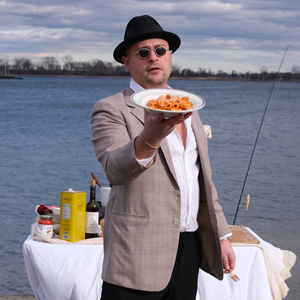
[00:00:10] Ray Latif: Hello, friends. I'm Ray Latif, and you're listening to the number one podcast for anyone building a business Fine Foods or beverage, Taste Radio. In this episode, we sit down with PJ Monti, the founder and CEO of award winning Italian American sauce and pasta brand, Monti's Fine Foods. One of PJ Monti's most successful sales pitches startled a woman so much that she clutched her purse. A few weeks later, PJ's tomato sauce was on the shelves of her husband's influential grocery store. It's one of dozens of stories that PJ, a streetwise, fedora-wearing entrepreneur, has about the development of Monti's Fine Foods. A brand of premium, clean-label sauces and pasta, Monty's launched in 2020 and is an homage to PJ's family, which has a long history in the restaurant and hospitality industries. A former clothing designer, P.J. shifted his focus to food five years ago and began selling jars of homemade sauce out of the trunk of his car. Today, the brand markets a trio of tomato sauces that are produced in small batches and made with carefully sourced ingredients. Monty's also sells bagged Bucci and Rolatini pasta. The brand is carried in over 1,000 retail stores across the U.S., including Target, ShopRite, Fairway and Erewhon, and Monty's is planning to expand its presence in several other chains later this year. In the following interview, PJ talks about how his family's background motivated him to get into the food business, why he credits, quote, human being relationships to early wins and the continued growth of Monty's, how he reduced ingredient costs by 25% without sacrificing quality, and how he landed the brand at Target. Hey folks, it's Ray with Taste Radio right now. I'm honored to be sitting down with PJ Monty of Monty's Fine Foods. PJ, great to see you.
[00:02:12] Fine Foods: Great to see you again, Ray.
[00:02:14] Ray Latif: Again is correct because we first sat down a couple months ago as part of our Elevator Talk series. You joined us for 10 minutes and I was so blown away by you and Monty's Fine Foods. I was like, look, we got to get this guy on Taste Radio for a longer conversation. And here you are. Thank you again.
[00:02:31] Fine Foods: Absolutely. It's a pleasure to be back. And you're right. I got the gift of gab. I told you I needed some more time.
[00:02:36] Ray Latif: You definitely did. And you're definitely getting it here. So I got to tell you, PJ, we, uh, we have lunch brought in every Tuesday and today is a Tuesday into the office. And, uh, we had some chicken parm and some eggplant parm. It's all good. It's pretty good actually. And I was just thinking the whole time, man, it would be so much better with some Monty's tomato sauce.
[00:02:59] Fine Foods: You're right. You're right with that.
[00:03:02] Ray Latif: Yeah. I've had your products and they are fantastic. Thank you. And you come from a family tradition of making great food. Talk a bit about your background, your family's history in this food business.
[00:03:16] Fine Foods: Absolutely. So it all started in 1906 in Brooklyn when my family came over from Avellino, Italy, opened up a little shop in Carroll Gardens on Carroll Street, 451 Carroll Street. It was known as Angelo's Tavern, originally grew to become Monty's Venetian Room. which became a real hotspot. And it kind of evolved over time from this little shop with my great-grandmother making the sauce and Neapolitan classic food, feeding the immigrants that also came over from Naples, that back-home comfort food, to a kind of a hotspot in its heyday was probably 30s, 40s, 50s, the Rat Pack hanging out there, wise guys on one side of the bar, the politicians on the other, a very well-known and noted spot. and technically the oldest Italian restaurant in Brooklyn, very famous for its red sauce, of course, a handful of dishes, the strip allamonte, clams allamonte, so on and so forth. Our cheesecake was number one, our Italian cheesecake. That's really where it all started and where the recipe originally started for our sauce, as well as some of the recipes that still live on our menu today. In 1956, my grandfather and his brother, my great uncle Nick, They took a trip out to Motok looking for linguine clams. They ended up at a spot called Gurney's, which was, you know, it was really a little fishing village at that point, not a whole lot of hotels or restaurants going on. And they stopped for linguine clams at this place called Gurney's Inn. They couldn't get served booze there. They were arguing about that and offered to buy the place probably after one too many cocktails on the ride out.
[00:04:58] Ray Latif: Wait, wait, I got to pause you. I got to stop you there. Wait, they weren't able to get booze there. Is it because they were already over served somewhere else? Is that what you're trying to say?
[00:05:07] Fine Foods: No, no, no. Mr. And Mrs. Gurney were Christian scientists, so they didn't serve booze on the property. And they said, you know, him and his company, it was back in the day, this is 1956, they were, they were arguing over who makes the best linguine clams. So, the gentleman who offered to bring them out to Montauk and cook them linguine clams. They might've had a couple of cocktails on the ride out, right? And so they sat down for lunch instead of going and having the clams that this guy offered up. And they stopped for lunch there because, you know, plans went awry. And my great uncle Nick said, this place is beautiful. Granted, it was just a little restaurant with four cottages on the beach at the time. He said, if you ever want to sell this place, give me a call. Two weeks later, he got a phone call from Mrs. Gurney. Hey, I'll sell you the place for $200,000. He scrapped together the money, bought the place, called my grandfather, said, pack up the kids, pack up the wife. We're moving to Montauk. I need you to run this place. He said, where the hell is Montauk? My grandfather said, all right, fine. Came out, and they built it up to be a 100-plus room resort spa and conference center, which is where I grew up. Born and raised in Montauk. I worked. in the hotel my whole life alongside my family, my uncles, my aunts, my grandfather, my father was the GM, my cousins, my brothers, my sisters, everybody worked there. I grew up as a kid working every single department there, stirring the sauce, flipping the burgers, parking the cars. And we sold that about 10 years ago, had a little restaurant upstate when that happened. I reconnected with the fa side of things. I was liv all sorts of other things sauce frankly aside from I fell back in love with sauce, which was just like And I kind of had that light bulb moment where I was like, you know, this is the story is here. The legacy is there. The product is amazing. It's fresh. It's clean. It's delicious. The clean label movement in tomato sauce in particular was really taken over with what Rios did. Our story had a lot of parallels there. Our product I found to be superior. I said, you know what? I think this really encompasses everything that I've been doing in my life and that I represent. This is my way of carrying on the family legacy, carrying the torch after four generations. Dropped everything, moved upstate, started jarring it up by hand, selling out of the trunk of my car. That was roughly four to five years ago right now.
[00:07:35] Ray Latif: I'm sure you learned a lot talking to folks. You know, what are some of the most notable sales stories, meetings that you had that kind of shaped the brand and the vision for the brand today?
[00:07:48] Fine Foods: There's a ton of funny stories, amazing stories, interesting and enlightening stories from selling sauce to grocery stores in Harlem where they would have to drop a bucket down out the window and put the invoice in there and switch out the cash because they got stuck up too many times and, you know, knocking on doors left and right, going to the Italian delis where they feed you mortadella and they're cutting you the check. And, you know, those are like the really charming stories that that human being relationship in this business of, you know, selling groceries and selling food that struck close to home with me because we grew up in the hospitality business. I always say we were in the hospitality business. My family always says that as well, meaning like we weren't just hoteliers, right? We weren't just restaurateurs. We were really like, it was the human connection that existed. And when I sell my product, you know, there has to be that human interaction that really cements and really makes our brand different, right? One time when I was, I was trying, I live in in the Hamptons during pandemic when the brand was really just starting to bubble up and it became a real business. We started raising some money and you know, in the Hampton Cinderella, that's number one. So I was emailing Cinderella, I'm asking this person to give me a phone number. I was getting no response for, you know, a year or something like that.
[00:09:11] Ray Latif: And Cinderella, just to be clear, is a grocery store?
[00:09:15] Fine Foods: It's a beautiful, very high end, amazing grocery store. It's like a very specialty gourmet shop. There's three in the Hamptons, maybe four or five in the city. That's a big guy. That would be a big win at that point in time in the sauce. After countless emails with no response, I'm driving from the Hamptons to the city to go unload a trunk full of sauce. and I stop in Bridge Hampton to grab a coffee along the way and I see the owner, this guy Joe, Joe Knows Fish, he's a legend, right? And I'm walking out of Pierre's and I bump into him, I'm like, Are you Jono's fish Joe? He's like, yeah. And his wife kind of clutches her purse. He gets a little nervous. I'm like, I'm like, listen, I give him a little introduction on PJ Monty, yada, yada, yada gurneys, just that in the third, I give him a quick elevator pitch, you know? And, and I'm like, I would love to just give you a sample of my sauce. And he's like, his wife kind of like he's a supplement. Oh, I love gurneys, you know. I said, let me, let me leave you, leave you a sample. I'll leave you alone. I go to the trunk of my car. I put together a bag with the sample, my business card, my sales sheet. I run up, I give it to him. And I was like, Let me know what you think. You know, no harm, no foul. I just really appreciate your feedback on this. And he's like, is your business card in there? I said, yeah. He said, all right, cool. Two days later, I get an email back finally after like a year and a half from the buyer. Like, hey, sure, we'll take a couple of cases at all the Harrington stores. But it's that human connection that really drove it home. You know, I bumped into him. Might have shook him up a little bit. But, you know, that was what it took. And that's why sometimes it's the trade show that you got to actually see the person that you've been emailing for two years or maybe it's got to be, you know, knocking on that door going to pay him a visit every once in a while just because you open up that account. Two years ago don't get too comfortable you know built that relationship maintain that relationship. And so from Monty's we have some day, one of my day one guys, Josh he's been with me from the beginning putting labels on jars during the pandemic and shipping them all over the country that me and him opened up the first 350 doors, literally knocking on those doors. He's calling these people every single week, you know, he's going in person, he's maintaining that relationship and those relationships are really important. That was the foundation of our brand. And now as you go to the bigger box stores, you lose a little bit of that connection, but any way that you can try to maintain that, that's important to me.
[00:11:43] Ray Latif: That's a really good point, PJ. It feels like this is a person to person business. This is one where the human connection can make the difference between you getting into a retailer and the retailer having no idea who you are, just someone who sends them a lot of emails.
[00:11:58] Fine Foods: Right.
[00:11:59] Ray Latif: Sometimes you got to see that person's face. They got to see yours and you got to do it any way you can. And I think, you know, running into that, the founder or the owner of Citarella's, sometimes, you know, that happens and you got to be ready for your shot. And I wonder. You know, from that first sale that you ever made, or maybe it wasn't even a first sale, from that first pitch that you ever made trying to sell Monty's sauce up until now, has your pitch evolved? Has your pitch, I would assume it has, but you know, what about your pitch has changed? What's made it more effective?
[00:12:28] Fine Foods: Sure, that's a great question. I think at a certain point in time, I've realized as the brand has grown now and we're in big box stores and probably close to a thousand stores right now as we close out the year, it's hard to maintain that level of relationship with every single buyer. And there's a certain threshold when you start getting to headquarter levels and this person, that person, brokers, distributors, it really takes the human out of the equation. So I almost realized like, hey, we kind of need to go get back in the street a little bit, you know, get back to knocking on doors. So I try to keep everything in mind where I'm not trying to be selling it out of the trunk till I'm 85 years old, like kind of the way that a lot of my family worked. till, you know, forever. They don't know how to retire. We threw a retirement party for my grandpa on his 75th birthday. He was back in the wine cellar the next day. It's like, I'm trying to break this generational trauma here, but at the same time, I'm doing that hard work that was instilled in me and taught to me by them. And it's important that we carry that along and not necessarily take the long and slow road. But like, you know, there's not anything wrong with the scenic route as long as you're going up the hill.
[00:13:44] Ray Latif: That's a really good way of putting it. Preserving your family's legacy is really important. I can understand that because, you know, my family is tight and we have a family business that's been running for over 20 years now, and it's important. And I think the number one aspect. of our family's business is that personal relationship that we have with our customers, but also just as important is quality. It is an extremely high quality product, the sauce and the pasta that you sell. How do you think about maintaining that quality as you continue to scale and grow?
[00:14:19] Fine Foods: Yeah, absolutely. It's a great question. And you know what? It's been a challenge and I'm really proud of how far we've been able to scale it and kind of crack the code of maintaining quality without cutting the corners. We make our sauce exactly how my family's always made it. Like if you cracked a jar open and you try a batch of sauce in our restaurant in Montauk right now that they make fresh every day, you couldn't tell the difference from side by side. And that's because we use restaurant grade tomatoes, we use fresh produce, we use sea salt and black pepper, and we cook in small batches. Everybody else is using the BC&D tomatoes that are crushed and pureed, which are crushed and pureed for a reason. because they're ugly, they're not as good, they mash them up, right? And they come in drums and totes, which are susceptible to light leakage, air contact, which affects the flavor. You're going to get more acidity in them. You're not going to get this fresh tomato flavor. Ours go into number 10 cans that you typically see at a pizza place or a restaurant. Most of my factories, I drive them crazy because we make them crack number 10 cans, thousands of cans. You crack a can of Campbell's soup, right? Takes you, got to twist it like this. Sure, there's machines, but it's still a much more laborious process than taking a forklift. with a big plastic drum that looks like gasoline should be in there filled with mediocre tomatoes and dumping them into a 1,000-gallon kettle. I'm taking these little cans. We're cooking it at only a couple of hundred gallons at a time. The reason for that is that first jar and that last jar are exactly the same. When you're cooking a huge vat of sauce for hours, which it takes to deplete a 2,000- or 1,000-gallon kettle, that last jar is going to be much more thick and tart than that first jar that comes out of that kettle. We found the sweet spot of just the right batch size. We use the same cans of tomatoes that we've used in our restaurant. We use fresh produce only, no IQF, no dried, no preservatives. None of that. And that's how we maintain our quality. And a lot of people call me crazy for trying to maintain that level of quality. I remember our first coat packer tried to push us to use tomato paste so we could add a couple hundred gallons of water to our first batch. And I was like, that's not our recipe one, but two, that's very enlightening that, you know, you guys are already at the manufacturing level where you guys get no real kickback from, or there's nothing in it to gain from you guys making my cost cheaper necessarily, right? That's on the grocery side, technically. Those are the ones that really try to drill you on the price that they were already just so programmed to push you to make it a cheaper product. to cut corners. You know, seed oil now or you know, real olive oil. They're c you know, using tomato pa the B. C. And D. Tomatoes get it cheaper from, you k do a blend to kind of mi get away with this or tha out there. I turned your read those ingredients. I And I've seen them change too. I'm not out here to name names, but I've seen how these brands hit a certain point and they start to cut the corners. I'm sure everybody's seen what's been going on with a couple of the big guys out there. There's a lot of people waving flags of this brand using certain oils or this brand cutting this corner or that corner, the flavor profile changing. I'm gonna die on this hill. And we've managed to bring this product without cutting any corners to market at a competitive price point with all the other premium sauces out there. And that's from hard work, from being scrappy, from being stubborn. There was an easy way, but I don't think Monty's would be Monty's if we didn't deliver the quality.
[00:18:15] Ray Latif: You know, at a time when everyone is complaining about the cost of their groceries and the cost of the groceries in their cart, how do you communicate value and how do you communicate that premium price point to consumers and to the retail buyers that you're selling to?
[00:18:30] Fine Foods: Sure. You're 100% right. I think there's two things. While the customers are more cost conscious, you know, especially today with inflation and everything else, the fact that you can buy, say, Rayo's tomato sauce at a convenience store, you know, the bodegas in New York City, for example, are not just carrying ragu anymore. I think it's a testament to the customer. And you can just look at the numbers. The premium tomato sauce market is growing significantly year over year compared to the value sauces because it just simply didn't exist 10 plus years ago, right? But at the end of the day, we're neck and neck with those brands and the price point. And that's because we worked really hard to deliver that because I want everybody to be able to afford Monty's. I don't see any problem with what we're doing with Monty's right now, which is selling it in ShopRite and Target. And we're also selling it in Erawan and launching Whole Foods in January. Because you want to know what? Everybody deserves to have this product. It's an amazing product. And $8.99, $9.99, like to feed four or five people. And with the 24-ounce jar, you could probably get away with a pound and a half of pasta, you're going to feed a nice-sized family with that. Target's one example where I said yes before we had that margin, and then I went and fought for it. My director at sales, a couple other people were like, if you don't have that margin right now, you're going to lose your shirt. I said, watch me. Within two to three months, we dug really deep into our whole supply chain and managed to save about 20-25 percent on our cost of goods sold without changing a single piece of our recipe.
[00:20:14] Ray Latif: That is pretty amazing because that's not common. It's not. But one of the things you changed at Target is your pack size. For the longest time, you were in a smaller jar. Was it a 16 ounce jar?
[00:20:25] Fine Foods: That's right.
[00:20:25] Ray Latif: Yeah. And moving into a 24 ounce jar that was specifically for Target, but you know, other retailers are adopting that pack size as well. Did they ask for that specifically? Was that part of the deal in getting into Target?
[00:20:38] Fine Foods: So, you know, it's not like a list of demands. You know, it's more of a, you take a look at what is on shelf. They'll give you some data and some information of like what is the price range that they think works for this product. And then you kind of look at the size as well. They're very forward with the fact that there needs to be value taken into consideration with your product being there. And we've known for a long time that the 24 ounce jar was going to find a savings and be able to get a little bit more cost competitive on the price per ounce. So they were not the first retailer to come back to us and say, hey, your jar's too small, your price is too expensive. Like, we've heard that till we were blue in the face. I just kind of had it set in my head to basically unlock that when the right anchor really justifies it, right? If you're talking about three flavors of sauce and you want to do now two sizes, that's six SKUs. that's more logistics, that's more cost of manufacturing. There's a lot more moving parts there. And so before you take on more headaches as a company, you really got to find the justification to do so. But that bigger jar allowed us to get to that competitive price point. Additionally, like I said, I'm stubborn. I was stubborn about that 16 ounce jar because that's what we started as was in that 16 ounce jar when I was making the sauce by hand in my family's restaurant. Started cooking when the restaurant would close at 11, 12 o'clock at night and I'd be there till four in the morning making sauce. lugging it upstairs here in the jars popped when they would seal and cool down. And then waking up in the morning and labeling them. I was buying 16 ounce jars from Dollar General's upstate New York where I was. And at one point during a pandemic, we were making so much sauce by hand, by the way. I've brought three of my friends upstate with me. It was a whole assembly line. I was cooking all night and the day they were waking up and putting everything in UPS boxes, bubble wrapping them and shipping them out everywhere, stamping them, labeling them, so on and so forth. At one point, I bought out every single Dollar General in a three-hour radius. But that 16-ounce jar I really loved because, A, it was a little bit of a differentiating factor on shelf. Even though it's not bigger value differentiating, it was actually like eye-catching because you don't get lost in the sea of sauce that's in your typical grocery store aisle. And also that 16-ounce is perfect for one pound of pasta, a pound of sauce to a pound of pasta. It's the perfect amount. I found the 24 ounces, frankly, a little wasteful. How many times have you had that 24-ounce jar, you make a pound of pasta, you put it back in the fridge, it sits there behind your milk for two weeks and it goes sour, you throw the whole jar out. So I really had this affinity for the 16-ounce. But then as the business grew, the customer and the clients out there, they were really looking for a bigger jar and that allowed us to unlock savings along the way and get to that competitive cost on shelf.
[00:23:47] Ray Latif: There are probably folks that are listening to this right now. There might even be folks who have a tomato sauce company and are saying, well, it's really cool what Monty's is doing. I feel like there's a lot of interest and enthusiasm for the brand because they are that new kid on the block, because they are that upstart brand, because they operate in small batches. They make their products in small batches. But sometimes I think that cachet is really hard to maintain, even though it's something that is so inherent to your business and so important for your business, the idea of being the small guy. As you continue to scale, it starts to disappear. How important is that sort of cachet and how do you maintain it, especially when there are all these newcomers and upstart brands right behind you, nipping at your heels?
[00:24:32] Fine Foods: Yeah, I mean, frankly, like our goal is not to just maintain the new kid on the block or the little guy cache. If anything, we're probably the oldest guy in the block. If you include a restaurant, you're 120 years old. And what I'm saying about caring about quality and quality control, it does not have to be, you know, synonymous with being the little guy, frankly.
[00:24:57] Ray Latif: PJ, I can't thank you enough. This has been such a great conversation. Thank you so much.
[00:25:00] Fine Foods: Thank you, Ray. I really appreciate it. Great to be back again, and hopefully we'll do it again soon.
[00:25:05] Ray Latif: Absolutely. Next time in person. Let's do it in person.
[00:25:08] Fine Foods: Say when.
[00:25:09] Ray Latif: I'll cook. All right. Sounds good. Thanks again.
[00:25:11] Fine Foods: Ciao, Ray.
[00:25:15] Ray Latif: That brings us to the end of this episode of Taste Radio. Thank you so much for listening. Taste Radio is a production of BevNET.com, Incorporated. Our audio engineer for Taste Radio is Joe Cracci. Our technical director is Joshua Pratt, and our video editor is Ryan Galang. Our social marketing manager is Amanda Smerlinski, and our designer is Amanda Huang. Just a reminder, if you like what you hear on Taste Radio, please share the podcast with friends and colleagues. And of course, we would love it if you could review us on the Apple Podcasts app or your listening platform of choice. Check us out on Instagram. Our handle is bevnettasteradio. As always, for questions, comments, ideas for future podcasts, please send us an email to ask at Taste Radio.com. On behalf of the entire Taste Radio team, thank you for listening, and we'll talk to you next time.
[00:26:05] Fine Foods: you