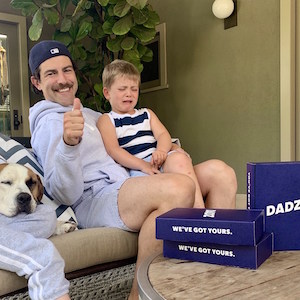
[00:00:10] Ray Latif: Hey everyone, I'm Ray Latif and you're listening to the Top Podcast for the food and beverage industry, Taste Radio. This is Episode 224, which features an interview with Hollywood actor Max Greenfield and Mike entrepreneur Mike Constantiner, the co-founders of Dad's, a new dad-focused consumer products and lifestyle company. Just a reminder to our listeners, if you like what you hear on Taste Radio, please share the podcast with friends and colleagues. And of course, we'd love it if you could review us on the Apple Podcasts app or your listening platform of choice. During our conversation for this episode, Max Greenfield and Mike Constantiner bore the classic signs of dad fatigue. The three-day facial scruff, baseball caps pulled over weary eyes, and a slightly dazed demeanor. As some of us can surely attest, it's a common look for dads of young children. To help manage the day-to-day strain of fatherhood, Max, an actor known for his roles in the television series New Girl and The Neighborhood, and Mike, a veteran CPG entrepreneur, co-founded Dads, a company created to positively benefit the lives of modern dads via performance supplements, personal care, and baby care products. Launched in June, Dad's first product is a plant-based and natural energy supplement powder called the Lightning Stick, which is sold direct to consumer and promoted to optimize for mental clarity and focus. The company has also formed a strategic partnership with Life of Dad, a popular social platform and online community for dads. In the following interview, Nosh editor Carol Ortenberg spoke with Max and Mike about the origins of DADS and their respective roles in the company, how the brand is resonating with target consumers amid the pandemic, and how they address skepticism about the need for a platform focused on DADS.
[00:02:02] Mike Constantiner: Hi everyone, Carol here, and today I'm excited to be joined by Mike Constantiner and Max Greenfield, two of the four co-founders of Dads, an emerging brand creating wellness products for men, particularly dads. Hey guys, thanks so much for being here today.
[00:02:18] Max Greenfield: Thanks for having us.
[00:02:20] Mike Constantiner: So talk to me about why you guys wanted to launch this product. What inspired you to create Dads?
[00:02:29] Max Greenfield: you know, dads these days more than ever are more active and more engaged in their role as dad, right? Especially like the current generations, and that trend is not going anywhere. 62% of men in the United States at some point go on to be dads. And when it comes to kind of parenting products specifically, or even just like consumer products in general, nobody has really spoken to this modern dad, right? And who these people are and what they're doing day in and day out and kind of saying like, hey, like, we recognize you and we're here to support you.
[00:03:03] Mike Constantiner: And where did you see the white space in the market, both in terms of, you know, product type, as well as clearly appealing to dads?
[00:03:12] Max Greenfield: Yeah. So our first product, the Lightning Stick, you know, we call it like, it's a better for dad energy supplement, plant-based, less than a gram of sugar, uses nootropics and adaptogens, you know, kind of taking a lot of these ingredients that come from the like, you know, wellness, the kind of coastal wellness world. We did a focus group with a bunch of dads through the Life of Dad community, which is one of the largest online communities of dads. Through those conversations, these one-hour conversations with all these dads, one of the things that just kind of kept coming up in terms of what they needed or what they're looking for was that they were tired, that they needed more energy. And you would think with all the kind of like, solutions out there that they would find it, but so much of what energy drinks are these days are just crazy amounts of sugar, crazy amounts of caffeine that give you these like very quick, you know, boosts and then major crashes. And, you know, not only with dads, but, you know, at the kind of stage in life when men are having kids, you're also maturing men, right? And those kinds of ingredients are becoming less and less good for you to be taking on a regular basis. So we were like, look, if they want energy, what would that product look like? And through the kind of a few months of research and development, we put together what we launched as the Lightning Stick.
[00:04:29] Mike Constantiner: You mentioned coastal ingredients and trends. Is this a product just for the urban dad? Or are you trying to make a product for all dads? And how did you kind of think about making sure that you were reaching everyone with this item?
[00:04:43] Max Greenfield: Yeah, it's really trying to appeal to like a mass audience of dads. But really specifically, like, we talk a lot about like dads who are who care, who are active, right? And these are dads that do, you know, outside of being dad, they do all kinds of cool stuff, right? Whether it's, you know, through some kind of hobby, whether it's through their profession, whether it's just the energy that they bring to being a father. These are dads who really put a lot of effort into everything they do. And that's kind of who we're going after as our target audience.
[00:05:13] Mike Constantiner: And Max, how did you come to get involved in this project?
[00:05:17] Max Greenfield: I am internationally known as a dad and the universe recognized my efforts and strengths in this category and everyone involved agreed that it was a perfect fit. And then in quarantine, it really is all I do anymore is participate as a father. I have no job anymore or purpose in life other than to shuttle kids around and make food for them and participate in their lives, which are more important than my own or my wife's, nor do they care about our relationship. So I thought I need to somehow turn this into income and a business. And so here we are. I inserted myself into what Mike and Russ had worked very hard on creating. And we've branded me the face. But it's been a really interesting process, you know, to piggyback a little bit on some of the things that Mike has been saying and, you know, with the energy drink, the Lightning Stick and what we're doing. It was interesting. It's like, you know, we did all this research. I shouldn't say we, Mike and Russ had done all this research and they had talked to this large, large community of dads. And of course, every one of them, had said that they were exhausted. And sure, then it makes sense to make this energy drink, specifically one which I'm really excited about, that's healthy and plant-based and not like, oh, why is it neon? And so it sort of lent itself to, oh, okay, well, that makes sense. But as we've gotten out there and really talked about who we are and what we're trying to do and what we're trying to create as a brand, it's lent itself to a really interesting conversation, which has been and one that I can very much relate to specifically in the situation that we're in, which is we want to promote being an active parent in your kid's life. And so much of being a dad, you know, at least my experience with it is you push, you push, you push, you push, you push. You are Responsible or you're trying your best to be responsible to their every needs throughout the day but. you know what about the extra what about like okay well this is my moment to like sit on the couch and it's like well i could be sitting on the couch or we could be out on a bike ride or like you know what we have this week we're not doing anything i mean i guess we could do it here and they could be on their screens and like we'll figure something out or maybe we go out on the road I mean, but it really is. It's just like this idea of what's possible and not only like, you know, being an active parent, but like really excelling in that area.
[00:08:15] Mike Constantiner: Sounds like there's a lot of pressure to constantly be the best dad you can be. And that also seems like something that maybe doesn't get discussed all the time.
[00:08:25] Max Greenfield: Yeah. And I think the truth of the matter is is I think you know that pressure is is self induced. I don't know that it's coming from any place else. It's just it really comes from your own. want to be the best parent you can be. And you know, you see your children, and I'm sure they'll all become like wonderful internet stars. But you know, watching them attached to a, an iPad or some sort of device and devouring TikTok, it eats at you and you go, what else could we be doing right now? And you want that time back, what could I have engaged them in or what could we be doing right now? And I think that's a big part of what we're trying to sell and what we're trying to promote, which is fucking get involved. It seems daunting and tiring as an idea and impossible when you've gotten into a nice groove on the couch or after you've made breakfast and done everything else in the morning and it's 9.30 and you can't believe that it's only 9.30 and a whole day hasn't passed. It's like, all right, now we really start to go and now the day starts for what seems like again. And what are we going to do now? And are we going to, like, coast? Or are we going to, like, try to accomplish some things and try some things and probably fail? But where does that extra come from? Tune in at the end of this episode for an exclusive interview with Matt Lin of Belay Solutions. He sits down with Melissa Traverse to break down the biggest inventory and accounting mistakes CPG founders often make. You'll learn how to bring clarity to your numbers so you can scale with confidence.
[00:10:33] Mike Constantiner: And you guys have partnered with Life of Dad to help dads start this discussion between them. Do you think right now it's hard for men to talk about parenting struggles? Do they have a place to do that as much as maybe moms have a place to do that?
[00:10:49] Max Greenfield: We're not allowed. Dads are not allowed.
[00:10:53] Mike Constantiner: But it sounds like you want to give them permission to do that.
[00:10:56] Max Greenfield: No, that'd be a trick. No, one of the things that we've found has been, you know, we've opened this up to the Life of Dad community and just basically anybody, any fathers, and really there's been like a lot of moms who have joined the conversations as well. And the willingness of everyone to open up and talk about, you know, there's just a struggle of being a parent in general. And again, specifically in the time that we're in right now, is something very needed, I think. I think a lot of people feel really alone right now in being a parent and feel often that it's an impossible job. I think they feel like, oh my god, do I not like my kids anymore because I've spent the last seven million hours with them. And like, I don't, I don't understand when a break is going to happen, but the willingness of people to sort of open up and not feel so alone and discuss these things, you know, look, parenting is not something that is done perfectly by anyone. And so I think, The ability and willingness to talk about it and talk about it honestly and to share our experience with it is really needed.
[00:12:22] Mike Constantiner: So I will admit, I ran this past a couple of my friends who are moms, and they were like, ugh, dads, they don't need help. So what do you say to moms who kind of roll their eyes at the thought that dads need more support when there's a lot of discussion right now, especially during the pandemic, about moms needing support and how women will be leaving the workforce in increasing numbers if we can't get school back. How do you kind of marry these two needs and questions together?
[00:12:54] Max Greenfield: Sure. Well, one, we're certainly not asking for support or throwing up our hands and saying, please consider us. But I do think there's a narrative where, you know, the energy drink is not the end all be all of what we're trying to do. And what we'd like to eventually create down the line and success would be a dad centric children's line, you know, where we have diapers and when we have wipes and hopefully use that as a way to incentivize fathers to go to the store. I mean, the tagline somewhat being, and I'm just making this up now, being like, send him. You know, and I think, like, we are seeing this shift. I mean, maybe it's in my household. It wasn't really a shift. It's just always been this way. But we are seeing a shift of fathers and men being way more proactive. And forget, like, what we typically think of as, you know, what a mother does and what a father does, just as a parent. And like, you know, going to the store, making breakfast, getting the lunches ready. I hope my wife isn't listening. But like, I do a lot. I do. I percentage wise. I do. I mean, she looks she definitely organizes things in a way that I could never scheduling. I don't even touch it. But man, I make a lot of lunches and I go to the store. And like I think we really want to I think it's a fun way and a real way we hope to sort of level that that workload which is typically been done by a mother.
[00:14:50] Mike Constantiner: I like how you mentioned the new generation of dads. I was reading another article with you guys and Mike, I think you talked about the fact that dads geek out over dad purchases now and it's cool to be excited about something you bought for your kids. I had a friend who recently was like bragging on Instagram about his new diaper bag that he was really excited by. Tell me what you found kind of about how dads talk about parenting now, Mike.
[00:15:18] Max Greenfield: I think it's like, you know, guys in general, maybe have a little bit more of like a competitive nature to them, right? In like a fun way, right? And then maybe that roots in the background of a lot of sports or whatever. But it's kind of this like demonstration of like, hey, like I'm I'm being a better dad, right? And like, look at the fun stuff that I'm doing with my kid. And it's not like a real competition, but I think it's just this like, idea of like, molding the kid, right? I'm like, I'm instilling these like themes and these ideals and these lessons in the kid, and doing it in a fun way, right? A lot of times it's more physical. A lot of times it's more like hands on and like tools and things come into play, where it's interactive with the kid. And so I think, you know, you think about guys and gear, right? And like all their tools and like, how many guys, you know, that have like craftsmen tool set and they never use it, right? But it's just the idea that they have this kind of tool set. And I think it's playing into a little bit of that stuff that we want to tap into as we develop products down the road.
[00:16:18] Mike Constantiner: Mike, you're also an investor in emerging brands. If you were evaluating this company as an outside investor, what about this business would be appealing to you? What would make you say, yeah, I want to place some capital here. This is a great bet to make.
[00:16:34] Max Greenfield: Yeah, when we were starting the company, we kind of were like, this is the things that we have to do. And it's the same thing that I think about when I'm investing in a company. You know, one of them is, you know, especially right now, like directed consumer CPG is very hard to launch companies. I think there's a lot of like, these like crazy expectations based on like, unicorn type stories, the glossaries, whatever. And that the reality of that is just like, you know, most success stories don't happen like that. But there are ways that you can at least give yourself a good head start or a good foundation to build yourself off of. One, of course, is the founding team. And I can't really speak too much of that because of the bias in it. But I've been an entrepreneur for 11 years. Russ has been an entrepreneur founding team member for also something like 11 years. Previously was at Hello Bello, which is obviously a parenting company. and was running the supply chain biz dev logistics. And then Dan comes from a performance marketing background, has sold a couple of his own companies in that space. So then you kind of look at the team, and then you want to look at the addressable market, right? So 62% of men go on to become dads, men in general, huge audience regardless, right? So there's something really there. the product categories, supplements and vitamins, personal care, baby care, all huge opportunities. And then CPG companies, what you also kind of want to look at is what is like their shortcut basically on day one that they have, right? And a lot of times, well, sorry, not a lot of times, but rarely in very special situations that they have some kind of distribution with a major retailer locked in, or they have some kind of like partnership with a built-in network or, you know, like in the Glossier case, Emily brought a huge following with her. So with dads, we, you know, we have this Life of Dad partnership, which is a huge community of, Their Facebook group has three and a half million dads. Their Instagram has 270,000 followers. Yeah, three and a half million dads. And that's one of their many Facebook groups. And then of course, partnering with Max was a huge part of that foundation, right? Max has an extremely awesome, loyal fan base. Max is really like the epitome of what we kind of like think of as like the modern dad and was creating a lot of amazing content around that, you know, the onset of COVID with the homeschooling videos with his daughter. So the combination of those things is what, you know, we really said, like, we have to have these kinds of things in place to actually give this a shot, you know, from my, my last company that started and actually failed, we started with nothing besides a cool brand and a product on day one. We had no audience and it was really, really hard to build a following. And so we've been able to jump a few steps. We're a month in and things are so far so good because of those things that we laid at the foundation.
[00:19:31] Mike Constantiner: You mentioned having experience with a startup that ultimately didn't work out. Is there anything you wanted to make sure you didn't do this time around? Words of advice to entrepreneurs who are maybe listening to this that they should try to avoid doing.
[00:19:45] Max Greenfield: I mean, if you're doing like CPG or direct to consumer, like, yeah, make sure you have that kind of like what your differentiator, your moat is as a, as a company, right? Whether that's a dish, like I said, like a distribution thing, a partnership with some existing platform, or that you bring your own audience day one. Do you want more repeat buyers on Amazon? Well, this free resource in collaboration with Straight Up Growth will help your brand turn first-time buyers into long-term subscribers. Download Winning the Repeat Purchase Game on Amazon now at Taste Radio.com slash SUG. That's Taste Radio.com slash S-U-G to start building retention-driven growth for your brand on Amazon. Scaling a beverage brand into major retail comes down to operational readiness. From packaging lead times to co-manufacturing strategy, the details can make or break a launch. In a new ebook in collaboration with Octopi and Asahi Beer USA, industry leaders share what they've learned in helping brands scale. Download it now at Taste Radio.com slash octopi. Do you need to scale your team faster without compromising on talent? Join Oceans for a live webinar on April 20th and learn how leading companies are hiring top global professionals who are ready to grow with your business. Register for the webinar now at Taste Radio.com slash oceans. That's Taste Radio.com slash oceans.
[00:21:15] Mike Constantiner: It's interesting you mentioned DTC, that is really popular right now. And I personally am getting pitched so many brands telling me that they're launching their own platforms. And it's, you're right, it's harder to do well than a lot of people realize.
[00:21:32] Max Greenfield: Yeah, I mean, the economics are so challenging, right? Customer acquisition costs have become, you know, let's see, like, you know, five, six years ago, maybe, right? Like, it was really cheap to buy customers off Facebook and Instagram. It's become more competitive, more expensive to do that. you know, these kind of like tech firms that were coming in and investing in DTC brands had got smart really quick over the last few years because, you know, they realized that they were basically subsidizing this business's growth. And that, you know, really just doesn't work the same way as it does with like with software. And so those have disappeared. So it's become extremely hard to launch like CPG, D2C, especially if you're doing D2C only, it's really challenging, the economics are very difficult. Especially if your product, like my last company, we were selling, our main product was toothpaste, right? And the average order value was just over $10. So you think about how many times a person has to buy, so we break even on the cost that it took us to get them as a customer. Stuff to think about that I think a lot of people are just like, oh, well, I see these other companies do it and I'll figure it out. And I don't think that's really, five years ago maybe, but not today.
[00:22:37] Mike Constantiner: You mentioned social media. Max, you have quite a robust social media following. How are you guys thinking about integrating social media into your marketing plan in kind of a way that feels authentic and natural to all of you?
[00:22:55] Max Greenfield: Yeah, I think you hit it on the head, which is authenticity and sort of an organic integration. It's been interesting in launching and doing a lot of the press for the brand. And it's shown us, like, I think, the direction that We're going in and we really want to take it. So I think understanding all that information is really helpful so that when we do do it, when we do start to really produce content for it, that it's the right content and it is exactly what you said, organic and appropriate and sending the message that we are honing in on now.
[00:23:34] Mike Constantiner: Have there been any key takeaways from starting to ramp up this press that have really resonated with you?
[00:23:43] Max Greenfield: You know, when you talk about the brand a lot and you're asked, you know, a myriad of different questions by different people, you start to really see things differently and discover what it is you're exactly selling. You know, we know we have a good product and the energy drink's great, but what is it that we're trying to put out into the world and what's the story of this company? And I think it went from, you know, we have this great energy drink that we hope, you know, that we're marketing towards dads because dads are tired and we want to get them up. And I think that was sort of like the feeling behind it when before launch and then talking about it really became more like, no, I think we really should be talking about like excelling to the best of our abilities and what's possible as a dad.
[00:24:37] Mike Constantiner: So guys, thinking about how much more you can do, if you had a crystal ball and you could peer into the future, where do you want to see this company going in five years? How do you want to see it grow up?
[00:24:49] Max Greenfield: on the business side of things, right? I think we have, like Max just touched upon, this idea that we really have the opportunity to make a real positive impact on the lives of not just dads, but families, you know, the United States or internationally, right, through products that support the idea of being a parent and being a good parent. And, you know, however, that kind of takes place in terms of like rolling out through our distribution and the products we introduce. Our main goal is really just to like support parenting, support dads. And of course, what that turns into is just the next generation is going to be better off. One of the things that constantly came back to us during the launch and doing so much press was there really isn't a baby-centric or child-centric product line that is marketed towards dads. And the majority of people who sort of wrap their head around that were really excited about that idea, as are we. And to me, you know, I mean, there's, look, there's certainly like boy products out there. You know, you can buy Spider-Man. diapers. But this idea of those products being marketed towards fathers might give them the initiative to go out and be the one who's actually purchasing them. And to me that type of impact could be one that I think is really exciting. And this idea of shifting the norm where, you know, it's typically the mom, for whatever reason, has been the mom's responsibility to go out and be the one that brings those products home. And we're like, Fuck it, have him be the dad. Go out and get it yourself. Let's send him. That's the line. And happily so, because I think once you do, I know if it was me and I was walking down the aisle at Walmart, I'd be like, Do I get those or do I get these ones with, let's say, dads on it? That sounds fun. And then all of a sudden you're bringing home this product line and it's a fun way of integrating and making it a more communal experience, the parenting experience more communal.
[00:27:18] Mike Constantiner: Well, I think that's an exciting vision for the company and where it can go. And thank you guys so much for joining me today.
[00:27:23] Max Greenfield: Thanks, Carol. Thanks, Carol.
[00:27:30] Ray Latif: That brings us to the end of Episode 224. Thank you so much for listening and thanks to our guests, Max Greenfield and Mike Constantiner. As always, for questions, comments, ideas for future podcasts, please send us an email to ask at Taste Radio.com. On behalf of the entire Taste Radio team, thank you for listening, and we'll talk to you next time.
[00:28:02] Carol Ortenberg: Hello, I am Melissa Traverse here for the Taste Radio podcast, talking about some of the biggest tension points that CPG brands and founders face when they're scaling a brand, and those are financial accounting and inventory management. I am joined by Matt Lynn, inventory accounting guru from Belay Solutions, and he is going to shed some light on all of this that is going to help everybody out quite a bit. Matt, thank you so much for joining us today.
[00:28:32] New Girl: Thank you for having us, Melissa. It's great to be out here at Expo West and it's great to sit down and be able to chat this because it's kind of a passion project of ours, working mainly with CPG brands and hoping to help them scale.
[00:28:43] Carol Ortenberg: It's been such a pleasure chatting with you and the team and learning all about what you do over there at Belay Solutions. Can you tell us a little bit about yourself and what your role is and the kinds of solutions that Belay gives to CPG brands and founders?
[00:28:59] New Girl: Yeah, absolutely. My role with Belay, I'm actually our inventory accounting manager. I run our inventory department, so we work with CPG brands, taking them from spreadsheets, putting them on inventory management systems, and really helping connect their tech stack between their sales online marketplaces to that inventory management system, even down to their financial systems like QuickBooks. But Lay overall is kind of an outsourced accounting firm. And with that, we're helping teams. We have different levels with bookkeeping, controller level work, even high level into CFO type items. So we really help those brands in any way that they need financially. And then I just have a subset of a department where we're really just laser focused on inventory.
[00:29:42] Carol Ortenberg: It's certainly a complex topic and there are plenty of places to go wrong. Let's start by going right and start super simple. Can you tell us what some of the biggest red flags are that would help a founder understand or, you know, the person running a brand understand that it really is time to get some help with some of these areas?
[00:30:02] New Girl: Yeah, absolutely. I think some of the early red flags is just everything is chaos. So when they're looking in their financial software, maybe they don't really have an accounting background, and they're kind of just piecing it together and doing their best. And what they'll see is that reconciliations take forever, if they even happen. They have a lot of transactions that don't get coded, or they just put them into placeholders to just get rid of it so it's not an eyesore. they'll notice they have revenue but no cash or they notice that they have a good amount of cash but their blind spot is really seeing the vendor invoices that are sitting there just needing to be paid and so they just lack that clarity that's going to really be around the corner.
[00:30:40] Carol Ortenberg: You know, you were talking about one of the red flags that comes up that I think makes so much sense. When somebody asks you what your numbers are and you can't come up with the right number, that's a big problem because that's something that you really should be able to share with decision makers who you're ideally looking to do business with. What should you be able to call up at a moment's notice?
[00:31:04] New Girl: Really at any time, you should be able to know an accurate margin. It's amazing how many founders we end up talking to that they can tell you their revenue numbers, they can tell you their selling price, and then the minute you start talking about cost or their cost of goods sold, they just get a deer in headlights look. So really it's very hard to tell, am I even making money? or if you don't know your entire landed cost. Maybe you know what the freight cost is, the duties separately, but you're not really getting that as part of your unit cost. So it's really hard to tell. Am I even making money or am I losing money from the very beginning?
[00:31:37] Carol Ortenberg: And do you recommend that founders are able to call up a margin by channel?
[00:31:42] New Girl: Absolutely. And depending on the number of products and channels, you kind of want to know what are your best sellers, which ones are making the most and which ones maybe you're not making as much. But especially if you're branching out and you're doing D to C with B to B, absolutely want to know that.
[00:31:58] Carol Ortenberg: Gotcha. You mentioned that when things feel really chaotic, that's probably a red flag. I would say that it probably almost always feels chaotic if you're running a CVG brand. And I know this may be hard to quantify, but is there a revenue number? Is there a number of doors number that would help a brand understand whether or not it makes sense to bring on a partner like Belait? Understanding that so many brands are bootstrapped or they might be tight for cash. What is that friction point?
[00:32:29] New Girl: 3 3 3 3 3 But as you're growing, as you're getting to those six-figure revenue numbers, and especially as you're approaching seven, you want to make sure you've got good financials. Because as you scale to that point, most likely you're going to be looking to raise capital. And investors, the first thing they're going to look at is your books. And are they clean? And do they show a clear picture of your business?
[00:33:02] Carol Ortenberg: You know, another area that folks might look to to organize some of the chaos are their systems. So many folks stick with Excel spreadsheets for a good amount of time. How do you know that you need to outsource some of your accounting to an organization like Belay Solutions versus maybe signing on to a Synth7 or NetSuite or something like that?
[00:33:24] New Girl: Well, that's actually something we really help with when it comes to that cost question. That's something that trips people up. And sometimes if you just have a turnkey business, you buy and sell a finished good, you can maintain with spreadsheets. And we've had clients with million dollar revenue that can do that. But we see so many brands nowadays are using contract manufacturers. and they're just sourcing certain parts of their product. So when you start talking cost, they have no idea exactly what their unit cost is. So that's where we come in and we kind of understand, we'll speak with the customers and the clients and get their needs. And then if we think they're ready for a system, then we'll help put them on that system so they can get some of that clarity. And it's not something we force on anybody. There are plenty of times where founders come to us and we'll tell them bluntly, you're not ready for it right now, but we'll let you know when we think you are.
[00:34:10] Carol Ortenberg: That sounds like excellent advice. What should a founder or somebody running a brand look for in an outsourced accounting partner? Are there certain checklist items that they should make sure that their partner be able to execute or be able to help them understand?
[00:34:27] New Girl: Absolutely. I think one of the keys there's, there's a lot of outsourced accounting firms out there. Some focus on service-based SaaS companies, but if you're a CPG founder, you really want to make sure that your accounting firm has CPG experience. I would ask them, you know, what kind of brands have they worked with? And even beyond that industry specific, because there's so many subsets of CPG. And that's something that I think is great about what we do with Belay is that we kind of run the gamut. It's kind of like the insurance commercial. We know a thing or two because we've seen a thing or two across a broad spectrum.
[00:34:57] Carol Ortenberg: Probably getting references is always helpful, right? Absolutely. All right. So this all sounds great. I think we have a really good understanding of would it make sense to hire an outsourced partner? You know, what some of the things you should be looking for are. What does offloading this kind of work mean for the brand? What can this do for lightening the load of a founder or lightening the load of a brand operator? Like, how does that help them in their everyday business?
[00:35:26] New Girl: It just tries to really help quiet the chaos. So what we're looking to do is just take some of the weight off that founder's shoulder. Let them focus on building the brand, building the business, getting that exposure. If you don't have sales, you really don't have anything. So we want them to be able to focus on that while we take care of your back-end office work. And we can just present that to you on a monthly basis. You can help make decisions. You can take that to investors. And really, you can just focus on growing your business.
[00:35:52] Carol Ortenberg: I feel like I felt founders and the folks who are running brands collectively sigh. A breath of relief just hearing that. How can people learn more about Belay Solutions?
[00:36:03] New Girl: So people can text TASTE to 55123 for their free inventory guide to get started.
[00:36:08] Carol Ortenberg: Matt Lin, Inventory Accounting Guru at Belay Solutions. Thank you so much for joining me here at Expo West. It's been such a pleasure to chat with you and learn about what you all do over there to help founders and brands with their financial accounting and inventory management. For everybody else out there, thank you for listening to the Taste Radio podcast. I am Melissa Traverse and we'll see you next time.