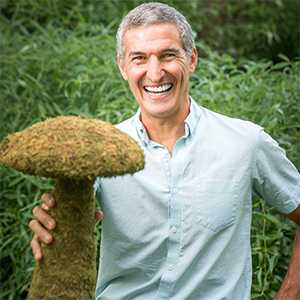
[00:00:10] Ray Latif: Hey everyone, I'm Ray Latif and you're listening to the Top Podcast for The Good and beverage industry, Taste Radio. This episode features an interview with Honest Tea co-founder Seth Goldman, whose latest venture, Eat The Change, is keeping him steeped in the business of better-for-you food. Just a reminder to our listeners, if you like what you hear on Taste Radio, please share the podcast with friends and colleagues. And of course, we would love it if you could review us on the Apple Podcasts app or your listening platform of choice. How do you affect sustainable change in The Good system? If you're Seth Goldman, you begin with tea and continue with mushrooms. As the co-founder of Honest Tea and Chair Of The Board of Beyond Meat, Seth has played a key role in democratizing access to organic beverages and plant-based meat. His newest company, Eat The Change, is a mission-driven platform designed to give people, quote, daily actionable choices that make a difference via chef-crafted, planet-friendly snacks. Last month, Eat The Change launched its first products, a line of organic mushroom jerky created by co-founder and celebrity chef Spike Mendelsohn, who is also Seth's partner in Plant Burger, a Chair Of plant-based, quick-service restaurants. In an interview featured on social media platform Clubhouse and recorded for this episode, Seth discussed how Eat The Change fits into the context of his career, why he and Spike chose Mushroom Jerky for the company's inaugural product line, and how they plan to communicate the brand's mission and product attributes to mainstream consumers. He also addressed claims of Beyond Meat's products as being overly processed, the evolution of Honest Tea as a Coca-Cola-owned brand, and why he eats Pringles from time to time. I'm Ray Latif, the editor and producer of Bevinette's Taste Radio podcast. I'm with John Craven, Bevinette's CEO, Mike Schneider, Bevinette's CMO, and Jacqui Brugliera, our marketing manager. And we are once again honored to be with Seth Goldman, the co-founder of Honest Eat The Chair Of The Board at Beyond Meat, and the co-founder of Eat The Change. Once again, Seth, thanks for being with us today.
[00:02:25] Seth Goldman: Thank you guys. It feels like an old family reunion here.
[00:02:30] Ray Latif: It definitely does. It definitely does. I gotta start out by saying that it's really good to hear your voice and I can feel you smiling through the microphone. You're always smiling.
[00:02:40] Seth Goldman: You're always smiling. Not always, not always, but you know, it is a hopeful time. I mean, you know, thinking about where we've all been collectively over the past year, it just feels, I actually just got my second COVID shot today. So it's like, I feel like we're around the corner.
[00:02:58] Ray Latif: Congratulations. Yeah, that's awesome. Throughout your career, I mean, what makes you angry?
[00:03:06] Seth Goldman: Oh yeah, look, you guys know, these early stage companies are brutal. You've got people who take advantage of you, who don't pay you. That certainly doesn't help when you're trying to launch a business. And to me, that's a lack of integrity. You know, that gets me mad. And the other thing, I mean, thinking about the past year, it's been a stressful year. There's been such divisive, rhetoric in our country, which is, that makes me angry. You know, I'm not taking sides either way, but just, well, I am taking sides, but we don't need to go there. But, you know, to have such divisive language in a country which was really founded on this idea that we can all bring diverse people together and may not agree on everything, but, you know, build a better society, you have to have some level of tolerance. And I just saw that eroded this past year. And that was, that was hard to see.
[00:03:59] Ray Latif: When you are a person such as yourself who is an agent of change, so to speak, I can imagine that when people are trying to turn back the clock, I guess, on things that you have championed over you, it can be pretty frustrating.
[00:04:16] Seth Goldman: Yeah. Yeah, that's for sure. And I will say the one thing that has continuously made me hopeful is what we're seeing around climate change and recognition of our diets. The clock isn't being turned back there. I mean, this is now, the train is leaving the station or The Board is getting unstuck out of the Suez Canal. We're moving forward. And so that's a hopeful moment. I've been at this for more than two decades and there certainly have been times where you feel like, People don't Eat The memo, they don't understand, and now they do. So that's a good reason to be hopeful too.
[00:04:48] Ray Latif: For sure, for sure. Well, I really appreciate that positive attitude. It makes me feel so much better. It really does, Seth. Thank you. So let's talk about Eat The Change. I had an opportunity to sit down with you a week ago in a virtual seminar talking about Eat The brand is all about, what your mission is, but I wouldn't do it justice the way you would. So tell us, what is Eat The Change and what do you guys want to accomplish with the brand?
[00:05:10] Seth Goldman: Yeah, it's a multifaceted approach to a critical problem. The problem is that our diets are the single biggest driver we have on a daily basis of climate change. Yes, you know, yes, we drive cars and fly in airplanes, but we don't buy cars every day. We don't fly airplanes every day. But we eat every day and every day we have the choice and the chance to make different choices and choices that are better for the environment. And so Eat The Change is really a call to action. It's a call to empower people that what they choose to eat can make a difference. And then it's offering foods that make that difference. Obviously, the product line, the mushroom jerky, as you mentioned it, is one of the offerings that makes sense. But, you know, it's even the restaurant, we've got Plant Burger, is really part of an approach. It's making plant-based food delicious and accessible and available. And then we have a grant program under Eat The Change where we're donating, this year we'll donate over $500,000 to non-profits that are helping organizations, community non-profits, democratize planet-friendly food. and make people more aware of these choices and make it easier for them to access these choices. So we're trying to go after it. You know, I hope that ultimately it's a movement. And so with a movement, you know, you've got to have multiple players. You can't just have a company, certainly, and you can't just have nonprofits.
[00:06:28] Ray Latif: Absolutely. You know, one of the things that kind of surprised me, however, was the story about how it got started, because the brand has its roots in a fast, casual chain that you co-founded called Plant Burger. That's how you met your co-founder. Can you talk about that?
[00:06:45] Seth Goldman: Yeah, so boy, I guess at least five years ago or more, I spoke at a conference in D.C. at George Washington University, and Spike Mendelsohn, the celebrity chef, was there. And like any good salesman, I brought along a case of a cooler bag, and in the cooler bag, I had a few bottles of Honest Tea and some Beyond Burgers. And I was trying to, you know, hey, I got to sell this guy on my product. And so I snuck the cooler bag under Spike's chair, and then we spoke afterward. Because he and his family own some restaurant concepts in D.C. One was called The Good Stuff Eatery, which is a renowned burger place. It was where when President Obama was president, he and his wife used to go The Good Stuff Eatery all the time to grab a burger. And so I thought that'd be a fun place to have Beyond Meat sold. So Spike took those It turns out he already carried Honest Tea, so that wasn't—I mean, I guess it was just a reinforcement sale. But the burgers he loved, and his wife, who's vegan, which I didn't know, she really loved them. He came back to me and said, hey, we should launch a restaurant concept. And we walked around. We had lunch together. We walked around downtown Bethesda. We looked at some sites just to see what would work. And as I'm walking around, I'm like, oh, man. I don't know anything about restaurants. I've never been. And all I hear, all I see, because Bethesda is a real proving ground for restaurants, is I see these guys launch concepts and go out of business. And so I said, well, I'd love to explore that with you, but I'm not ready to sign a lease. But I'm friendly with the folks at Whole Foods. Let's approach them. They have something called a friends program. where you can basically stand up a restaurant inside the store. And that felt like a much lighter way to do it. So we got the opportunity to launch a restaurant in Silver Spring. And as we're putting those plans together, we realized we need some marketing help. Because I'm obviously still involved in Honest Tea and Beyond Meat, and I'm not able to really join the business full time. So I managed to convince one of our sons to come and head up the marketing for this. And so we had a son. We have a son. name Jonah, who had been doing some marketing in Israel for a sustainable packaging company. And Jonah's just really creative. He came back to Bethesda and is still running the marketing at Plant Burger, but he came up with this phrase, Eat The change you wish to see in the world, which is really a play on a phrase that's attributed to Gandhi about, you know, be the change you wish to see in the world. And I just love that phrase and immediately felt like that's a brand. And then then the next question is, how do you create a product line that fits it? And so that's where Spike and I started playing around with ideas. And of course, we had visit. We worked with a mushroom supplier. because of plant burger and that's where on a Tip Top the mushroom farm we realized that there were so many different directions we could go with mushrooms. And then just one last comment that for me gave me a measure of confidence. I had to make sure I was launching a business that wasn't going to create a conflict of interest with Beyond Meat. And as you know, Beyond Meat has the potential to go in so many directions. We've announced this partnership with Pepsi, which has the potential to be other extensions. And so The one area I knew Beyond Meat wasn't likely to go into was selling food in its native form. Beyond Meat is about working with plant proteins to create analogs to animal-based products. So one of the guardrails we have at Eat The Change is we're selling food in its native form. So when you look at our jerky, you'll see mushrooms and it's flavored and smoked, but it's not in a different form.
[00:10:11] Ray Latif: It's not in a different form, but it's still something that isn't necessarily that intuitive to some folks.
[00:10:17] Seth Goldman: Oh, yeah. Yeah. But the point is you can recognize it as a mushroom. It's like, you know, by the time obviously you look at a plant, a Beyond Burger, you don't say, oh, those are peas, right? Exactly. Yeah.
[00:10:28] Beyond Meat: Yeah. And so you're leading with mushrooms. And how did you make that decision? Because I know mushrooms can be kind of divisive.
[00:10:35] Seth Goldman: Oh, not anymore. Mushrooms.
[00:10:38] Beyond Meat: It's definitely, definitely, you know, a trendy, trendy, trendy product.
[00:10:43] Seth Goldman: It is. No, so here's a fun story here. I've been, you know, when organics was getting, Going early on, this goes back more than 15 years, I was on The Board of Pennsylvania Certified Organic, which is the certifier that Honest Tea works with, and of course Eat The Change works with. And this is a—it's really a nonprofit in Pennsylvania. And one of the fellow board members was a woman who worked with an organic mushroom farm. And they were having a really hard time getting organic certification because the USDA certification looks at plants and animals. Well, it turns out mushrooms aren't plants or animals. They're their own classification of their own kingdom. It's the fungi kingdom. And so I got to know her and learn more about mushrooms. And so that, like I said, 15 years ago, we just had that curiosity. And then I kept reading about mushroom, the healthy properties of mushrooms and the environmental properties of mushrooms and sort of reading books and, you know, hearing folks like Paul Stamets, who I was just talking to earlier today, talk about how mushrooms can stop bee colony collapse and how mushrooms can even be involved in addressing oil spills and sort of curing the land. and just realize this is an ingredient we want to be part of. And of course, what we've seen over the past year, as you all know, people are seeking out immunity related or immunity attributable ingredients. And then for Spike, our chefs, mushrooms are like the ultimate ingredient because they're a blank canvas and they take on flavor. And so, you know, it's like the perfect canvas for an artist to paint and Spike is an artist. And then that what really Topped it off was we found a smokehouse we could work with, one that works with beef jerky. And what we were able to do was use hickory wood to really smoke. I mean, obviously there's liquid smoke out there, but if you're really creating a crafted product, when you can put hickory wood, it just gives it a totally different taste.
[00:12:36] Ray Latif: So this is surprised me actually, because I feel like you've been involved in so many brands over the years that I thought you would have co-founded several, but this is only your second CPG brand, right?
[00:12:47] Seth Goldman: Well, as a co-founder, yeah, but you know, look, so Honesty, obviously that was 20 years of time with that. a founding board member of Happy Baby and certainly helped Shazi and Jessica really grow from the earliest, you know, sort of. To me, if you're involved with a business before it's doing a million dollars, you may not have the title of co-founder, but you could be involved. So I was involved with Happy Baby. I joined Beyond Meat when it was doing under a million dollars in sales and really worked intensely with Ethan and the team to grow that. I certainly feel a sense of ownership and pride over those enterprises as well, but no, partially because I've spent so long with Honest Tea. This is the second brand, well, aside from Plant Burger, where I can say I guess I'm a CPG co-founder.
[00:13:37] Ray Latif: Yeah, I mean, that was interesting to me. I mean, going back to Beyond Meat for a second, you were with Beyond Meat before it was doing a million dollars in sales?
[00:13:45] Seth Goldman: Yeah, yeah. Wow. Early on. They had this chicken strip they had developed. They had used it in food service. And it was it was OK. But, you know, just to give you a sense of how good it was, we don't sell it anymore. Eat The Change is a really interesting name for a brand. There's a lot of things you could play on. You were talking about bees before and I could just see a slash through the eat and putting a bee on top of it. I think 20 years ago you couldn't have done this because you'd find a lot of people with coins in their bellies because you know everyone trusts you. You obviously like brands that are plays on words. Honesty is a play on honesty, and Eat The Change has a Be the Change sort of play there. What are some of the parallels to building the Honesty brand that you see in building the Eat The Change brand? What are some of the big differences? Yeah, you know, food versus beverage. Sure. So one of them is authenticity, right? I mean, hopefully that's underlying all the companies I'm involved in because food is about, you know, one of the things Spike says that I love is that food is the only drink, food and beverage are the only experiences we have as humans that tap all five of our senses. Right. You can watch a movie. You can see some art. Food is the only one that incorporates all five senses. And so to me transparency and authenticity are just critical. And so that means that you have to create brands people trust. And so you have to be transparent about how you're sourcing it who you're sourcing it from. You have to to the extent you can share their story and share the landscape and let people feel like they they're connected to it because ultimately we're asking people to do something that requires a great deal of trust is we're asking them to put our product in their body. And there aren't many other things that get more trustworthy than that. So we have to earn that trust. And so I think that to me underlies both of these brands. Obviously, the other things are that commitment to organic, we're sourcing in a way that we think has the least impact on the planet, then telling a story and hopefully inspiring people through the way we Eat The way we package this product and deliver it to them, to aspire to something they can feel good about. One of the big differences, and this is what I have to say, kind of like finally, is this product is just physically a different product. So Honest Tea, heavy, mostly liquid, usually in glass in terms of how it's shipped. Beyond Meat, cold chain. And so we've had a lot of fun here. We need to change as we start to get e-commerce going. To have these pouches we can just throw in an envelope and not worry about it getting banged around. So that's going to be an approach, especially as e-commerce becomes a bigger part of business. We feel really good about that aspect of it. The other piece, you know, a lot of other differences, just the way the whole, obviously the The difference 20 years makes in terms of knowledge and networks and contacts. I mean, we've already sold. We're in our first quarter of business with Eat The Change, but we sold more than Honest Tea has sold in its entire first year. So that just comes with knowing how to build a business.
[00:16:53] Ray Latif: It also comes with the understanding, I mean, as you mentioned before, mushrooms are becoming a little bit more of a, what would you call, I mean, it's its own kind of product. It's not a vegetable, it's not a fruit.
[00:17:04] Seth Goldman: It's a kingdom. It's its own kingdom of plants. It's its own kingdom of, it's neither. So they're fascinating. Mushrooms, first of all, there's literally millions of species of mushrooms. We only know several hundred thousand. So it's like a whole unexplored world. But they also, mushrooms just have amazing, their nutrients are different. They have nutrients that are more, some that you can't get in plants, like B2 and B3, riboflavin and niacin, that you find more in animal-based products. So they're just, I could go on and on. They're a really exciting category.
[00:17:39] Ray Latif: Yeah, your team sent over a bunch of the flavors, and I wanted to get into that because you can hear Mike in the background. I'm going to open his package. It's so good.
[00:17:46] Seth Goldman: Thank you. Thank you. That's Spike at work. That's when you get a chef as a co-founder. He doesn't just go with the spicy or the barbecue. He's like, no, this is what a chef does. And so he came up with these great recipes. But then I put an additional challenge on. I said to him, we've got this brand to change. We need to do something on biodiversity. But what's the right form? How do you incorporate biodiversity into food because you can say, oh, we're going to donate money to some nonprofits, but that's not a proactive approach. And so as I was learning more about, you know, studying on food, I realized I read there was six crops that account for 57% of all agricultural output and their corn, soy, wheat, potatoes, rice, and sugar. So I said to Spike, all right, can we make these recipes without any of those ingredients? And first, Spike's like, well, wait a minute. Those are like in everything. And then he's like, you know what? This is like the top chef when they give you the mystery box. He said, yeah, yeah. So that actually helped shape. And then, of course, you know, here he is with he's got a teriyaki ginger and he's got to make that without soy, which he was able to do. So part of it was we had these fun recipes, and I told him, like, make the best possible jerky you can. Don't worry about how to scale it. Just make it. Then, you know, we'll eventually figure out. And what's so neat is he came up with the recipes, but we actually, when we went to the smokehouse, it got even better. Like, he couldn't create that smoky taste in our own kitchen. And so it was kind of, it kind of got even better than what a, you know, a world-class chef could make in a kitchen using any ingredient.
[00:19:22] Honest Tea: You standardized, I think, well, at Eat The skews that I have in front of me, which are hickory smokehouse and habanero barbecue, and I've eaten almost all of it.
[00:19:29] Seth Goldman: Can't stop eating it. You're using portobello mushrooms. And cremini, portobello and cremini, yeah. And cremini and portobello mushrooms. And I guess the question is, have you thought about You know, if as these become more and more successful, have you thought about functional mushrooms as well? Yeah, so here's the interesting thing. So first of all, by the way, portobello and cremini are the same mushroom, it's just different sizes, different sort of stages of size. And so from our point of view, we wanted to, we told our supplier, like we want all the portobello and cremini that don't fit those little cups you sell in the retail, which means we could take all the oversized and undersized in their stems too. And the reason we chose those is because those are them, aside from like white button mushrooms, those are mushrooms everybody knows, the portobello. And the reason that was important is because, you know, like you say, not everybody's a mushroom person. And so we just wanted to pick you know, what really is the most popular type of mushroom. But, you know, we have looked at shiitake as a way to go. Once you get into the functional ones, they're just much more expensive. And of course, not at scale for the size we need. And that's, you know, like any good startup, we've got to make sure we have the ability to scale this. So for us, for right now, portobello and the cremini feel like the right place to start. But, you know, we can definitely see us doing more specialty mushrooms, because some of them just taste amazing. I mean, even the shiitake has a little more of an umami note to it that you could get. So yeah, we could go into some deeper action. Of course, it'd be more expensive. And that's the only other- It was kind of a trick question, Seth, because the hallmark of any great startup is focus, right? Yeah, that's right. No, that's true.
[00:21:12] Beyond Meat: So, I mean, we've been talking about mushrooms a lot, and is this a mushroom-based brand, or what do you see going forward as other ingredients?
[00:21:20] Seth Goldman: No, that's a good question. Well, mushrooms are a great place to start because they are the proof of concept about what this brand is. But you're you're right to ask it because no we won't exclusively be a mushroom based brand. I mean it's just like with honesty like the glass bottle in the you know in the natural channel with the minimal sweetener was a great place to start because it put up this mark of credibility. And once you build that and demonstrate number one that it sells and that it's the real thing and it's authentic. Then you can do extensions and like we did with Honest Tea brought up more of the just a tad sweet or we went into honest kids. You know you could which weren't tea at all. So you can expand. And so with us mushrooms is where we're starting in the jerky. We have to make work. So I don't want to give any indication that we're already off pushing something else. But. We will be exploring other categories, and the guardrails have to be the same, right? It has to be food in its native form. It has to be organic. It has to Eat The opportunity for a chef to work wonders on it. So we're not going to be doing just the straight-up dehydrated food or what you'd see as sort of freeze-dried food with no flavor. make sure what we're doing is, you know, sort of crosses into delicious territory. And then, of course, nutrient dense as well. That's another piece that's important to us. We want to make sure what we're selling isn't just extra calories. But that said, obviously, there's a lot that leaves a lot of different places to go. And we've come across some really fun stuff. The last thing I'll say is we have to make sure we're developing things that can't be easily copied, just because, you know, in the playbook, this is much more in the Honest Tea mode than it is in the Beyond Meat mode, right? Beyond Meat has proprietary science behind it. With us, we recognize what we're doing could be copied. And so ideally, we're either through the recipe or the cooking or drying method, we're doing things that can't be easily replicated.
[00:23:16] Ray Latif: John Craven, I know you have a question for Seth, and you guys go way back. Oh, way back. Way, way back. Way back to The Good days.
[00:23:24] Seth Goldman: I remember when you guys got started. We're just getting off the ground. First, I've got to say, as a fellow entrepreneur, just congratulations, John, on the brand you guys have created, the community you've created, the influence you've developed, and how you've also diversified. It was just beverages, and it's obviously much more than that.
[00:23:43] Eat The: Appreciate that. Always great to hear feedback like that, but especially a lot from you, Seth. Yes, we go a ways back and also side note. I love seeing your son there and the speaker list whose icon looks like a younger version of you.
[00:24:03] Seth Goldman: He's so much fun. He's so much fun to work with and he's so creative and this is not a kid you know obviously it's easy to say oh well you got you know his your son you know so that's why I got the job. This is someone who's just so dynamic and comes up with ideas that I'm like oh my I didn't even, you know, I just, that didn't occur to me. And so it's kept me really on my toes. Like I got to make sure I continue to think fresh and new. And we just had a great conversation last week around packaging because he doesn't believe recycling is real. And so, you know, we've made, sorry to, I'll get, I want to hear your question, but just to share a little, you know, we, we chose to get a package that is recyclable. It's recyclable in the same stream as shopping bags. He's like, well, that's not real. And it's like the best we can do with this time, but it's like, all right, there is a real stream. You know, we can have the debate about what happens to it. But, you know, that's an important point of view to hear. And so I love the challenge and just the opportunity to interact with him. It's really, it's fun.
[00:25:03] Eat The: Awesome stuff. Those sound like fighting words in your family, though. Well, I wanted to ask just, you know, going back to something you talked about Eat The beginning, that's obviously hanging over everyone's head right now is the pandemic. And, you know, just curious kind of how it impacted the launch of the brand, which, you know, obviously happened during it.
[00:25:24] Seth Goldman: Yeah. Well, so a year ago or maybe 13 months ago, I was aspiring to launch the brand in 2020. And once the whole pandemic came down, it was just like, no, don't do it. To me, it was a horrible pandemic. I would never wish it to happen again, but it was a gift. that it gave me the time to really think through the brand, to really understand that Spike was the right partner, to really develop the product. Because, you know, my normal mode, which is good for entrepreneurs, is move really quickly and worry about getting stuff right later. But just because of the pandemic, I knew this wasn'Eat The right time. And even that, you know, from a retailer, like retailers didn't want to hear, even if it's, you know, someone like me with more experience, they don't want it. They just don't have the bandwidth. They shouldn't have. taking on new products when they're trying to keep just the basics, the staples on the shelf. So we basically took the year. And in fact, what we did instead of launching the brand is we launched the grants program. And we said, well, look, these nonprofits are going to be hurting more than ever because you know, they've lost some of their, some of their funding is gonna be challenged. And so the grants program gave us the chance to really understood what we wanted to support. So the other piece, and we're just now, you know, gonna start dealing with it, of course, you know, the brands that all of the brands I've been involved with really rely on demos and experience to connect with people. And that's something we can't do. I will note that this month, I am gonna be actually doing demos We're launching an Air One, and the plan is for me to get to every Air One store for a demo. So I think there's eight of them, and I'll be doing that later this month. So that's the first demos that we'll be able to have happen, and it's just a different environment. And so we've got to find a way to connect with consumers. And so one of the things we're doing is actually launch today. is this incredible planet challenge where for 21 days each day we're putting out a challenge for people to nudge their diet towards more planet-friendly options and behaviors. And so today's option was to swap out a dairy milk for a plant-based milk. And you know, that's the case. We're not, obviously, there's nothing in that that is selling mushroom jerky. That is about trying to get people to shift their diets. And obviously, at some point, Eat The Change will be a beneficiary of this movement. But part of what thought leadership is, is doing stuff that isn't about selling products. It's about changing minds.
[00:27:53] Ray Latif: As it relates to Beyond Meat I've heard I guess some mixed things about how the pandemic has affected consumption of plant based foods and plant based meats. How did it. How did it play out. Yeah. Well how has it.
[00:28:06] Seth Goldman: Sure. Yeah. Beyond Meat grocery business grew dramatically. You know well over 50 percent growth in retail which is amazing. Where it took the hit is in food service. And you know for all the obvious reasons a lot of the places that were the core of our food service business were the more of the you know sit down or you know whether it's college or university or eating in a restaurant where you take place an order. And so that was a big setback. And of course As you've heard since we had launches that we were scheduled to do with young brands and McDonald's and those basically got pushed back here. We just announced those in. I guess it was just just last month that those got announced. So you know we lost time there. But overall you know to see the kind of growth. And then now that we've been able to launch announce these partnerships you know we're excited about what's ahead.
[00:29:02] Ray Latif: I'm excited to see what's ahead. I think there is, we've been reading about this and this has been reported in a few different publications, that there's been a little bit of a backlash to Beyond Meat and other plant-based meat products. Some people are calling it ultra-processed or whatnot. How have you been able to address those concerns? Because I think it's, whether or not I, you know, or anybody really believes that's true, it's out there. It's unfortunate that it's out there.
[00:29:26] Seth Goldman: Well, y'all got to look, partially, one thing you want to do is look at where it's coming from. And so there is this meat-funded, meat industry-funded group, Center for Consumer Freedom or something like that, that's putting that message out there. And so, you know, you understand why they're saying that, because they feel threatened. I can tell you from my point of view, you know, The Board process is everything goes through a process. So meat goes through a process. I mean, what happens, you know, is an animal ingests plants, runs it through, at least in the case of a cow, three different stomachs bathed in acid, and then that animal gets slaughtered and the pieces are carved up and served as meat.
[00:30:05] Ray Latif: That really doesn't sound appetizing.
[00:30:06] Seth Goldman: I left out all the part about the hormones and antibiotics and all that. The process for Beyond Meat is that peas are picked, the starch is separated, and so the protein, what becomes a protein isolate, is run through the same kind of equipment that is used to make pasta. So it is an extruder, which uses heat, pressure, and cooling to texturize the protein. It's blended with fats like coconut oil and canola oil, obviously flavors as well, and results formed into patties or into sausages. And that's how the meat is made. So if someone has a problem with that process, in my view, they shouldn't be eating pasta either, because they may feel like pasta is too processed for them. And look, you're not going to win everybody over. We know that, but I think that claim or that charge about the process is really an inauthentic way for someone to try to defend themselves. You know, there's a separate conversation on other parts of this category when you look at whether it's cell-replicated meat or GMOs that Beyond Meat's not part of. That's a conversation worth exploring, but I just don't think that's a— I haven't heard people, I'd say legitimate health experts, talk about the process as a point of concern. They can talk about sodium or fat as an issue, but I haven't heard Eat The process somehow makes this product unhealthy.
[00:31:30] Ray Latif: Okay, two things just came out of that. One, I think I actually did get you kind of frustrated.
[00:31:34] Seth Goldman: No, no, no, no.
[00:31:38] Ray Latif: But in a good way. But then the other thing is, I didn't even know this. And I just looked at your LinkedIn profile earlier today. And you were so diplomatic in how you address that. And I realized that some of that might have been coming from your work as a deputy press secretary from way back in the day. I had no idea. Wow, that's pretty cool. Well, we have a question from the audience, and I have a feeling this is someone you know. Paul Bopre, who is the Chief Operating Officer of Tip Top Cocktails. Paul, go ahead.
[00:32:08] Honest Tea: Yeah. Hey, Seth.
[00:32:08] Seth Goldman: Good to hear your voice. Good to see you. Good to talk to you.
[00:32:12] Honest Tea: My question is, if you had more time, what are some great businesses that you wish you could be involved with or recommend to other people?
[00:32:21] Seth Goldman: That's neat. And thank you, Paul. And we'd love to see how you evolve. Paul and I were part of the Coca-Cola VEB organization together and excited to see him running his own brand and business. I'm excited about what I'm seeing around stuff around soil. So there's a really neat algae company, actually based in Bethesda, launched out of the Bethesda Green Incubator, that's doing some novel work with how algae can help Eat The soil and be a nutrient, an ingredient. And of course, algae on its own, it basically replicates, it's a little like mushrooms where it can grow extremely effectively and efficiently. in a very nutrient resource effective way. So that's a cool one. I'm interested in seeing this whole, the pandemic as disruptive and horrific as it's been has also created some just different ways for us to interact. And so whether it's shopping or even the way restaurants work, I know there's opportunities there. And so that's interesting to see. And then in the green living space, And here's a, I don't have any answer for it, but I can share with you that, you know, which crop is the most pesticide and fertilizer intensive? Most people go, oh, it's corn or wheat. It's actually grass. It's yard grass. It's the most, you know, that's where so much, all the personal, all our personal use of pesticides and sprays goes to yard grass. And so is there a cleaner, greener way to make grass? And some people say, yeah, it's called AstroTurf. But I'd love to see that explored as a business idea and for the planet too.
[00:33:59] Ray Latif: I'm glad you clarified that it was yard grass.
[00:34:02] Seth Goldman: Yes, yes, yes.
[00:34:04] Ray Latif: Good catch there. Thank you so much Paul for joining us. You and Paul work together at Coke and you've said this a lot that honesty helped democratize access to organic products. Coke was a really big part. Absolutely. Yep. The brand has evolved under Coke since you've left. And you know since you even when you were there are you happy with that evolution and has that experienced. shape your perspective about aligning with the strategic for change.
[00:34:29] Seth Goldman: So what's interesting is the brand, the product hasn't, I believe, hasn't evolved. But what I mean by that is Eat The core of the honest brand is about organic, less sweet, fair trade certified for the T's. Those are all those equities are very much still in place. So there's certainly been no degradation of the brand. You know, some of the distribution has changed or evolved. And so I was actually very happy. I was at a Baltimore Whole Foods this morning just after I got my covid shot and saw a beautiful shelf of honesty in the natural channel where it's still strong. Some of the distribution has gone through hiccups over the past year, as you've seen. A lot of what happened, basically there was a retrenchment at Coke, and so some of the less high velocity SKUs, of which Honest Tea is one, got cut back. So I'm still hoping to see that expand. But no regrets about partnering with Coca-Cola, because the goal was, as you mentioned, to democratize organics. And so I look at, whether it's McDonald's or Wendy's or Chick-fil-A or Subway, to see Honest Kids there, that's part of the dream. That was what we were hoping to do. And so the calorie impact the organic impact and expansion of that is Eat The other thing that got a little stalled in the pandemic was the global expansion of honesty. But I'm really glad to see that reemerging now as well. you know, the business unit managers around the world sort of get back to focus on that. So, no, no regrets. I still very much feel a pride of ownership of Honest Tea. My name's still on the bottle. And I'm in regular daily correspondence, not almost daily, with the folks managing the brand because I still care about its success.
[00:36:18] Ray Latif: Absolutely, it's so great to hear. Let's bring up David Benzequin, who's the founder and owner of Mission Plant. David, how are you?
[00:36:25] Seth Goldman: Good, thanks. Hey, Seth, thanks for all you do. Great to see you. I just recommended Mission in a Bottled Room to about 400 people yesterday, and I got a lot of excitement from folks who hadn't heard of it yet. Thank you. Hopefully that spreads The Board you do great work. So I wanted to ask you about your decision to go into shelf-stable. I mean, obviously you're going into jerky, so it's shelf-stable by definition, but, you know, with all of the growth in refrigerated and frozen plant-based and jerky on the meat side, not necessarily being as explosive at least in wording, at least in awareness as it was a couple years ago with Epic and with Crave and everybody blowing up. So I was interested in what's your thinking around going that direction? Yeah, that's a neat question and a few things. First of all, there's this snackification going on, which is just people are, they're just eating more in different ways. So fewer meals and more interest in sort of having an occasion where they can get a savory experience and it doesn't have to be in the meal form. So I saw a business opportunity there. I think the other piece is, Looking where is meat dominant and how can we reshuffle the deck? And so, in Jerky, basically, there's some plant-based analogs that seek to be analogs, but not too many. And so, it felt like this was a chance to take a category that's pretty, call it stable, but bring new people to it. And that's one really neat thing we've seen is already people who aren't mushroom people or not even jerky people are drawn to this. The other thing that was interesting is that, and we see this and we're getting some merchandising here, where the salad bar, who knows if it'll come back, but at least for now is on hold. And so we started talking with buyers like, hey, this jerky, a bag of jerky can easily be a substitute for a lunch someone was going to have in a salad bar. And so we've gotten some really neat placements where people will just put bags of jerky in the stores where the salad bars are because there's an opportunity to reach people. So I guess part of the answer is a new challenge, new space, is category worthy of reconsideration and reinvigoration. And then I think the other piece that worked well was clear, bright lines where Beyond Meat wouldn't, there wouldn't be a perceived conflict of interest from what they're doing. make sense. And one other thing I'll mention really quick, you said, what's the alternative to grass? I think it's vegetables. That's right. That's a good one. Yeah. Or, you know, even sort of like wildflowers or rock gardens. Yeah. You know, it's funny. I almost feel, Ray, like we should have got, I didn't go into it, but the whole psilocybin magic mushroom thing, we didn't go there, which is fine because it's not my bag. But a lot of people, when they think about mushrooms, that's one area of interest and growth too.
[00:39:22] Ray Latif: It always comes up. It always comes up. We did a conversation or we did a clubhouse chat with the founders.
[00:39:27] Honest Tea: Who would mention that?
[00:39:30] Ray Latif: With the founders of a brand called Earth and Star. They're also the founders of Blueprint Juice and they have a lot of mushroom lattes. And I think there's a lot of misinformation and confusion about that. But yeah, if you haven't tried that brand, that's a pretty fantastic product and brand as well. Let's bring up Matthew DeBoard, who is the founder and president of New Gem Foods. Matthew, how are you? I'm doing well, thank you. And you have a question for Seth?
[00:39:55] Honest Tea: I do. As always, I just want to thank you guys for these forums and Seth making time to talk to us. It's such a great experience to learn and get all this information. So I just I have a couple of questions that are somewhat add-ons to already discussed subjects and one is regarding soy protein. We use soy protein in our product so I was just curious because like seven years ago when I was demoing it people would almost assault me because we had soy protein isolate in our in our product and it's gotten less and less So just curious about that. Do you think the consumer is going to shift again. And then my second question is just about what do you consider like really processed. I know what you said about your product is interesting. We use pure A's dehydrate them. And so can you just give me your insight on you know is that is that natural.
[00:40:44] Seth Goldman: Yeah. So first of all, on soy, it's a really important and good question. And soy gets a bad rap. I eat soy all the time and I don't have any issues with soy from a health or nutritional perspective. Beyond Meat, we chose not to use it partially because it's an allergen, partially because people have concerns and you can't re-educate consumers about everything. And if it gives someone an excuse not to have it, then we just stayed away from it. With Eat The Change, the reason we avoided soy isn't because we have partially because it's an allergen, but also because it's that issue around monocultures. And when you have six crops representing so much of your agricultural system and your land system, it's just not a good way to create a resilient agricultural system. So that's the reason there. That said, there is baggage associated with soy. I don't know that it's necessarily getting better, but, you know, you just either have to be ready to address the baggage or live with it. And so, you know, that's the thought there. In terms of what I think is process that I would stay away from, you know, I don't consume products that are genetically modified. To me, that's a process where the science isn't yet. clear. And so I do try to avoid that. Obviously for me the best way Eat The easiest way to do that is just by choosing organic whenever I can. In terms of other you know hyper processed you know I'll eat a Pringles if I'm on a vacation with a family. But to me that isn't real food, so something like that isn't a product that I think has many nutritionally redeeming properties. But look, a dried product or a dehydrated product, I have no problem with that. And I think it's when you start adding ingredients Eat The science may be not clear on or just throwing in tons of artificial ingredients, that's what I personally stay away from.
[00:42:35] Ray Latif: Outstanding. Seth Goldman just admitted he eats Pringles.
[00:42:38] Seth Goldman: On vacation, on vacation.
[00:42:40] Ray Latif: On vacation. I'm just giving you a hard time, Seth. That's pretty incredible, though. But Pringles are my vice as well.
[00:42:48] Seth Goldman: It's so funny. That's literally what we'll do. Like, it's our vacation. Grab a can of Pringles. So that's why twice a year we'll do that.
[00:42:55] Ray Latif: Yeah. There's a great brand called The Good Crisp. Are you familiar with it? The Good Crisp company?
[00:42:59] Seth Goldman: Yeah, I've heard of that. Yeah.
[00:43:01] Ray Latif: Yeah, they're a much better for you type of Pringles product. So maybe try that on your next vacation.
[00:43:07] Seth Goldman: Food in a can, you know, potatoes in a can, it's just wild.
[00:43:11] Ray Latif: It really is. But then again, so is mushroom in a bag, right? That's true. Yeah. So, I mean, it's a remarkable industry we're a part of. This has just been such an amazing conversation, as is every single time we speak with you, Seth. And just echoing what Paul and everyone else have been mentioning, thank you for your contributions to this industry. without people like you to Eat The way. Yeah, but seriously, without people like you to Eat The way, I think, you know, we wouldn't have what we have right now. It's true.
[00:43:41] Seth Goldman: Well, that's kind of you to say, but you know, one of the great things that's actually came up, we just had our Passover Seder and one of our, someone Eat The table said, you know, Everyone sort of, the world's got challenges. The only folks who are going to solve it is us. There's no magic savior coming in on a white horse to do stuff. It's just us. And so it's everyone in this community who can support each other and work together to get stuff done. And so we need each other. We need to get inspiration from each other. We need support from each other. We need occasionally get kicked in the pants by each other to hold each other accountable. And I've never been more hopeful about the potential for this industry to shift the diet for both better health and better environmental futures. And so it's an exciting time to be doing it. And I'm glad you guys are on the ride with us.
[00:44:31] Ray Latif: Can we get you to stick around for one last question? Sure. Let's bring up to the stage Lan Tru. I hope I'm pronouncing your last name correctly.
[00:44:39] Spike Mendelsohn: It's fine. Hi, Seth. I used to be a brand manager for Z Coconut Water. I'm an admirer of your work. I have a question regarding the new mushroom jerky. What do you think about on the talk about what's in the soil, for example, lead and other toxic chemicals, which may still allow it to have organic certification, but then if the mushroom was planted in that soil with lead, This is not something declared on the label right now, but it has been such a bad reputation for a lot of baby and infant products out there.
[00:45:16] Seth Goldman: Yeah, I mean, with organic, it is important that those things not be in there. I certainly haven't heard about organic soil having those things in them, and I can't imagine they would be allowed to get certification if they did. So there have been stories, especially with mushrooms grown overseas, where there are you know, whether it's lead or other ingredients that you don't want in there. One of the neat things we did here, and this, you know, with Honest Tea, we were sourcing from fair trade farms all around, primarily India and China, and, you know, amazing. This, going back to the earlier question that I think Mike had, one of the really neat things here is we're sourcing these ingredients domestically. So our supplier is a fourth generation family farm out of Kenneth Square, Pennsylvania. And I just really it's wonderful to be able to support not just American farmers but American jobs in a way that we weren't able to do with honesty. I mean obviously we had the bottling plants but I love being able to connect to the farm which is just a few hours away from here us in Bethesda. And I feel very good about not just the conditions under which the mushrooms are grown but the waste streams that they both they both intake waste to feed the mushrooms and then they use waste in the you know from what they a lot of the fruiting bodies and that kind of thing go in a very healthy way so I haven't tested the soil but I know with organic it's a much higher standard than it would be if it weren't.
[00:46:42] Ray Latif: It's a really cool farm. I recommend to folks to go to the Eat The Change website, eatthechange.com, and watch the video that they created. And you see these mushrooms in the farm. It is amazing.
[00:46:53] Seth Goldman: It is really, really cool. It's crazy. And it grows. And it's so efficient. It grows seven layers high. There's an amazing story, actually probably a great book to be written, just about mushrooms as an industry. So Kenneth Square, which is the mushroom capital of the world, they sell 61% of the mushrooms sold to the United States, come out of this township in Pennsylvania. And the amazing thing is there's nothing about that township that is, you know, it's certainly not a climate thing that makes it special. It's just the accumulated knowledge and infrastructure that supports a mushroom industry. So it's really cool how it evolved. It was just quickly, a bunch of Italian immigrants came over four generations ago, five generations ago, to work on a quarry. The quarry got depleted, and so they had to find a way to diversify economically, and they went into mushrooms.
[00:47:38] Ray Latif: Well, there you go. Pretty amazing story. And this has been, once again, an amazing conversation. Seth, you know, thank you so much again on behalf of the entire BevNetNosh and Taste Radio. Thank you, guys. Hopefully we'll see you at some point this year. Maybe Expo East. Maybe Expo East. Maybe Expo East. All right. Signing off for our amazing team at BevNetNosh and Taste Radio. And thanks again to Seth Goldman. I'm Ray Latif, and we'll talk to you next time. That brings us to the end of this episode, thank you so much for listening, and thanks to our guest Seth Goldman. As always, for questions, comments, ideas for future podcasts, please send us an email to askatasteradio.com. On behalf of the entire Taste Radio team, thank you for listening, and we'll talk to you next time.