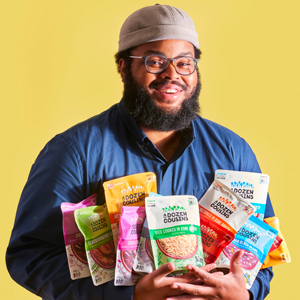
[00:00:10] Ray Latif: Hey folks, I'm Ray Latif, and you're listening to the number one podcast for the food and beverage industry, Taste Radio. This episode features an interview When Ibraheem Basir, the founder and CEO of A Dozen Cousins, a brand of ready-to-eat meals and sides inspired by traditional Black and Latino recipes. Just a reminder to our listeners, if you like what you hear on Taste Radio, please share the podcast with friends and colleagues. And of course, we would love it if you could review us on the Apple Podcasts app or your listening platform of choice. When Ibraheem Basir launched A Dozen Cousins in 2018, retail buyers questioned the marketability of the brand's first products, a line of premium-positioned cooked beans. Four years later, those buyers are asking different questions. Namely, how do they keep up with demand? A former marketing executive with General Mills, Ibraheem founded A Dozen Cousins with the aim of increasing accessibility of better-for-you food within Black and Latino communities via healthy ingredients, authentic seasonings, and a convenient way to cook. Available in varieties such as Mexican Cowboy Pinto Beans and Trini Chickpea Curry, the beans are packaged in microwavable pouches that can be heated in 60 seconds. As distribution of Pinto Beans has grown, A Dozen Cousins has found traction with a broad variety of consumers seeking a quick, flavorful meal or side dish. The brand has since added two additional complementary product lines, bone broth cooked rice and seasoning sauces for rice and meat dishes, and expanded availability of its products to retailers in all channels of trade, including Whole Foods, Walmart, Trader Joes's, Kroger, and REI. In the following interview, I spoke with Ibraheem about how the brand's reason for being has evolved, working with co-manufacturing partners to ensure quality standards, why sampling was critical to its development, and why keeping a foot in the familiar is a key tenet of its innovation strategy. He also explained why A Dozen Cousins is relatively quiet about capital raises and shared his take on improved opportunities and continuing challenges for BIPOC food entrepreneurs. Hey folks, it's Ray with Taste Radio. Right now I'm sitting in front of Ibraheem Basir, the founder and CEO of A Dozen Cousins. Ibrahim, how are you? I'm doing good, man. I'm excited to be talking to you again. How are you? I'm doing fantastic. So great to see you. We're recording here at Nosh Live Summer 2022 in New York City. So I should also say welcome home.
[00:02:55] Ibraheem Basir: Thank you. Thank you. I'm excited already that whenever I come back to New York, I can feel the energy. I feel like I'm somehow recharged up, of course, growing up in Brooklyn. So it's always nice to be back.
[00:03:04] Ray Latif: Absolutely. Yeah. What part of Brooklyn are you from?
[00:03:07] Ibraheem Basir: I am from Fort Greene. So kind of right on the cusp of Prospect Heights, Bed-Stuy, Clinton Hill, that downtown Brooklyn area.
[00:03:15] Ray Latif: Outstanding. I don't think I've been in that neighborhood, but I assume it's great for families.
[00:03:21] Ibraheem Basir: It is, it is. As you know, we needed plenty of space. It was, you know, throughout my childhood, we kind of slowly upgraded apartment size and moved neighborhoods as we added more kids. And that's where we settled. And my mother still lives in the same neighborhood.
[00:03:36] Ray Latif: You come from a very large family. You have nine brothers and sisters, yes? That's right. That's right. I am number seven out of 10. Seven out of ten. Okay, I have one more sibling than you do. I have ten brothers and sisters.
[00:03:48] Ibraheem Basir: That is impressive, man.
[00:03:49] Ray Latif: Yeah, isn't it nuts? So, you know, when I think about our family, I think about growing up. It's funny, I actually saw four of my brothers yesterday. They were in town for the Fantasy Food Show. I think about our parents making dinner or making lunch. And I'm like, how did they, how did that happen? You know, like, how did we figure out, or how did they figure out how to feed 10, 11 kids at one time? And I still don't know what the answer is. Do you have a sense of how your, how your parents did it?
[00:04:17] Ibraheem Basir: You know, man, I think often about my childhood, and I have two children of my own now, and just thinking of, like, how hard sometimes I find it to, like, stay on top of them, and then think about my parents doing that, you know, five times over. So I don't know that I have the answer, but I will say, for us, we were spaced out enough that the older siblings helped out a lot. So now I have, like, I have my parents, and then I have, like, my big brothers and sisters who are, like, you know, junior parents and helped out. So we made it through, and, you know, it's always fun to be back with them.
[00:04:47] Ray Latif: Yeah, it's true. The older kids were asked to do some of the, well, parenting or raising, rearing, whatever you want to call it, of the younger kids. Although I don't know if I did such a good job of it. I was the one causing a lot of trouble as much as anyone else, so.
[00:05:02] Ibraheem Basir: Where do you fall in the birth order?
[00:05:04] Ray Latif: I'm the third oldest. I have two older sisters. And then, so it's two girls, eight boys, one girl.
[00:05:09] Ibraheem Basir: Okay.
[00:05:10] Ray Latif: Yeah. Yeah. It is fun. The thing that always comes up in my mind when I think about going back to dinners for a second, I was just like, It was like 10 boxes of pasta, like humongous pots of boiling water and just dumping in all kinds of pasta. And that was a meal every week, at least once a week. And it was fun because everyone loves pasta, right?
[00:05:30] Ibraheem Basir: Yeah, it's funny. Just one more bullet on this topic. My mother really didn't have a ton of brand loyalty, right? So I think about in the context of our current profession in the world of CPG, she would buy whatever was on sale. And so like, you know, like people ask me, oh, what was your favorite cereal growing up? And it was like, whatever was on sale, man. I ate it all, you know? And like, she managed her budget. You know what I mean? She got through what she needed to feed us all. And you know, kudos to her.
[00:05:55] Ray Latif: Yeah. God bless her. She sounds like an amazing woman. Yeah, she was. She is. She is. The only brand loyalty I think we had growing up was Listerine. My dad always bought the Brown Listerine. That was his thing. I don't know why. Speaking about brands, you have a great brand. That Dozen Cousins is a fantastic brand. It's such a great brand name. I love it. I think everyone who comes across, they're like, wow, that's such a cool name. And as I've talked about on the podcast in the past, you know, I love examining the creation, the ideation behind a brand name. Yours has a very specific meaning.
[00:06:31] Ibraheem Basir: First of all, thank you for saying that. I'm glad that you have like a positive reaction to it. That was one of the things we really wanted to do when we were trying to think of the name. You know, in terms of the background, the brand is named after my daughter and her 11 cousins. So, you know, I have 11 nieces and nephews. And when my daughter was born, she was number 12. And I knew I wanted the brand to be rooted in this idea of family and culture and kind of just harking back to my experience around food growing up. And so the name was very symbolic of that.
[00:06:58] Ray Latif: Were there any other names besides the Dozen Cousins that you were considering?
[00:07:01] Ibraheem Basir: There were none that were like finalists, you know what I mean? Where I was like, we were looking at copywriting it or, you know, doing trademark searches or anything like that. But we had a very robust brainstorming session, as you can imagine, right? Like once we had the idea around family and food being the center of what we wanted, you know, I remember some names were like Kin or Breaking Bread. Those are two that I recall. But they were all around this idea of like food and family. But none of them stuck quite the way that A Dozen Cousins did, and I'm happy with that choice.
[00:07:32] Ray Latif: Yeah, it's a great name, as I mentioned. It's funny, when you said kin, my eyebrows raised, because there's a brand called Kin Euphorics, whose founder I recently interviewed, and that would have been interesting. But I don't recall her mentioning that the word kin had anything to do with, like, the family aspect of it.
[00:07:49] Ibraheem Basir: Yeah, yeah.
[00:07:50] Ray Latif: So, interesting stuff. You know, we met about four years ago when you first launched. We met at Expo East 2018. Is that right? That's right.
[00:07:58] Dozen Cousins: Yeah.
[00:07:59] Ray Latif: There was this real buzz about A Dozen Cousins. I could feel it. I think a lot of people just wanted to come up and meet you and learn about your brand. And I feel like a lot of it had to do with the fact that it really solved a problem. Your first product, a line of cooked beans in a pouch that you could heat up in 60 seconds and have a meal or have a side dish. And that is such a brilliant idea and one that I'm like, how come no one did that before you? On the other hand, when you started the company, there was a different kind of why. There was a different kind of reason for being. Can you talk about that and how that why has evolved for you?
[00:08:39] Ibraheem Basir: Yeah. First of all, again, thank you for the kind words. You know, when I started a Dozen Cousins, it was really rooted in this feeling of almost being split between two worlds. You know, I had started my career in the natural products industry, had a chance to work on some great brands, really fell in love with the ethos of this industry around like better food, responsible business, good sourcing. But the challenge I always had was that when I would like look at the brands or go shopping, none of them felt like home to me. Right. In terms of the Whole Foods and the flavors that I had grown up with. You know, I grew up in a really working class, Black and Latino community. And so a lot of Whole Foods that we ate were from the South, from, you know, Caribbean food, Latin American food, et cetera. And so the goal when I started A Dozen Cousins was really around like representation, you know, and wanting to have these foods and flavors in a Whole Foods or in some of these, you know, natural retailers in a way that like the product was high quality, but it also felt authentic and culturally rooted. So, you know, that was my why, right? Of like, just wanting to go into the supermarket and feel like, okay, here's a brand that speaks to me as a consumer, that speaks to people who grew up like me. You know, what I will say just to your point about the product is that I almost think about them as like, there's like two different levels, right? In terms of like the needs that you're solving, right? There's like, the brand and emotional level, which I just talked about, but then there's also just the functional product level, right? I was like, okay, why is this different or better than what I can in the supermarket today? And in that case, you know, to your Pinto Beans are delicious. They just, they're not that fun to cook, right? They take a certain amount of time, a certain amount of prep, a certain amount of skill. And so, you know, for us with that first product line, we were really focused on bringing convenience and quality to a category that really hadn't been innovated in, right? It was just, big sacks of dry beans and cans of Beans and Trini a lot by way of like flavor and innovation and convenience.
[00:10:31] Ray Latif: Accessibility is an important part of any brand that is trying to scale. And I think at the outset, were you thinking about accessibility as much as you were about the mission of representation and reaching Black and Latino communities?
[00:10:45] Ibraheem Basir: Whenever you have a brand that goes out into the world that those early days are like there's a formative process, right? So I had this kind of pristine image of a Dozen Cousins and then it has to be created and brought into the world. And I would say, in the early days, some of the most formative conversations we had around the brand was like, who is your consumer target? How do you actually reach them? What does the product need to look like? in order to be useful to them, right? And so, you know, when I first started, I was very laser focused on Black and Latino consumers, people who grew up eating these foods, people who are from the same community as myself, and they still remain kind of the heart and soul of the brand. What I'll say is, one of the things we realized is that we needed to have a go-to-market strategy that actually reached those consumers. And we also needed to recognize that the market was much bigger than them, right? And so for us, that came to life by way of like, OK, what's our channel strategy, right? We were in Walmart within our second year of launching. We were in Costco in our second year of launching. So trying to get into retailers that enabled better price points, that enabled accessibility for the communities that we really cared about. And then on the flip side, we also kind of opened up our mind a little bit to say like, OK, your typical Whole Foods shopper, right, might not necessarily be from these communities, but they're still going to appreciate the flavor, the convenience. And so the brand, I think, has become a lot more open and inclusive over the years. So we still have this, you know, core consumer that grew up with our foods and that, you know, like I said, it's kind of the heart and soul of the brand. And then we also have this much broader consumer base that, you know, loves the product for, for many other reasons.
[00:12:15] Ray Latif: When did you realize you were starting to get traction with mainstream consumers and how did it impact the business strategy?
[00:12:21] Ibraheem Basir: One of the big touchstone moments for us was launching nationally at Whole Foods that happened about six months into market, right? That was like June of 2019. And that was just a big moment for the brand because you're now in, you know, most of the states in the country, hundreds of thousands of people are seeing the product, buying the product every week. That for us was just a signal that, okay, obviously there's, this is working, right? There's people who care beyond it. We started to get that feedback. in terms of comments on social media, seeing how people were cooking the food, seeing people post food imagery online. So you started to see in a really visceral way, like, okay, these are the people who the product is resonating with. And like I said, I think the tweaks to our business strategy at that time were pretty subtle. It was just like, okay, how do we think about marketing? How do we think about our brand voice tone? While basically just straddling that line, right? Being true to the communities that our foods and flavors come from, which is still always a priority for us, but making sure that we were positioning ourselves and our product in a way that other people felt welcome. And it wasn't like, we don't care about you or we don't want you here, right? It was more like, hey, you can come grab a seat, you can take part as well.
[00:13:28] When Ibraheem: guessing your margins, that's risky. Belay Financial gives CPG brands the clarity to scale smarter, faster, stronger. Get your free inventory ebook by texting TASTE to 55123 and start making data work for you. Vibrant Ingredients is the natural ingredient partner powering food and beverage innovation, delivering flavor, function, and protection through a science-backed portfolio. Vibrant delivers purpose-driven solutions that help brands create extraordinary experiences. Discover what's possible with Vibrant today. Visit VibrantIngredients.com.
[00:14:15] Ray Latif: How do you prepare yourself for a national launch at Whole Foods, especially at that stage of your development?
[00:14:21] Ibraheem Basir: So when we launched the business, our plan initially was to just kind of launch regionally, take it slow, right? We'll see how the product does online. We'll see how the product does in a few regions of Whole Foods. And, you know, the opportunity came up to launch broader than that. And we had a few scenarios, or I had a few scenarios in my mind of like, okay, there are certain small group of retailers that we'll do it for, right? Like we'll roll the dice and kind of go big. And Whole Foods was one of them. And the reason that, you know, I had that comfort was number one, they are, they're still the leader when it comes, in my opinion, and that's no disrespect to other retailers, right? But like, they're the leader when it comes to the natural product world, right? In terms of their consumer is trained to understand advanced benefits, new brands, new products. They're not intimidated by seeing something that they've never seen before on shelf. And so, you know, if you're a brand, as we were with very low awareness, really just getting started in the market, you want to be at a retailer where people are not just shopping for the brands they know, right? They're willing to discover and explore. So that gave us the confidence to kind of roll the dice and go a little bigger than we had. And, you know, second thing I'll say is we just had really good advisors around us in terms of our brokers, some of our early investors helping me think through, okay, this is what the investment needs to look like to set yourself up for success. And, you know, we had a good model built around it. So, and thankfully things have gone well.
[00:15:37] Ray Latif: From a manufacturing standpoint, did you feel like you were buttoned up enough that you could address the demand that you would be getting at a Whole Foods?
[00:15:43] Ibraheem Basir: We were, man. I got to also give kudos to our manufacturing partners. We've never had any hiccups along the way in terms of capacity or just product delivery. We have a very consistent product, so we knew that we felt good that we could produce at that level and still maintain the quality we wanted.
[00:16:01] Ray Latif: How do you find a good co-packer?
[00:16:03] Ibraheem Basir: For us, a lot of it was networking, interviewing, Googling in the early days. And it's true, I'm sure, for any brand, but you're balancing a lot with a co-packer, right? It's like, sure, we know who the best co-packers are, but are you appealing to them, right? So it's like, OK, you got to find someone who There's a size fit between how big your business is and how big their lines are and what their minimum runs look like. You're also looking for, like I said, quality of output, consistency. You're looking for a relationship, right? Is this someone who I feel like I can get on the phone with and have a productive conversation, have a difficult conversation? Is that communication there? And there are other things that I'll go down, but for us, that was it. It was just a combination of third-party research and first-party recommendations.
[00:16:49] Ray Latif: Did your background working in food, working at corporate food companies help in that process? Would you say that sort of gave you some leverage and that you knew what you were talking about, you knew the questions to ask?
[00:17:01] Ibraheem Basir: For sure. So I, you know, I had worked with many co-packers before I started A Dozen Cousins on behalf of, you know, other brands that I was working for. And so I knew, number one, some of the things that we were screening for in those early conversations that, you know, some of the things I just listed out in that previous answer were things that I was familiar with before I started ADC. And then likewise, you know, I had a network of people who worked in manufacturing and who understood the landscape. And so I was able to get down to a short list, maybe a little faster than I would have if I was just doing it on my own. For sure, I think, and that's true, honestly, across our entire business, right? Where there's so many things that I had the good fortune of having kind of practice at really, right? Of just doing it for other brands or doing it as an employee. So when I was doing it as a founder, it wasn't quite as intimidating, right? It felt kind of like maybe the second or third time around, which was fun.
[00:17:50] Ray Latif: It's interesting you say that because some entrepreneurs, successful entrepreneurs have told me in the past, you know, naivete is what helps them, you know, just like picking up a phone and calling up a code pack and be like, Hey, can you make my product? And in some ways getting lucky or just, you know, asking the right questions. But I always think experience. is really helpful. Like if you have worked in the industry, if you have immersed yourself in a particular business before you actually leap into it, I would assume that's the case with you. And you, I mean, you just said that in so many ways that working in food gave you essentially a leg up over other entrepreneurs that had no experience.
[00:18:28] Ibraheem Basir: Yeah, I've heard other people praise this question of like the beginner's mindset or naivete, as you put it. And I do think there's a lot of benefit to that. But I think what that is, what it comes down to is a mindset, right? Of like being willing to try new things, being willing to throw away past experiences where you're able to say, okay, this is different than that time, right? So I guess my point being to me, experience becomes a hindrance when you're stuck on the idea that it has to be done this way all the time. And I've tried not to allow that to be the case for me, right? It's like, I did this before. It gives me an idea of what it should feel like or what I'm looking for. But I still want to keep in mind, like, we're a different company. This is a different time. We have a different competitive landscape. Like, I'm very willing to challenge those past experiences. So I guess that was a very long way of saying I'm not definitively in either camp, right? I think the experience helps a lot because it lowers the risk. It gives you a framework to kind of start with. But at the same time, I do think you want to keep a beginner's mindset and be willing to try novel approaches, be willing to throw out maybe some things you've done in the past and try something different.
[00:19:30] Ray Latif: I want to talk about your beans because the beans are the flagship products. The process though, let's talk about that process of how you get to that final product because it's not inexpensive and it's something that has to be right. How do you get your manufacturers, how do you get your co-packers to make a high quality product right every single time?
[00:19:51] Ibraheem Basir: That's a great question. I think, you know, first and foremost, it starts with a really clear gold standard of what you want the product to be. Right. And so before I get into the co-packer question, it's just like, you know, we spend a lot of time on just the question of what should the bean texture be like? What should this product look like when you open up the pouch? What should the pouch smell like? Right. Like we take a full kind of 360 very multi sensorial approach to product development and trying to understand, okay, what is the full experience we want someone to have both as they're preparing, eating and just talking about the product afterwards, right? You know, once you align on that, then it's just a question of like, iteration and discipline, you know, like, okay, sample one comes back. It's not quite where we want it. You have to be willing to push. I think sometimes it's easy, particularly when you're working with any party, right, of like, they have their vested interest, which might be, hey, let's make this as easy as possible, as quickly as possible. You have a different interest, right, which is how do I make the best product possible? And I think you have to be willing to kind of work that tension a little bit. So in our case, it took, I won't share a number, but many, many rounds of iteration to get the products to where they are right now. And I think we have, humbly, I think we have the best product in our segment, right? In terms of the texture, the appearance, the taste. So that'll be the first thing. And then beyond that, it's just, like I said, having good systems in place to, we taste every batch of product that comes off the line. You know what I mean? Like literally. And so that allows us, again, to have just really high quality control.
[00:21:17] Ray Latif: That's such a great idea and something that I think a lot of entrepreneurs should ask of their co-packers is to taste the product every single time before it goes out. Because that one time that it doesn't taste great is that one time that you lose a customer or potentially lose a customer. The idea of elevating beans, again, I think is a brilliant idea. You know, elevating a commodity category has been done before. Elevating a commodity product has been done before. Did you take any cues from other brands that have done a similar type of or taken a similar type of approach to something that is in some ways kind of like a boring food?
[00:21:58] Ibraheem Basir: To be honest, the brands that I took inspiration from were not around elevating a boring food as much as brands that I felt had really created a platform around meals or around a particular cuisine. And I'll decline to mention those brands by name, but they exist. And that's really what I looked for inspiration was, you know, beans I always assumed would be our first product, but not our last product. And so like I, even from the early days of the business was trying to think about how do you craft the brand? How do you create a portfolio so that When people think about cooking a meal from these cuisines, we're their first choice, right? And that we feel like more than just a product. And so I would say that's probably a little bit more where I focus my mind in terms of inspiration versus upgrading something boring.
[00:22:43] Ray Latif: There's no lack of beans on shelf. You go to any grocery store and you can definitely find beans dry, in cans, or more on in pouches, which you deserve a lot of credit for that. But yeah, I mean, staying on that, you know, the idea of a premium bean set is a relatively new concept, I would say. How did retailers take to this idea of creating a premium tier for beans?
[00:23:09] Ibraheem Basir: Yeah, first of all, thank you for saying that. We appreciate all credit that comes our way for doing this.
[00:23:15] Ray Latif: Well, like I said, I see a lot more beans in pouches nowadays than I had three years ago.
[00:23:20] Ibraheem Basir: You know, it's funny. Over the last three years, I can feel the transformation that's occurred. When I think back to those very early buyer meetings, the questions were, Will people pay a premium for beans? How much do you think this can be? Is there a need for this? Versus the conversations we're having today are, well, which brands should be in that premium set? And so it's almost become now a foregone conclusion that every retailer should have some, that there is a desire to trade up, that convenience is valuable. And that in and of itself is like a big win for us, right? I'd much rather be having the conversation around like, hey, why is your brand better than these others? Versus is there a need for you guys to be on shelf? So that's the first thing I'll say. Second, in terms of how I think it's evolved, and we're still in the very early days of it, right? If you just think about how long some of these premium products have been on shelf, I think it always comes down to incrementality. Like at the end of the day, if you're a good retailer and you own a certain chunk of space, you're trying to think about what can I bring into this category that's gonna bring in incremental dollars, right? Either different people, people who had left the bean category for whatever reason, and we've been able to bring them back, or different occasions, right? Like I think about how much I look on Instagram and see people using our product for breakfast, for lunch, in kids' school lunches, right? Like these were not uses of beans, these were not heavy uses of beans, three years ago, right? Like beans were primarily a ingredient for dinnertime. It wasn't people making breakfast burritos at home before they went out to work. And so like, that's what I really take pride in, right? Is like, have we been able to open up different people and different uses for the category? And I think we have.
[00:24:55] Ray Latif: When you are presenting to buyers and when you didn't present to buyers, when you were talking about the potential for a premium bean set, what really moved the needle for them? What really got them excited about this idea and your brand in particular.
[00:25:12] Ibraheem Basir: you know, we didn't have a ton of data, right? Like it wasn't like, obviously that very first buyer, we had no data, right? Where it was like, we weren't in physical retail at all. And so, you know, some of it is just telling the story and painting a picture for the future, right? And so I think about our first kind of 12 months of selling, I can see the slide in my head right now. Like there wasn't a data point on there. It was just, you know, it was a very qualitative statement about how our product was different than what was on the shelf, right? So it was like, Dry beans take two hours. Our product takes 60 seconds, right? Canned beans require additional ingredients. Ours do not. Refried beans are using lard and all kinds of, you know, processed ingredients. We're using avocado oil and real vegetables, right? And so, like, that was it, right? It was just, we're going to tell you a story about why we think this product is different than what's on the shelf. And I think that's, you know, that would be my number one piece of advice, you know, on that topic of how do you break through with buyers? You have to be willing to embrace and have a story around why you're different and better. I think sometimes people are very obsessed with like, I'm going to steal a slice of this other brand's thing just because like, okay, our marketing might be better or our packaging is nicer. And that's cool, but like really you want some nuts and bolts points of difference that you can hang your hat on. And I think that that has made us successful. You know, in terms of your second question around like building buyer relationships, in my experience, it has come with time, right? So the buyers that we have the best relationship with, the people who took an early bet on the brand, It's done well in their stores. We've come back and supported them. We've shown gratitude for the early bet they took on our brand, and we've been able to kind of build like that over time, right? Like any other relationship, good communication is key, right? Like we're not leaving people in the dark, you know, or jerking people around or saying, you know, making a deal and then going back when you think you have a little bit of leverage, right? Like, and this is true of any business relationship. I think it's a lot of the same building blocks, right? Is there trust? Is there honesty? Is there good communication? location.
[00:27:10] Ray Latif: You use the word bet a couple of times. Is there a way to mitigate the risk for that buyer in that they shouldn't be thinking about taking your brand on as a bet?
[00:27:21] Ibraheem Basir: I mean, the most obvious thing is just thinking about your footprint and how you launch, right? And we've taken a different approach with different retailers, right? In some cases, we've launched very small, you know, small footprint. We'll test it out and kind of scale with time. And then there's been other times where we felt like, look, we believe, right? And like we want to We want to go bigger than that. And so I think, you know, that's the number one risk mitigation factor from my perspective of like, if you're dealing with a retail launch, thinking through how many stores do you want to be in? How much money do you want to put behind it to ensure that it's successful? And then you kind of triangulate on the right plan with that buyer.
[00:27:51] Ray Latif: So do you tell the buyer, look, if the buyer offers you 100 stores and you're like, I can't do 100 stores, but I can do 20. I mean, is that a conversation you've had in the past?
[00:27:59] Ibraheem Basir: I've had that. I've had conversations where we've asked down and I've had conversations where we've asked up, right? Because there's also a risk in going too small or not having enough data or having a really long time between resets, right? And so it's not always the case that you want to go small, but I have been in that situation where a buyer wanted to do a little more than we were comfortable with at the time or that we, you know, we wanted to ease our way into it. And then there's been times where it's been the reverse.
[00:28:25] Ray Latif: Well, I ask about that because support of the brand on shelf is so important. If you can't adequately support it for your promotion, for your sampling, then chances are the brand won't be as successful. When you started out, how often did you do trial? How often did you do sampling in those Whole Foods stores so that people could not only taste how great your products were, but understand Again, the use case and versatility of A Dozen Cousins.
[00:28:51] Ibraheem Basir: Again, at the risk of not giving out too much specific detail, I'll say that we were very focused on trial in our first year at Whole Foods, right? And so all the levers that go along with that, whether that's social, price promotion, in-store demos, we had a really robust plan. I think what you're articulating is 100% right, right? At the end of the day, Velocity is going to be the king, right? When this is all said and done, you've told your story, you've built trust with your buyer, you've gotten in the store. Now they're going to look and see, okay, how's it selling? And so we do keep a really, just a really close eye on Velocity wherever we are. And we focus a lot on drive and trial.
[00:29:26] Ray Latif: when you're helping your retail buyers build out that premium set for beans, how do you do that, again, without actively helping the competition? You know, everyone talks about a rising tide floats all boats, but you still want to be the highest boat on that tide. So, you know, what's the answer? What's your answer?
[00:29:43] Ibraheem Basir: Yeah, for us, we're telling a story about the segment and about the use case, right? So, you know, I articulated to you by putting beans in a pouch and having them be higher quality, people will eat them more frequently and at different times of the day. Like, that's the story we're telling. A smart buyer is then going to look at that and say, well, okay, here's another brand that's maybe doing something slightly different than you, or maybe they have flavors that you don't have, or maybe they're at a lower price point than you, or maybe they bring something else to the category, right? So, like, they're going to play that same game in their mind around, okay, how can I bring even more incrementality into the set? And so, like, I'm never actively promoting my competition to be very honest, right? But I do know that us growing, us having velocity on shelf, us growing out the segment is gonna attract others into the space and buyers are gonna put some there. The goal, as you alluded to, is just to make sure that we're still performing better than they are, right? But I do think some of that rising tide is true and it doesn't necessarily require any active behavior by the brands. At least that hasn't been the case in my experience.
[00:30:46] Dozen Cousins: Do you want more repeat buyers on Amazon? Well, this free resource in collaboration with Straight Up Growth will help your brand turn first-time buyers into long-term subscribers. Download Winning the Repeat Purchase Game on Amazon now at Taste Radio slash SUG. That's Taste Radio slash S-U-G to start building retention-driven growth for your brand on Amazon. Scaling a beverage brand into major retail comes down to operational readiness. From packaging lead times to co-manufacturing strategy, the details can make or break a launch. In a new e-book in collaboration with Octopi and Asahi Beer USA, industry leaders share what they've learned in helping brands scale. Download it now at Taste Radio slash octopi.
[00:31:36] Ray Latif: One way to stay ahead of the competition is through innovation. And you started out with beans. Your second product line is rice cooked in bone broth, which is incredible. And I love this product so much because it is the best, easiest way to cook rice, flavorful rice, I will say that. Like, you know how they have those like bags of white rice that you can go to Trader Joes's and like you microwave it in three minutes, you have some white rice. But like, there's no flavor to it. You still have to add all the flavor to the rice. Yours has a ton of flavor. You can put it right next to your, you know, main dish and eat it, or you can just eat it on its own. All right. Sorry. I'm drooling at the mouth talking about your rice with the cooked in bone broth.
[00:32:13] Ibraheem Basir: Sorry about that. Yeah. So, you know, once, once we were in market, you know, the cool thing is you get a ton of feedback, a ton of data. Right. And so like one of the things we knew really from, you know, the first few months of the bean launch was that, the thing people were buying most commonly with it was rice. And specifically they were buying a lot of pouched rice, like microwavable, ready to eat rice, which makes sense. It's a convenience, you know, seeking shopper. So we knew we wanted to play in the category, right? That was like kind of a easy decision. Okay, you make beans, you should make rice. The question then became, what could we do that was really additive to the category, right? Like there's, as you alluded to, a million good options for rice, right? Whether that is you cooking it yourself, private label, any, you know, name the brands who's doing it. And so our focus was, you know, what's missing? And we felt like what was missing in the category was nutrient density, right? Like at the end of the day, white rice is delicious, but there's not much to it other than like carbs and starch, right? And so our focus was, can we add a little bit more and what we landed on was bone broth. And so the way our product is made is essentially we cook the rice in bone broth instead of water, and you end up with seven grams of protein, a few grams of collagen. You know, we were the first to market to do it. As of now, we're still the only rice cooked in bone broth. I'm sure others will follow soon enough. But, you know, that's how we thought about it was how are people using our original products? What would be complementary to it? And then what could we do that was different in the set?
[00:33:35] Ray Latif: It's, again, an amazing product. I know people know bone broth. How many people know about rice cooked in bone broth, I think is a separate question. Was there a level of education? Was there a real education initiative that you had to undertake to get people to understand what this was and why it was better than the alternative?
[00:33:56] Ibraheem Basir: You know, the behavior actually existed out there, I think at a level higher than you would expect. So if you went on like Pinterest or Instagram or looked at like places where food content takes place, you'll actually see a ton of people cooking rice and chicken broth or broth of different types as usually like a flavor hack, right? Like a really easy way to just season the rice, add a little flavor to it. And so that was one thing that actually gave us confidence was that when people see this kind of played back to them on a supermarket shelf, there'll be that resonance of like, oh yeah, I've seen people cook rice and broth before, or I've done that before, but it's never been presented in a really convenient, ready-to-eat way. So that's the first thing I would say. And then the second thing for us is we focus on our packaging being really clear and being able to stand on its own. We don't have a huge marketing budget to go out and educate consumers candidly. And so our perspective is, look, if the only thing we can do is hand you this product, give you 30 seconds with it. Like, will you understand what it is? Do you understand the benefit? Do you understand why it's different? And I think we were able to do that with our bone broth, right? Where it's like, you get it, right? Even if you had never heard of it before, when you read the front and back of the package, you'll kind of understand, so.
[00:35:06] Ray Latif: Is that the magic number, 30 seconds?
[00:35:08] Ibraheem Basir: That was a number I just threw out. Honestly, you probably have less than that in the supermarket. You know, it's probably something more like, you know, five to ten to get the initial interest. And then maybe another, you know, ten if they want to actually read the back and engage. But one shorthand I've heard, and who knows where I got it from, but it was six feet in six seconds, right? So is it clear enough to be seen from six feet away and to be processed in six seconds? And whether or not any of those numbers are right, I think the general idea is it needs to be really clear and you got to be able to digest it quickly.
[00:35:38] Ray Latif: Well, I like that a lot, because I think that's absolutely right. I mean, if I'm looking across this room, I see a Purell hand sanitizer. I know exactly what that is. I know the brand. I know what it does for me. I know the use case. It didn't take me six seconds, though. Well, I mean, that may not be the best example, because like Purell is a well-known brand name. But I think the point you're trying to make is, do people see the brand? Do people see the brand on shelf? And are they instantly familiar with some aspect of it? This brings me to a point that you brought up the last time we spoke, which is keeping a foot in the familiar. And do people have an anchor for this product? I guess the point I'm trying to make is, when you're thinking about innovation and when you're thinking about extending the brand and becoming more of that platform brand that a Dozen Cousins has evolved into, how do you continue to find things that people are familiar with? while being as innovative as you want to be? Because again, going back to retail buyers, retail buyers in a lot of cases are looking for things that are a little bit more dynamic, are different, are exciting to put on shelf so that their customers can be like, oh, wow, you know, this retailer carries interesting, unique, different products. But how do you stay familiar while being innovative? How do you do both at the same time?
[00:36:50] Ibraheem Basir: Yeah, I think, you know, there's a spectrum, first of all, and every brand doesn't need to play at the same spot on it, right? Like, I think there's products that I enjoy that are pretty, you know, pretty left field in terms of just, they're very different, right? They're very different than what's out today and some of them work, right? And then you have brands that are, super traditional, right, where it's like, I don't think it's innovative at all, right? And like, you know, we want to be kind of in the middle of the spectrum. At the end of the day, our brand is rooted in tradition, is rooted in foods that have been around for hundreds of years. And so we're automatically starting with a little bit of an anchor point around, look, if we're going to deliver Cuban black beans, it needs to feel like a Cuban black bean, right? And we can play with the oils that we use or the packaging format, but we want that core product experience to be familiar to what people would have experienced. And so, you know, what we do is we look at categories, we look at products and we just, we kind of poke and prod and we're, you know, we're, we're modern consumers ourselves as, as employees of the business. We're consuming food content all the time. We're looking to see what's interesting and new in terms of ingredients or cooking methods or formats. And then we try to apply it to Whole Foods and the categories that we already love. So I don't know if that answers your question, but like my goal is to be kind of in the middle, right? Like we want to have a really clear anchor point in something that feels timeless and traditional. And then we want to try to upgrade it where we can with ingredients and formats.
[00:38:09] Ray Latif: Your third product line, you recently launched seasoning sauces and I love your Peruvian pollo a la brasa. That is... Thank you. a phenomenal product. You know, when you want to make chicken at home, so often the chicken is so bland and Peruvian chicken in particular is some of the best flavors out there. It has some of the best flavors out there and your product just nails it. I love it. Thank you so much. It's notable that all three product lines are in pouches. How much has that package type come to represent the brand?
[00:38:40] Ibraheem Basir: that packaging type represents convenience for many consumers, right? And so to the extent that we want our brand to be rooted in convenience, I think that they are very closely related, right? Like, you know, whether for us it's ready to eat in the case of our Beans and Trini or something that's really quick to cook. I think the pouch kind of communicates that. It communicates the element of portability, of convenience, of speed. So all those things I think are important brand attributes. But, you know, I'd hope that our brand, you know, is operating at some level above just the format. You know what I mean? Hopefully that makes sense.
[00:39:12] Ray Latif: Yeah, it does. And I guess, would you ever consider moving to a different package, say, for another product line? I mean, yes, it's convenience, but let's say it turns out that a can, you know, works out better for your next product line. Is that something that would detract from people understanding or people recalling A Dozen Cousins? Or do you think, you know, it's at this point, you know, the brand can stand on its own, you know, regardless of the package type?
[00:39:37] Ibraheem Basir: To the first question, 100% we'd be open to exploring different package types over time, so long as it meets the need of the product, right? Like, and again, if that is like, if we're able to deliver a really high quality experience with great ingredients, high convenience level, we consider other packaging formats. Obviously there's the business question, right? Of like, is there some efficiency for us being in a particular format over time and having, you know, consolidated group of suppliers and manufacturers, like, Yes, there is benefit to that, so we wouldn't throw it away for no reason. But if there was a compelling product out there that we wanted to launch, I think we'd be open-minded to that.
[00:40:11] Ray Latif: I want to talk about funding for a second, because Ibrahim has a smile on his face, because this is an interesting topic for A Dozen Cousins. You've been quieter about funding for A Dozen Cousins as compared to other food companies. Why is that?
[00:40:25] Ibraheem Basir: You know, my perspective is that we as, you know, certainly for me as an early stage brand owner, I have such a limited amount of airspace, right? In terms of like, how often can I speak to the retail community, the, you know, supplier community in our industry, to our consumers, right? It's like, you know, we have a few moments each year where we can kind of, you know, have that touch point. It's like, do I want to use that to talk about, our funding and our cap table, or do I want to use that to talk about our brand, our products, our mission, the retailers where you can find us, what we care about as a company, what our culture and values are. Like to me, those latter things are all so much more important and much more integral to like why I started the company. And so, you know, that might be a false choice, who knows, right? I don't own any outlets or, you know, publications to tell you how those things are balanced, but that's been the mindset we took. I don't ultimately think consumers care about that, right? Like that's a very, insider baseball type of thing of like who invested and how much do you think they own and how much do you think the company is worth at this stage? Consumers don't care about that and so we've just focused on those other messages that we think are more important.
[00:41:32] Ray Latif: That makes a lot of sense. At the same time, you do get into publications, you do get industry press, you do get attention when you say you raise money, when you say certain investors are involved in the brand. you know, it doesn't sound like it, but in hindsight, do you ever think that maybe you missed an opportunity to reach other investors, you know, by not being a little bit more vocal about your funding?
[00:41:57] Ibraheem Basir: I'm sure there's been some opportunities missed, right? In terms of just like the hypothetical case of, to your point, people care a lot about it, right? They are excited when they hear about a brand raising money. I'm sure that it has a positive impact on talent, right? In terms of where they wanna go work or with other retailers in terms of feeling like, hey, this brand can support a larger expansion, right? Like I know that there are benefits to the publication of fundraising. So I'm not naive to that, but I haven't felt like the trade-offs haven't been worth it, right? We have a great team. We've been able to hire and recruit. We have a great set of retailers. We have a great set of partners. So, you know, it's hard for me to point to areas and say like, man, if only I had talked about our last fundraise, you know, I don't, I don't, can't say I feel that way, but I do understand that in the alternate universe, in the metaverse, there might, there might be a different scenario where we did talk about fundraising a little bit more and have some different outcomes.
[00:42:50] Ray Latif: How many people on your team at this point?
[00:42:52] Ibraheem Basir: We have five full-time employees and probably will double that during the course of this year.
[00:42:56] Ray Latif: Wow. Wow. Congratulations. Well, it sounds like funding helps, helps you do that. So I won't get any further into it, but I think it is something that entrepreneurs do need to consider is, you know, do you want to be known because you raised money or do you want to be known because you have a great business and a great brand?
[00:43:14] Ibraheem Basir: Yeah, and to be clear, you know, we've had outside investors in our business really since day one. And so I'm like very, I'm not like anti-investor or anti-outside capital or anything like that. You know, it's just a very specific PR choice, right? In terms of like, what information about your company do you want to publicize versus not? And I don't have any like ill feelings towards the companies that take a different approach, right? Because like we've talked about, there's benefits to both paths.
[00:43:42] Ray Latif: Let's come full circle to representation. You're a BIPOC founder, and I think when you started out in 2018, it seemed like the opportunity for BIPOC and female founders was not great. Here in 2022, I hope things are better, but I don't know. Do you feel like opportunities for BIPOC and female entrepreneurs is better than when you started, or is it pretty much the same?
[00:44:08] Ibraheem Basir: I think for sure it's better. You know, the number one proof point is just that there are a lot more successful, diverse founders today in our industry than I think there were three or four years ago, right? Like if I think about who I was looking at as role models or predecessors in the space, they'll probably count them on one hand, right? Versus today, I feel like I have you know, peers, many, many peer brands that are led by diverse founders and that are having great success or that seem to be having great success. So that to me is the number one thing at the end of the day is like we want to have successful companies and careers in this space. So that to me, I'll say for sure. And then the second thing I would say, which maybe is like a little bit more melancholy, you know, I think the events of 2020 and the murder of George Floyd and everything that surrounded it. There are so many retailers and investors and people who are adjacent to the industry that have made very purposeful programs and commitments and taking positive stances. I also helped found a non-profit organization in the industry with Project Potluck alongside Arnulfo and Asha. So for sure, I think that the landscape is very different today than it was three years ago.
[00:45:17] Ray Latif: What pain points still exist for BIPOC entrepreneurs?
[00:45:21] Ibraheem Basir: It's a great question. You know, I would say there's two or three that we focus on at Project Potluck and I'll use that as a framing mechanism, right? Number one is the question of just insider knowledge, right? Like this industry is still very, there's a lot of tribal knowledge and relationships that get things done, right? Whether it's, knowing the right brokers, knowing the right buyers, knowing the right co-packers, as we talked about, right? Like, this is not, I think, a very, it's not a super easy industry for outsiders to break into. And so like one of the things we focused on, of course, BIPOC founders, they face that even more so, right? Because maybe they just lack some of that industry network, right? And so one of the things we've tried to do, for example, with Potluck is create a mentorship program where we're connecting up-and-coming founders, up-and-coming employees in the industry with people who have done it before, right? And to try to overcome a little bit of that hurdle of like, hey, I need an intro to so-and-so, or hey, how should I think about this? That's one big obstacle, I think. Second pain point, and this one is declining in a good way, of just the question of feeling welcome, you know? I remember the first time I went to Expo East, and this is no knock on Expo itself, but it was just, there wasn't a ton of people there who looked like me. I mean, there's still not a ton of people who look like me really anywhere, but you know, it felt jarring, right? Versus today, like I think my Expo West, this past year kind of post COVID, it felt like this big family reunion, right? Like we had, you know, kudos to New Hope. They hosted a happy hour for diverse founders and there was lots of programming and events and it felt very different. So I think that question of like, just having the industry feel like welcoming and that this is a place for us. I think that's changed in a positive way as well.
[00:47:00] Ray Latif: What about funding? Do you see funding opportunities as better than they had been in the past?
[00:47:06] Ibraheem Basir: The question of funding is a harder one to answer because so much of it happens kind of below the surface, right, in a way that's not easily observable. So I don't know the answer to that, if I'm being honest. My intuition is that it's at least marginally better than it was three years ago, just because of the focus on it. And I know a lot of funds that have focused on how they're sourcing brands, the types of brands they're giving opportunities to. So I would hope that it's better, but there I don't have as clear an answer.
[00:47:33] Ray Latif: It's been so amazing speaking with you, Ibrahim. Thanks so much for taking the time to be with me today. I've been wanting to speak with you for a while, and I'm so glad we did. You shared so much great insight, knowledge, and just candidness about what it takes to be successful, what it takes to build a brand from the ground up. And I can't wait to see the future of A Dozen Cousins from here.
[00:47:55] Ibraheem Basir: Man, I appreciate the kind words, and it was a pleasure speaking with you as well.
[00:47:58] Ray Latif: Thank you so much.
[00:47:59] Ibraheem Basir: Thank you.
[00:48:03] Ray Latif: That brings us to the end of this episode of Taste Radio. Thank you so much for listening, and thanks to our guest, Ibraheem Basir. As always, for questions, comments, ideas for future podcasts, please send us an email to askatasteradio.com. On behalf of the entire Taste Radio team, thank you for listening, and we'll talk to you next time.