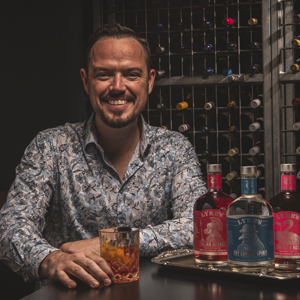
[00:00:10] Ray Latif: Hey, folks, I'm Ray Latif and you're listening to the number one podcast for the food and beverage industry, Taste Radio. This episode features an interview with Mark Livings, the co-founder and CEO of leading non-alcoholic spirits brand, Liars. Just a reminder to our listeners, if you like what you hear on Taste Radio, please share the podcast with friends and colleagues. And of course, we would love it if you could review us on the Apple Podcasts app or your listening platform of choice. For many consumers, mindful drinking is top of mind. A 2021 Omnibus survey conducted by market research firm Nielsen IQ showed that 22% of Americans are cutting back on their consumption of alcoholic beverages, citing health and wellness and shifting interests as two core reasons. Concurrent with a rise in interest for sober or sober-curious lifestyles is the emergence of a new cohort of non-alcoholic spirit and cocktail brands, including Lyre's. Launched in 2019 by entrepreneurs Mark Livings and Carl Hartmann, Lyre's markets non-alcoholic analogues of some of the world's most popular spirits, including bourbon, gin and tequila. Positioned as premium, sophisticated spirit alternatives without any compromise, Lyre's blitz-scaling strategy has enabled it to become the world's leading non-alcoholic brand, with distribution in dozens of countries. Investors have taken note of Lyre's growth. Last year, the company completed a new funding round at a valuation of $360 million and was led by D Squared Capital and Morgan Creek Capital Management, an early investor in Drizzly, Alibaba, and SpaceX. In the following interview, I spoke with Mark Livings about his vision for Liar's and the future of non-alcoholic spirits, why the company has prioritized market share and rapid growth, the development of its portfolio and product roadmap, Liar's thoughtful communication strategy, and how his management style has supported the brand's torrid trajectory. Hey folks, it's Ray with Taste Radio right now. I'm honored to be sitting down with Mark Livings, who is the co-founder and CEO of Liar Spirit Company. Mark, so great to see you.
[00:02:27] Mark Livings: Hello from Amsterdam. It's great to be calling into the US.
[00:02:29] Ray Latif: Yeah. How'd you end up in Amsterdam? You're Australian. I think most people would recognize that from your voice.
[00:02:35] Mark Livings: Yeah, most people tend to pick that up quite quickly. It's a long story, involves a pandemic, a whirlwind romance. That didn't work out, but my time here in Amsterdam, well, Amsterdam and I did work out, so I'm still here. So really, really enjoying it. And it's an absolutely brilliant city to base yourself from as a founder. You've got access to the UK, all of Europe. United States is a short flight away, but so is the Middle East and North Africa and other parts of the world. So it's a really beautiful central part of the world to be overseeing operations from.
[00:03:09] Ray Latif: Yeah. How's the non-alcoholic spirit scene in Amsterdam?
[00:03:13] Mark Livings: The same as it is in the rest of the world. It's in massive growth. It's being rapidly adopted. And we're seeing some really, really cool stuff coming out of not only some of the city's best mixologists, but it's also now starting to appear in, you know, bottle shops or office if you're from the UK or supermarkets. And what's really interesting, one of the trends that we're seeing that's not only in the United States, very visibly with players like Boisson or Free Spirit, we're seeing alcohol-free bottle shops appear all around the world. And there's one here in the Netherlands called Nix & Nix. There's two stores, and I believe they've got a third planned to open within the next couple of months as well. So, yeah, the alcohol-free category is alive and well here and being very much enjoyed by the Dutch public.
[00:04:01] Ray Latif: It is pretty impressive that we're seeing the growth that we're seeing in this space. I actually just saw a statistic that was reported on by a company called Insight Ace that said the low and no alcohol beverage market is expected to be worth $68.9 billion in 2030 and growing at a compound annual growth rate of 14% between now and 2030, which is pretty amazing. If someone had told me that this segment would be as big as it is expected to be, when you guys launched Liars, I would have been pretty skeptical. What did you guys see as the opportunity in this space? Because you are essentially the leading player at this point in no alcohol spirits. I mean, what was it that really piqued your interest and thought that this could be a viable business?
[00:04:53] Mark Livings: It's an interesting story. And I guess there's two parts to that question is why is this market now being triangulated by the authorities? It's so big and what led to us kicking it off. So I've got a marketing and advertising background and some of my clients over the course of the last 15 years have been some of the biggest beverage companies in the world. You know, I think Diageo, Pernod Ricard, Coca-Cola, et cetera. And I remember sitting down, it was 2015, We're doing some strategy work and there was a chart that I was looking at and it was Australian's relationship with ethanol. So it removed all of the trend, all the seasonality and looked at simple units of alcohol per capita in Australia. And they charted it over 10 years. And what stuck out to me is that it was not only declining. the decline was accelerating. So it was a classic reverse hockey stick that I was looking at with regards to alcohol consumption. So that was the first moment that it got me thinking non-alcoholic beer was starting to make moves and I thought there could be a great opportunity here for someone to do a range of non-alcoholic spirits. So launching it, we thought that we would, you know, grab, you know, super performance people, the health nuts, the pregnant and the religiously abstinent and, you know, people that were intentionally sober for other reasons. But one thing really changed and this was about 2020 for us. We realised that there was a tsunami of people adopting the category that didn't fall into those buckets. It was everyday people. And it seemed to transcend income strata. It seemed to transcend geography and it seemed to transcend culture. And what we worked out was happening is people are using the adult non-alcoholic beverage categories or non-alcoholic beer, wine and spirits. They're using it to moderate alcohol consumption rather than replace alcohol consumption. And that's where that massive growth is coming from. The statistic around spirits, that statistic you quoted, actually includes beer. It's growing significantly slower, but still in monstrous growth for a CPG category. Spirits are actually growing in places like the United States around the 80% mark year on year. So it's pretty extraordinary growth at the moment. And look, it's our conviction that the non-alcoholic beer, wine and spirits market will outgrow traditional in all categories for at least the next 20 to 30 years. We believe this is a fundamental and permanent change to humanity's relationship with alcohol and producers that are making products in front of the trend and building brands now while people explore, discover and adopt are going to set themselves up for some great success in the long term.
[00:07:35] Ray Latif: These are bold statements you're making. It seems like these are not just trends that we're seeing. These are monumental shifts in how people consume beverages. And I think it speaks to the fact that you're attacking this opportunity at a global scale. You're in 73 markets. At least you told me the last time we spoke, you're in 73. You might be in 74 at this point. I mean, that's a lot to undertake. That is a huge, ambitious plan. Why is it so important for liars to be in so many markets at this point?
[00:08:07] Mark Livings: Yeah, and your stat there is a little out of date as well. We just signed a Caribbean distributor, Monarch. Shout out to the guys, if you're listening. They've given us an incremental 41 countries. So lots of little islands with their own flag, of course, in their distribution catchment. But yeah, well over 100 markets. And yeah, Lyse has achieved that in three and a bit years. I was talking to the guys at Heineken a couple of weeks ago, and it took them seven years to get Heineken zero to 100 markets. So they're pretty blown away by how quickly we've moved. To answer your question, why it's so important, there's a couple of things. One is that we saw that this market was growing, transcending cultures, and it's also transcending international boundaries. And what that means for us is there's a demonstrable and very, very valuable first mover advantage available to the brand that first manages to grab itself a global footprint. The second thing that's really interesting, and I don't think a lot of people in beverage realise this until they've worked as part of a global brand at a very senior level. There's some very, very important accounts that you can only service if you have full global availability. And those are things like the international hotel chains. Those are things like airlines. And those are things like the very, very important travel retail providers like Heinemann, Doofree or DFS. So getting access to those accounts early and providing them with a supportive supply chain, which means that your brand can support all of their outlets for sale internationally and getting there first. means that you can virtually ring fence those sorts of accounts early, protect them and help them grow with the category as the category grows as well. So they're the sort of core reasons why we've scaled so rapidly.
[00:09:56] Ray Latif: It's expensive to do that, though. And it takes a lot of people. to help you to get to those markets and stay in those markets. I mean, you know, getting on shelf is one thing, supporting the product and supporting the brand is a whole nother thing. I was speaking to some entrepreneurs about a month ago and they expressed that getting on shelf is just one part. Your job starts after the product is on shelf. So what is it that you're doing? I mean, we talked about sort of a blitz scaling strategies, I think the way you described it. But how are you doing this from a funding standpoint? How are investors thinking about your plan and go-to-market strategy?
[00:10:39] Mark Livings: Sure. So I guess the seminal work on what you've just described is Blitzscaling. It's a book and it's basically the Silicon Valley business strategy for how to scale a startup and win a market. And you're right, it is expensive. So Liars is venture backed. We've been backed since the beginning. We've been through numerous fundraising rounds. And the business right now is not profitable. Now, that's no different to how a multinational beverage company would build and run a brand for five to seven years before it started to create value for its shareholders and be cash generative. We're doing it outside of that structure, though, and we're doing it with a lot more speed. And we're doing it in a very, very unorthodox way. We believe we may be one of the first beverage businesses or the first beverage business in the world to adopt that playbook and show that it can work. So Lies right now is only a few quarters away from profitability. And having a cash generative business less than four years old that has an international global footprint has always been the objective for us. So we've proven that it can work. And we believe that we might present an interesting blueprint to the rest of beverage industry moving forward. But it's not for everyone. The other part of your question involved building rate of sale and so on. What's really interesting about our category is given the growth, given that it's nascent, that the rate of sale of these products is going to be determined by adoption. If you're competing in a crowded category, let's say we're launching yet another bourbon or yet another gin, you need to get that product moving versus its competitor set. And for the most part, Lyres doesn't have a competitor set. You know, we certainly have competitive headwinds in places like the United States, the United Kingdom and Australia. But for the most part, the rest of the world really belongs to us in a very, very meaningful way. So we are getting that rate of sale that founders would be looking for when they win a point of distribution simply by default, given that we're the only option available at the moment. Now, will that change over the course of the next few years? Absolutely, it will. And it's one of our mantras as we move into 2023 is no dusty bottles, which is, of course, the telltale sign at retail or on the back of a bar that the product is not moving. So for us, you know, we're shifting gears now from focusing on scope to focusing on that rate of sale and making sure that the things that the very astute founders that you were talking to before, our brand is also achieving. So we'll fundamentally change parts of our marketing strategy, and we'll fundamentally change how we engage with both distributors and the trade, and how we engage with consumers to make sure that they're asking for our brand by name as they walk into an establishment or look for it as they walk into a supermarket or a liquor store.
[00:13:27] Liar Spirit: Guessing your margins? That's risky. Belay Financial gives CPG brands the clarity to scale smarter, faster, stronger. Get your free inventory ebook by texting TASTE to 55123 and start making data work for you. Vibrant Ingredients is the natural ingredient partner powering food and beverage innovation, delivering flavor, function, and protection through a science-backed portfolio. Vibrant delivers purpose-driven solutions that help brands create extraordinary experiences. Discover what's possible with Vibrant today. Visit VibrantIngredients.com.
[00:14:14] Ray Latif: A first mover advantage implies that you were the first on the market, but obviously Liars was not the first non-alcoholic spirit to come to market. I think Seedlit probably has that title. But when I think about what Liars is doing, you're almost making it synonymous with the category in so many different markets. In the competitive markets that you talked about, in the United States, UK, and Australia, What's that plan like? I mean, how are you trying to be top of mind, you know, the first name, the first brand that comes out of someone's mouth when they do talk about non-alcoholic spirits?
[00:14:45] Mark Livings: Yeah, good question. And hats off, of course, to the Seedlip team that really sort of made a step change in the category. Non-alcoholic spirits have been around since about the 70s, we can find. There's a very famous Australian brand called Clayton's that everyone used to drink. I think it's owned by a Jamaican distillery, the brand at the moment. It's a point of curiosity there. But there's definitely a difference between first mover and first scaler. And at Liars, we are looking to capitalize on the first scaler advantage. Or I guess one of the things that one of the ways that I've heard it put is first wins until better appears and then better wins. So that's what we're doing. And we consider ourselves, I guess, a generation two non-alcoholic spirit. The first generation of products were hydrosols, technically, so spirits distilled using water vapour. And, you know, they were fairly insipid and very botanical focused products, but they were marketed in a sophisticated way, presented themselves in an elegant and elevated way. And it captured the imagination of the public. And we saw demand rush into the vacuum that was sitting there for years without anyone having identified the opportunity and presenting an adult appropriate spirit alternative like Seedlit did. We brought to market something very, very different and a very different proposition. So for us, we have always focused on creating analogs of existing spirits. rather than a novel flavour profile. And the reason for that is I had a conviction that this would be the larger part of the market. And I figured it would look something like beer at maturity. And I knew the beer market really well. 70% of all beer sold is mainstream lagers. US leads the way in craft, and it's around 20% penetration, if I'm not mistaken, most other countries between 10 and 15, and some even lower. And I think that's where products like seed lip, and you know, other botanical or novel products belong, they'll command at maturity anywhere from 10 to 20% of the category. And I believe the vast majority of the category is going to belong to analogs. And the reason for that is people are wanting a frictionless interchange between a drink that they've already known and fallen in love with. They just want it now in a sinless way or a sans alcohol way. So that's what Liars does is we enable that frictionless interchange there. So for me, I've always had high conviction that that was the market that we wanted to chase. And we set about building the best in class liquids. And for me, this is where I answer your question. Sorry about that.
[00:17:29] Ray Latif: It's important. Context is important. So thank you for this.
[00:17:32] Mark Livings: Yeah, for sure, of course. But look, there's two ways that we go about making sure that we are top of mind and we are taking, hopefully retaining that leadership position in the category that we fought really hard to grab across the last three years. And liquid leadership is one of them. And we are investing and reinvesting and continuing to innovate with regards to our range of products. The second is credibility. So Lyres has entered virtually every competition of any repute that we could get our product into. We lobbied hard in the beginning for international wine and spirits competitions to create a non-alcoholic spirits category so we could compete alongside our peers and lift the awareness of the category. And early on, we were very cheeky. We were entering our non-alcoholic spirits alongside alcohol containing spirits where we couldn't get a category created for ourselves as well. So we've sort of done everything. And having the, I guess, the title of the most awarded range of non-alcoholic spirits in the world has been super helpful. But the one that I'm most proud of was actually given to this, and I'm holding up our Liars Italian Orange. So this is our riff on a Roman style bitters, I guess most visibly Campari is part of that category, but there's multiple bitters in that space. And we picked up the Spirited Award for Best New Spirit Globally at the Tales of the Cocktail Foundation Awards this year in July. And that one's really important. So one, that's the Academy Awards of Booze. That was great. The second thing, we're the only non-alcoholic product to ever receive that award. And the third thing, and most importantly, it's 200 plus influential bartenders that are career mixologists that vote on that award every year. And to have it sort of bestowed on us by our peers in mixology, that's a real watershed moment for us to go, hey, that's where the non-alcoholic spirits category has arrived. People are now taking notice of it. It's no longer got a question mark over it going, hey, is this thing a thing? Yes, this thing is a thing. And for us, it's leveraging superiority in our liquids. It's leveraging those awards. And it's, of course, pushing enormous amounts of our marketing budget into education and training and helping the trade understand what is the opportunity that non-alcoholic spirits present? How do you use them and get optimum results from the product? And really, really importantly, and this is true for both retailers and beverage alcohol operators in the on trade, is what is the profit opportunity that adoption of this category represents to your venue or group? And we've been showing them for the last three years that, hey, don't sell that person who comes through the door a Diet Coke or a San Pellegrino. Let's get them into something sophisticated and elevated. Let's give them the Leonardo DiCaprio holding a martini moment without alcohol if they want a beverage without alcohol in your beautiful venue. And that's something that we've been investing so heavily in. And I think because we've done the hard work with educating the trade, Because we've taken the time to go to the bars or to the supermarkets or to the beverage groups, show them the range, help them with menu development, that's really cemented our brand as top of mind with the trade. And that is always the first step to building that brand that consumers love. For Liar Spirit brand, undeniably, it's almost always built in the on trade and it's bartender or service person recommendation that is inevitably a person's first experience with the brand. And we are trying to win and we're trying now to keep that referral moment, that first experience with the brand that people, if they're curious about the category, come into with a single drink purchase in the on trade. So that's how we're doing it for now. And that may change in the future as the category matures, marketing strategies need to adapt. There's certainly a case to be made for a celebrity endorsement or a celebrity alignment. We've seen the power that that has with other spirits brands. So it's something that we're considering with Liars and it's something that we'll continue to monitor as the category matures, how strategies are going to change.
[00:21:52] Ray Latif: What you were talking about with communicating liars as a brand, as a product line to bartenders is value. What is the additive, what is the incremental value we can bring to your restaurants, your organizations? And what you described makes a ton of sense. I think the one thing that has been lacking in this space for a long time is great flavor. And it's interesting that, you know, it's, we finally come to this question of what does it taste like? And, you know, I think you alluded to it because you've won some awards. You've won that big Tales of the Cocktail Award, which sort of validates the fact that you do have great liquid, but there's still a stigma and there's still a stigma, and there had been for a long time with non-alcoholic beer. Does this taste good? Does this taste even close to what I expect it to taste like?
[00:22:40] Mark Livings: We break the original down and look, you take a measure of bourbon. Let's use Jack Daniels as an example. So we'll grab Jeff. So that's the flavour profile that we want to land as close to. It's really interesting when you look at flavour and you can appreciate the final product. So let's say we're looking at our Jack Daniels and what are the notes that we're picking up there? There's definitely cereal grains, there's definitely caramel, there's definitely vanilla. If it's a Jack Daniels, there's definitely big banana esters in there. But what's really interesting is you keep diluting it and 1% all the way through to 99% dilution. And what you find is that there's flavors behind the obvious ones. And the way I like to refer to it, it's like a Mozart piano concerto. The piano is playing the beautiful solo at the front. And they're all the things that people identify and they can nose them and they can taste them. You've got the string section, you've got the woodwinds providing beautiful texture and context to the drink. And it's not immediately apparent at the beginning. So if we're making something like a gin, it'd be very simple to go, you know, let's just grab a bunch of juniper and coriander and other bits and pieces. But when you really, really break a gin down, you find through the fermentation process, there's other more subtle notes in there. And that's what we sought to do with Liars, is to recreate not only those top notes and the things that are immediately apparent, but what are the things behind them that somehow work as part of a symphony to create it. And that's how we've landed, I think, with our brand far closer to the bullseye than what we consider most of the other brands that are attempting to do what we do. And then how do we get those flavours is the next logical question. We do use distillation and we do use ethanolic distillation to create part of our flavour profile. But one thing we worked out really, really early on is if you exclusively use ethanolic distillation and then de-alcoholise to create your non-alcoholic spirit, you inevitably end up with an inferior result in the glass. So we worked out that that was needed, but we also needed to augment it. So Lyres uses essences, which are water-soluble flavors and perfumes. We use extracts, which are fat-soluble flavors and perfumes. And we've got access to the world's leading nano emulsion technology. So incredibly tiny, tiny droplets of fat that contain enormous payloads of flavour and perfume. And then, of course, we have our distillates. And Lyres has something that's really unique. We have a proprietary de-alcoholisation process in order to bring the distillate ethanol content down post-distillation to the lowest level seen in the industry. And what that gives us is a couple of things. One, it gives us enormous headroom to play with distillates as part of our beverages. So we can hit the 0.5% ABV threshold with a whole bunch more flavor than most of the other players on the market that don't have access to this technology. And the second thing that that technology gives us is, where appropriate, and it's expensive tech, but where appropriate, we can launch true non-alcoholic spirits, so 0.0% ABV non-alcoholic spirits. And that's what opened markets up for us, like the Middle East, where the guidelines for alcohol content, unlike most of the rest of the world, it's 0.5% ABV. Theirs is 0.05% ABV. So it allows us to launch our products into markets like that, which is truly interesting because, you know, since the Islamic revolution in the 70s, most of the countries of that region haven't seen alcohol for a very, very long time. And we actually built Saudi Arabia's first speakeasy, we think, in order to launch our products as a pop-up, and it was a lot of fun. But the point I was making is, you know, not only are we creating great liquids using science and our understanding of flavour, but it's also because we're looking at it objectively and from a scientific basis, it's opening up entirely new markets. And what's really, really interesting. is that there's 2 billion religiously abstinent humans on the planet. And now the spirits industry has a product that's now viable for 25% of the population of planet Earth. So we've just increased the TAM of the spirits market, the total addressable market of spirits by 25% simply by existing. And we spoke earlier about fundamental shifts in the spirits market. If that's not one of them, I don't know what is. So it's a really exciting time to be working on this as a founder, working on this as someone who loves beverage, embracing science, which I personally love, and then being recognised through it, through the awards that you spoke of. So, yeah, it's a really cool thing that we're doing, I think.
[00:27:40] Ray Latif: It's great to see how happy you are, Mark. I'm watching this video and I can tell how excited you are about this opportunity. And, you know, when I think about entrepreneurship, I mean, that's why you get into the business is because you do want to do something that is not only great for yourself, but great for others. And it sounds like that's exactly what you're attempting to do with Liars. I do want to back up for a second and talk about this expansion, this global expansion of liars. Only three years in, you said you're in over a hundred markets at this point. And on this podcast, 99% of the time when an entrepreneur talks about getting started, they talk about an inch wide, mile deep, going big in your backyard, making your mistakes local and identifying where you can scale from a small sample size. When you launched Liars, I believe it was in the Australian market.
[00:28:37] Mark Livings: The Australian market was first July 1, 2019.
[00:28:40] Ray Latif: And what did you learn about how consumers perceive the brand, particularly ones that A, were looking for sort of a flex sober approach to drinking and B, those ones who never drank at all? And how do you apply those learnings to the distribution expansion?
[00:28:59] Mark Livings: Yeah, great question as well. Within our first quarter, we had six markets launched. So Australia, New Zealand, the United States, the UK, Singapore, and Hong Kong. So we were thinking global from day one. Before we started, we were already chasing that big global footprint. Australia, given our relationships there, we know the retailers well, we know a number of influential on-trade operators and groups, meant that we could get some great traction out of the blocks. And for us, I have to be honest, the initial discussions went something like this. Who the hell are you? What the hell is this? Who the hell wants to drink a non-alcoholic bourbon? No one's going to buy that. The product is how much? Get out of here. And now it's flipped to, hey guys, we know who you are. We're excited to taste your products. Can you help us develop our beverage strategy and our menus? What are the products we should stock as a retailer? And when can someone come and see us? And that's happened so, so, so quickly. But it was a massive extreme where we had, I like to call it ethanol fetishism, where we had an industry that was hyper addicted and conflating alcohol and alcohol content with value. And I think that there's been a fundamental shift now, not only on the trade side of the equation, but in the consumer, is that flavor is king and experience is king. And people want non-alcoholic beverages in the on-trade environment or at home when they're undertaking at-home mixology that are elevated, that help them feel like they're having a moment. It's not enough to crack a bottle of kombucha or make a green tea or, you know, put some soda water out of your soda stream and pour it into a glass. There's no ritual there. There's no there's no moment. And that's what I think our category and categories adjacent to us like non-alcoholic beer. You know, that's the refreshment moment. That's a getting together with your buddies moment. That's a post-sport moment. You can still have all of those moments of human connection. without the alcohol and that's what I think that we deliver as a category and that's the story that we were taking out there going hey Mr or Mrs or Ms hospitality provider or Mr or Mrs or Ms supermarket provider, people coming through your doors If your bar or your restaurant, you got into this space to be hospitable, you wanted to look after people. And now when somebody asks you what your non-alcoholic options are for cocktails or your non-alcoholic options are for mixed drinks, your non-alcoholic options for beers are, and you have some sneering bartender with no neck attached directly to their shoulders going, what the hell are you even doing in? That moment is now gone. And there's still some holdouts. There's still a few people and still a few markets that are still clinging to that conflation. But when we started articulating our offering, not just, hey, here's a nice product, but hey, you can deliver a better experience for your patrons. You can deliver a better experience for your shoppers. and there's money in it for you, they will pay you more to be there and they will have a better time coming into your venue or into your store. That's the story that we went out with and that's the fundamental change that we like to think alongside our industry peers have been really pushing and precipitating into now this mass, not only mass acceptance of the category, but also now this mass excitement about the category. And all of a sudden mixologists, had a rough pandemic, couldn't really flex their muscles during lockdowns. They're now back and the world of possibilities for non-alcoholic mixology are incredible. And we're starting to see some of the best flavour wizards in the world go, how do I create something amazing for that big chunk of patrons that's in massive growth when they come through my door? How do I get them excited and how do I give them a delightful and memorable experience in my venue? And non-alcoholic spirits are part of that toolkit that mixologists use if they're some of the leading lights in the industry. But for an everyday venue as well, non-alcoholic spirits are like, bam, mix with tonic. There you go. You've got something that helps you feel like you're part of what's going on here as well. We've got roles to play in all aspects of the trade, and it's really, really exciting to see that that moment of adoption has happened. And I feel right now there's a moment of acceleration that's happening right now. So people who don't have it on their menus, people who aren't stocking it in their supermarkets, they're starting to feel like they're missing out on something. And it's not only profit, but it's also retaining those people who want to come to those venues, ensuring you get a second or a third visit out of them as well.
[00:33:50] Ray Latif: Yeah, that acceleration you see everywhere. It seems to be a big trend you see on social media is people drinking less, whether it be Sober October, Dry January, what have you. There's a lot of people adopting a flex sober, you know, sober curious lifestyle. I think some of that, maybe a lot of it has really come from a pull sort of part of the equation. Consumers are asking, to drink less and looking for better for you non-alcoholic options. There's also a push part of that equation. I do see a lot of brands that are in the space saying, you know, consider drinking less, you know, consider great flavor without alcohol. How does the push part of that equation fit into your marketing strategy?
[00:34:30] Mark Livings: You mentioned things like Dry January, Dry July in the Southern Hemisphere, Oktober, there's FebFast, you know, there's No Drink November. There's all these sorts of things appearing. And what's really interesting is people are committing to doing months without alcohol with higher and higher frequency. And I liken it to how we are changing how we move our bodies. So if you're in the United States, you've got F45, you've got Orange Theory, you've got, you know, your local gym or yoga class. And you've always got these, you know, eight to 12 week body transformation programs. And it's like, right, let us take over your life. You're eating this, you're not drinking, and you're turning up to the gym four or five times a week, and we're going to take your money. Thank you very much. Part of those programs almost inevitably includes no alcohol as part of the program. And people go, my skin is looking great. I'm feeling like I've got more energy. I'm looking better naked. I'm ready for summer. Let's roll. So people come into the category in a moment of discovery. And the moments of discovery for the most part is Dry January or dry July. And then also when they undertake a fitness regime as dictated by one of the major fitness franchises. So that's their moment of discovery of the category because they're not drinking. They still want to be social. They still want to connect with other humans. They still want to feel like a person. And there's a beverage at the center point of most moments of human connection that have any meaning. So that's where they discover the category and more often than not, after they find the category during one of those moments, they adopt it into their repertoire and they keep coming back to it all through the year. So spirits typically live on, for most people, unless you've got a problem or you're a responsible industry professional, Most people's spirits live on a Friday or a Saturday, typically in the evening. That's the only time of the week that they live. For the non-alcoholic spirits category though, we have relevance between Sunday and Thursday, also Friday and Saturday if you're not drinking. But we also have relevance earlier in the day as well. So we're expanding the occasions for the spirits market also. So here's your midweek drink if you want something elevated. But you can also have your 3pm business meeting over a gin and tonic garnished with a slice of grapefruit and a sprig of rosemary with your colleague. And that can be perfectly fine in the afternoon. And it sounds like a delightful way to spend an hour with someone. So what we're seeing is those key recruitment moments transform into that expansion of spirit category relevance and people continue to consume our product and products likewise alongside their traditional spirits when they're not abstaining temporarily because of one of those reasons as well. So it's been truly interesting behavior but to really answer your question those are the moments we lean into. really activating Dry January, dry July and helping people if they want to take a month off, we write a program for that. We help them discover the joys of mixology whilst they're not drinking for a month as well. And it's been a really effective strategy to bring people not only into our brand, but into the category more broadly.
[00:37:45] Carl Hartmann: Do you want more repeat buyers on Amazon? Well, this free resource in collaboration with Straight Up Growth will help your brand turn first-time buyers into long-term subscribers. Download Winning the Repeat Purchase Game on Amazon now at Taste Radio slash SUG. That's Taste Radio slash S-U-G to start building retention-driven growth for your brand on Amazon. Scaling a beverage brand into major retail comes down to operational readiness. From packaging lead times to co-manufacturing strategy, the details can make or break a launch. In a new e-book in collaboration with Octopi and Asahi Beer USA, industry leaders share what they've learned in helping brands scale. Download it now at Taste Radio slash octopi.
[00:38:35] Ray Latif: You know, I think all this is happening sort of in parallel with the rise of ready-to-drink cocktails, canned cocktails, bottled cocktails. And, you know, I think the portability, the convenience of popping open a can is very attractive to a lot of consumers. I love to drink RTD Spirits at home, even though I know how to make a cocktail, because it is super convenient. And I think that is another part of your business that's really interesting to me are the canned cocktails that you've come out with. How do those play into the future of what you're doing and how do sort of pre-mixed drinks fit into what your consumers are looking for?
[00:39:13] Mark Livings: Again, always with the great questions, Ray. So yeah, we've got five RTD canned cocktails that are carbonated. And you may find this interesting. Yesterday, we launched three RTS, so ready to serve still in glass cocktails. So of the RTDs, we've got a non-alcoholic sparkling wine style product. And then we have a gin and tonic, we have a spritz, we have a dark and spicy, not a dark and stormy, that belongs to Goslings for anyone listening, don't rip their trademark off, and an American molten cola or an analogue of a bourbon and coke. So they're available in most of the markets that we sell in, but what's super interesting is they account for roughly 25% of our global revenue mix, and it's climbing. So I think there's a confluence of two tailwinds here. So one is non-alcoholic or better for you or more mindful drinking, plus the rise of that convenience that people are looking for. coming together and really pushing the RTD part of our portfolio forward. So we see them as really important for a couple of reasons. One, not only to tap into that convenience moment and help people at home have a great experience if they're struggling with mixology or have no interest in learning to mix drinks. But the second thing is they're at a far, far lower and more accessible price point than a bottle of non-alcoholic spirits. So one of the core reasons we know that people don't come into the category, so the number one reason people don't come into the category, they don't know it exists. So we peg it at the moment based on our own research at around 20% of humans in places like the United States know that non-alcoholic spirits are a thing. So that's 80% of the people that don't know that that optionality is out there. So we need to solve for that first. But the second thing is when they do have an awareness, they are interested in coming into the category. The reason they don't is they don't believe these products can taste good. So if you've got an RTD available at $1 or $1.50, it's a low risk proposition. for a consumer to come into the category, try it. If they don't like it, they can say, right, non-alcoholic spirits, I thought it was right, they wouldn't taste great. That's fine, I won't buy them again and I won't move into investing in a full bottle of spirits. But the RTDs for us serve as that entry level moment, that gateway drug into the broader non-alcoholic spirits category. And they're serving as a really useful part of our portfolio. as a key recruitment mechanism to bring people into the Liars brand and the non-alcoholic spirits category more generally. The second point I'll make on at-home mixology, and I talk about this a lot, is we absolutely boomed during the pandemic. And it would have been about April or May. We thought we were going to go out of business. It was a near-death experience, you know, hospitality sector shutting down, supermarkets hadn't discovered the category and hadn't adopted our product by then. And we're like, we're screwed. And lo and behold, the e-commerce capability that we built out really just fired up and started to fly. And we looked at what the hell's going on here. So you go to Google and you go to the other internet great search engine, which is Amazon, and we go, what is going on with the consumer? And I'm sure you remember the boom in at-home sourdough making, at-home pottery and so on. What was really interesting, cookbook sales went ballistic during the pandemic, but right behind them, and this is not known by many people, right behind them was bartending and mixology books and instructive guides. So we saw the pandemic create a whole new generation of at-home mixologists and that was a second of two confluences. So one, this at-home mixology passion that's going on and two, a desire to drink better or more mindfully, at least occasionally, as per the last question for a month of the year. or more generally, and those two things are coming together to create enormous demand in home for non-alcoholic spirits as well. So the RTDs serve that great purpose at the low price point and they serve as that convenience, but the at-home mixology boom that the pandemic sort of kick-started doesn't look like it's slowing down at all. So it's a pretty exciting time to have products available that service both of those consumer wants and desires.
[00:43:37] Ray Latif: That's such an interesting thing to hear. Are people still making cocktails at home, though? Because that was a couple of years ago that you couldn't go to a bar, you couldn't go and get your favorite cocktail. Do you see that as being a trend that will continue to exist well beyond whatever stage of the pandemic we're in?
[00:43:56] Mark Livings: For sure. And look, I think it should go without saying we've seen e-commerce sales and you can look at any publicly traded e-commerce company to see that people have returned to bricks and mortar and online grocery players, online food delivery services or the grocery and the beverage portfolio of major marketplaces like Amazon, for example. have significantly declined now that the hospitality sector has reopened. But that was a decline from a peak where the market had changed its dynamics considerably, and it's now reverting to the norm. So I do think that we'll see those behaviours that were developed during the pandemic continue to service the at-home mixology community. But it's certainly the more exciting thing for us is seeing the hospitality sector reopen and non-alcoholic spirits roar into life as cocktail menus were being designed for reopening. All of a sudden, non-alcoholic was top of mind for these venues and it really breathed incredible life into the non-alcoholic spirit sector. So whilst at-home mixology is important, I am far, far more excited currently about the mass adoption of non-alcoholic options ubiquitously by the hospitality community.
[00:45:04] Ray Latif: Yeah, I actually had a conversation with one of the co-founders of a very well-known respect bar, The Dead Rabbit, who coincidentally is not a drinker himself. He gave up drinking a few years back. And he had talked about the opportunity for non-alcoholic spirits. And I asked him whether or not The Dead Rabbit had been embracing some of these brands or not. And the Dead Rabbit is expanding into new markets. They're opening bars across the country. So it's an important question for him and for the future of the category. As far as I could tell, he said, yeah, you know, we're looking at these things. But again, it's a question of like, are these spirits that our customers want? And the front lines of teaching people about these products, are those bartenders, are those mixologists? I think there was a question, however, about whether or not spirits should be compared to the quote-unquote original thing, whether an American malt, you know, should be compared to a bourbon or whether original spirits should be created to attract new consumers to the category. How do you feel about that dynamic between comparison or sort of analog versions of original spirits versus completely new spirits and bringing these new ideas to market?
[00:46:17] Mark Livings: Yeah, and look great you're chatting with Dead Rabbit. That was one of our first world's top 50 bars that adopted the Liars brand. And yeah, we've been proudly on the menu at Dead Rabbit for the last couple of years. I think we've helped them make two or three of their non-alcoholic options on there. But to answer your question, I think that the category requires both. I think the majority of the demand sits in analogues, as we spoke about earlier in this show. But for me, there's certainly space for people to be presenting new flavours, new flavour experiences to the public, to the trade, and helping create things on the way through. For me, it's that frictionless interchange. I love gin and tonic. I want a non-alcoholic gin and tonic. Here you go. That is an addressable market. Or I'm out. It's Friday night. It's date night. I want a really interesting new experience for my palate that I can't possibly create at home. What can you give me, Mr. or Mrs. Mixologist, that really delights my senses and so on? And part of that creation may include a non-alcoholic cocktail. with a novel flavour profile. And we see novel flavours appear all the time in the traditional spirits category and we don't say well maybe we should stop making bourbon and gin and scotch, no we don't say that at all, we go hey how cool is italicus when that turns up with like this cool bergamot liqueur that the world goes bananas for, or the other end of the spectrum, fibre all coming out of the ski lodges of Canada and taking the world by storm, It doesn't mean we stop making the things that people know and love and that their palates are accustomed to and they actively seek out, but there's also room for the new in the traditional category. So I say to that, why not both in the non-alcoholic category as well?
[00:48:04] Ray Latif: Mark, this has been such a great conversation. And I think one of the things I really love about speaking with you is that you have such a great mastery of your own brand. You're an expert at liars. It's very clear. And the entrepreneurs that I mentioned earlier in the show, the ones who were talking about your job starts after you get products on the shelf. We're talking about in that same conversation that you have to be, or it's great to be, an expert at your own brand. It's very easy for you to be able to communicate, not just that you know how to run your brand, but that you're intimately connected to every part of the business. That is, I'm sure, challenging. Maybe I'm just reaching here, but I would assume it's very challenging when you are growing so fast, when you're in so many markets, when you have so many employees, new and existing ones to manage. How are you handling all this? I mean, especially when, and I don't know if we talked about this, your company is entirely remote. Everyone works in different places. There's no central office.
[00:49:04] Mark Livings: Yeah, we're an entirely virtual business and have been so since day one. So, you know, that made us accidentally pandemic proof, which was great. We didn't have to change how we did business, how we worked. That was already baked into how Liars was intending to be scaled. But to answer your question, how do I do it? The simple answer is, Ray, I don't. And thank you for the very kind words, but they belong to my team. And for any entrepreneur or aspiring entrepreneur out there listening, the secret is you have to recruit amazing people. And I'm really blessed with an incredible team. And I was asked this the other day at a conference, how have we done what we've done? And it was Liar Spirit conference. And the majority of attendees there were from the traditional spirit sector and said, I stole your best people. Quite simply, I have the Navy's people to boost. ready to kick ass and take names. And that has been the secret to Lyre's ability to scale at such an incredible rate across such an incredible breadth of geographies in a consistent way, in a high quality way. It's to do with the quality of our people. And there's characteristics that separate them. So they're typically highly autonomous and highly entrepreneurial. They're very, very good problem solvers. They have a breadth of experience, they're not, I've come from this silo and a giant multinational company, they have a breadth of experience and can work across all of the different functions of the business. And they've got that sort of, I won't call it a killer instinct, but they've got that spark that you just sort of know, and it's intuitive that, yeah, this person belongs on Team Liars. And I like to think we do things really, really differently from traditional players. Every single person that joins our business becomes a shareholder. We didn't develop that. That comes straight from Silicon Valley and straight from the Silicon Valley playbook, which we've adopted. But it helps every single member of the team feel ownership. And so they think every single moment of the time that they're sitting in their chair or they're out with their customers, how do I get this product moving? How do I win that incremental point of distribution? How do I make sure that production runs smoothly? Have I done the paperwork right to get it across, you know, customs and the border? So all of those things where there's ownership and a huge amount of personal investment in the business that they work for, and a shared vision for changing the way the world drinks, which is exactly what we set out to do with Liars. I think we've successfully managed to instill that culture throughout the organisation. And the people more than anything, the culture that we've created, and the vision that we try and articulate and re-articulate daily in terms of what we're attempting to do with the team, are the secrets to getting that right.
[00:51:51] Ray Latif: It almost feels like, and this is such great advice you're sharing. Thank you so much. It almost feels like. you're not running a beverage company per se. You're running, I don't know, this might sound a little over the top, but you're running like a movement. You're running something that is beyond the product itself, and you have to get people to buy into that movement as much as you're bought into it. That can be kind of a stretch for some people when you are hiring, that this is something that is, you know, at a scale, at a vision that, you know, hasn't necessarily been done, you know, in the beverage industry and this, you know, what you talked about at the top of our conversation. Does that buy-in, is that buy-in intuitive, you know, for some of these folks, do they know what they're getting into or is it sort of, we have to help them understand where we're going as a company, you know, what we're trying to do with liars?
[00:52:43] Mark Livings: Yeah. And I don't want to sound too hyperbolic here as well. There's a risk of that. People within the non-alcoholic adult beverage market can be sanctimonious, particularly around not drinking and how bad alcohol is for you. No one on the team, everyone on the team, I think with a handful of exceptions is a mindful drinker. So they don't drink and they do drink and they balance them together. But one of the things that you said is really interesting, we're not just selling a product, it's a movement. I like to think what we are selling is inclusivity. And that's what we go out there and we lead with. It's like, hey, we talked about this before, there's patrons coming through the door and you don't have options for them and they're not feeling welcome in your venue. Well, they're coming into your supermarket and they're looking for options they want to take home because they've got a member of the family that's not drinking for whatever their reason happens to be, and they're not finding options for them here. So, you know, we're not being great hospitality providers unless we're giving everyone a great experience that comes through the door or through the front doors of our store. So that inclusivity piece has been at the center of why we do what we do. And there's experts far better than I am in terms of building culture, Simon Sinek, et cetera. But why we do what we do is to help every human on the planet not feel awkward sitting there when they're at a post-work event or at a wedding and they've got the dreaded club soda or the dreaded Diet Coke with a slice of lemon in their hand and everyone's got a schooner of beer or they're holding a beautiful cocktail. We want to give them that moment where the social anxiety is gone. They're not holding a physical artifact in their hand that says, hey, I'm different from everybody else here in this moment. We're giving them something that looks and smells and tastes like the real thing, and they feel part of something. So that's why we do what we do. And the way we know that we're heading in the right direction, and this is, I guess, our mantra and the vision for our business, we are changing the way the world drinks. And the second part of it is how will we know we've done it? There's a bottle of liars behind every bar in the world. So that's what's called our big, hairy, audacious goal, is a bottle of liars behind every bar in the world. And it instills a sense of restlessness and relentlessness within your business, within your team, that that is what we're striving for together, is total, total saturation. And for me personally, I really don't mind if it's Lyres or another product, but if we've transformed every bar in the world, every restaurant in the world and every supermarket or bottle shop in the world to having mindful drinking options alongside the traditional, then we've fulfilled our purpose as a business and we don't need to sell inclusivity anymore. It's just there around the world for everyone to enjoy.
[00:55:29] Ray Latif: I took a look at my computer screen here and I noticed that we've been speaking for over an hour and I feel like we could be speaking for another couple hours because it's just brilliant what you're talking about, you know, this opportunity and how you're executing against that opportunity in a really thoughtful and ambitious way. Mark, it's been so great speaking with you. Now, I feel like I need to come out to Amsterdam, maybe for part two of this conversation, for maybe an evening of mindful drinking out in the town. Maybe we can make that happen soon.
[00:56:05] Mark Livings: I'd love that, Ray. And thank you for your very, very insightful questions. And it's been a real pleasure to chat to you on Taste Radio. So thanks for having me.
[00:56:12] Ray Latif: Thank you very much. That brings us to the end of this episode of Taste Radio. Thank you so much for listening. And thanks to our guest, Mark Livings. Our audio engineer for Taste Radio is Joe Cracci. Our technical director is Joshua Pratt, and our video editor is Ryan Galang. As always, for questions, comments, ideas for future podcasts, please send us an email to ask at Taste Radio. On behalf of the entire Taste Radio team, thank you for listening, and we'll talk to you next time.