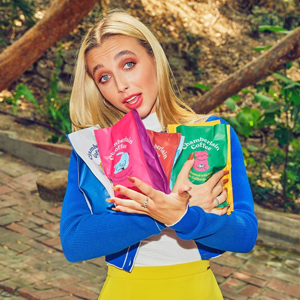
[00:00:10] Ray Latif: Hey folks, I'm Ray Latif and you're listening to the number one podcast for anyone building a business in food or beverage, Taste Radio. This episode features an interview with YouTube sensation and influencer Emma and Chamberlain founder of eponymous beverage Emma Chamberlain Coffee, who speaks to us alongside company CEO Christopher Gallant. We also sit down for a conversation with Buster Houston, the vice president of National Merchandising for supermarket giant Albertsons. The beverage industry hasn't broken Emma and Chamberlain yet, anyway. On the contrary, the 22-year-old, who rose to fame on YouTube and has since become one of the most prominent influencers in the world, says that she revels in the daily lessons learned from building her coffee brand, Chamberlain Coffee. Founded in 2020, Chamberlain Coffee sells whole beans, matcha, and instant coffee direct-to-consumer and also markets ready-to-drink, dairy-free lattes that are carried by Whole Foods, Albertsons, Walmart and Target. I met with Emma and Chamberlain Coffee CEO Christopher Gallant at last week's Beverage Forum held in Manhattan Beach, California for a conversation about the brand's development and growth strategy, why its identity is anchored by love and modernity, and how collaborations with other brands is determined by a set of, quote, filters. Hey, folks, it's Ray with Taste Radio. I am supremely honored to be sitting down Emma and Chamberlain and Christopher Gallant Emma Chamberlain Coffee. Emma, how are you?
[00:01:46] Christopher Gallant: I'm so good. How are you?
[00:01:47] Ray Latif: Fantastic. Chris, how are you? Amazing. You know, you guys were just up on stage here at the Beverage Forum. Fantastic job. There was a louder applause, I think, for you guys than there was for Robert Downey Jr.
[00:01:57] Christopher Gallant: Take that back right now.
[00:01:58] Ray Latif: Why? No, I think that you don't.
[00:02:00] Christopher Gallant: That is the greatest honor.
[00:02:02] Ray Latif: Well, come on.
[00:02:03] Christopher Gallant: I mean, I'm I'm blushing now. Oh, a little bit.
[00:02:06] Ray Latif: You have a great product. Your products already in Whole Foods isn't.
[00:02:09] Christopher Gallant: Oh, my God. I love that. Oh, I love Whole Foods. My God, I love Whole Foods.
[00:02:13] Ray Latif: Whole Foods is pretty amazing. This is not a knock on Whole Foods. I don't see a lot of new brands, particularly in the cooler set.
[00:02:20] Christopher Gallant: Totally.
[00:02:21] Ray Latif: Emma Chamberlain Coffee is one of the few in the last year or so. Yeah. I mean, how are you feeling about that? Is it going well?
[00:02:27] Christopher Gallant: I mean, it's such a mind boggling thing because retailers, it's a tough world out there and they are not messing around. If it's not moving, it's not happening. And it's been kind of frightening, but we've been so fortunate to have figured it out. I feel like in a very short period of time and we have such an amazing team just really grinding to build these relationships all simultaneously so that we can have a strong retail presence in a short amount of time. And it's been, I think, somewhat overwhelming for the team. We're exhausted a little bit, but I think it's exciting because there's a lot in retail. That's, I think, a really promising sort of strategy for us, and I think we realize that, and we're like, let's hit it hard then.
[00:03:18] Ray Latif: Yeah, I had spoken with another entrepreneur in the coffee set a few years back, and they said, you know, getting on shelf is the easy part in so many ways. Coming off shelf, selling the product is another thing. And Chris, you know, when you're talking about Whole Foods, they'll be willing to work with innovative brand partners, but they want to see your brand turn a lot. How are you getting the product to turn?
[00:03:40] Emma Chamberlain: Absolutely. I think one of them you already mentioned is being in the cold box. As soon as you're in the cold box, your velocity goes up like crazy. And we talked about this on stage a little bit, but even as a talent-led brand, with all the brand awareness we get from Emma, we still need to do all the nuts and bolts. We still need to have promos to drive trial. We still need to have off-shelf displays, work with Instacart, work with Amazon for Whole Foods to really drive velocity. So we don't really escape any of that just because of who we are.
[00:04:09] Ray Latif: A lot of people Emma and Chamberlain, you know, they're just passionate about you and what you do, but getting them passionate about coffee, getting them passionate about a can of coffee, I feel like it's a different thing, is it?
[00:04:21] Christopher Gallant: It is. I mean, I think, you know, it's completely different because people's taste buds are far more, I mean, it's more polarizing. Like you either really like something or you don't. Whereas someone's personality, it's, it's a completely different experience. And so I think, you know, that's why we're so excited about diversifying what we offer and in all categories, right? Like we don't just do coffee. We also do matcha. Um, you know, we have a sweet canned offering. We have, lower sugar canned offering. We're trying to diversify what we have so that we can appeal to a broader audience in the way that I think a personality can appeal to a broader audience in a way.
[00:05:01] Ray Latif: But I hear in the beverage industry all the time, you don't want to be all things to all people. Totally. So how do you be the one thing, but the one thing that people love you for?
[00:05:13] Christopher Gallant: I mean I think even though we are diversifying what we have and we sort of, so that people feel like they can find themselves in the brand, we also still have a very I would say solid and specific brand identity in the sense that we aren't necessarily doing everything. We're vegan. We're plant-based. So the product is appealing to that audience, right? And that's not appealing to everybody, but it's appealing to a lot of people. So it's enough people, right? We're leaning very... I don't want to say Gen Z, but modern coffee drinking in a way, leaning towards iced Beverage Forum the most part, various ways to make cold brew. We have lots of products that allow for cold brew making at home. And we're not everything to everyone, but I think we're trying to cater to the modern way of consuming, not even just coffee, but caffeinated beverages, I think, that you would get from a cafe.
[00:06:10] Ray Latif: Chris, what does the modern caffeine beverage drinker want to see beyond the caffeine in their beverages?
[00:06:17] Emma Chamberlain: Well, it's tough. You talked about RTDs earlier, and it's really hard to hit flavor profiles there because with our coffee, right? Take the coffee home, you grind it, you make it however you want. You add milk, you add plant-based milk, you add sugar, no sugar, whatever you want, and then it's your cup of coffee here. we've got to make it, we've got to make a drink pre-made ready to go that you love. And so I think it's been, you know, it's been a lot of work and a lot of back and forth, a lot of focus grouping to figure out how to get a product that the modern consumer wants. I think what we've identified here in this latest iteration we have, it's oat milk. It's a little bit sweeter. It's not quite where you see some major brands at 40 or 50 grams of sugar, but it's a little bit sweeter. I think we're hitting a real for lack of a better term, sweet spot in taste profile for that modern consumer.
[00:07:04] Ray Latif: You know what's interesting, Emma? I think about Starbucks. Not to bring up Starbucks, but they're the elephant in the room. Oh, of course, of course. And I almost wonder, if Starbucks had approached you and said, hey Emma, we want you to be the face of a new line of beverages, that might have been an easier sell than saying, hey, Starbucks consumer, come buy a Emma and Chamberlain Coffee. But when you are thinking about a Starbucks, because again, I mean, whether you like it or not, you're competing with them. How do you talk to their consumers and say, try us?
[00:07:35] Christopher Gallant: I mean, number one, I think for me, I've never been a huge Starbucks fan, right? Like it's like they didn't necessarily cater to me. I think there's been, you know, It's a very, that's a different consumer in some ways. No, not necessarily, because it is very broad. But I think what we offer is something that has maybe a bit more of a personality in the sense that it also feels, I think Chamberlain Coffee feels It feels more boutique-y in a way. It feels more, I mean, and that's just because I think naturally we're a smaller brand, but also because our packaging and the personality of the brand is very distinct and it's very playful and it's very fun. I feel like there's something about that that You know, it adds another dimension to the experience that you maybe don't get from a Starbucks, just because Starbucks is so, it's so massive that it almost, you don't get that sort of warm and fuzzy feeling maybe with it anymore. And I bet there are some people who do, but I think that our branding and And just the, you know, the way that we present ourselves as a brand is much more of like, we want to be your happy coffee family in a way. And we want you to find a character that you resonate with. And we want you to feel a part of this brand. Whereas I feel like with Starbucks, it's just such a big thing now that it's like, you can't, it's very hard to connect with it, I think.
[00:09:02] Ray Latif: You know, can I be a consumer for a second? Sure. I feel like your brand says love and it literally says love on the back. It does. And Starbucks, no offense to Starbucks, I don't feel the love. Totally.
[00:09:11] Christopher Gallant: So to speak. It's impossible almost to feel the love from them. They're so huge.
[00:09:15] Ray Latif: They're so huge.
[00:09:15] Christopher Gallant: Yeah.
[00:09:16] Ray Latif: Corporate. Yes. You know, I mean, no matter what they do, I think, you know, you go into their cafes and as welcoming as some of them might be, you don't get that warm and fuzzy feeling that you were talking about. Totally. Yeah. I mean, sometimes you get that warm and fuzzy feeling from merch, and I see your sweater there, which feels both preppy and also both, you know, preppy and loose and fun and casual at the same time. Totally. How much does merch play into what you guys do right now?
[00:09:43] Christopher Gallant: I mean, I feel like merch is not a huge part of our brand. I mean, we have fun with it. I think we just recently did a limited drop for Able Fools, which was like a shirt that had a coffee spill on it, like printed onto it. And so like, that's fun for these sort of marketing moments and, you know, getting people talking about the brand. And I think, you know, obviously, naturally, people like to sport brands that they love and things that they love, right? So I think we like to have an offering there. But it's not like a main, I don't think it's a main pillar of our business by any means, but it's important to have.
[00:10:15] Emma Chamberlain: I think we sell a lot of accessories, right? Coffee mugs and tumblers. People want to buy that. I think with merch, it's more, like you said, limited drops, interesting things that come along. We also try not to be huge branding all over it, right? So you can You don't feel like you're a billboard for our company.
[00:10:32] Ray Latif: Yeah. Chris, the last time we sat down and spoke, we talked about collaborations. And I wonder what it takes, you know, for someone who's listening right now and said, man, I think it would be, you know, if we do this with Chamberlain, it would be awesome. So when someone approaches you with the idea and then Emma, you hear it, how does that work? So you're like, yeah, that does make sense. Yes, we want to do this.
[00:10:52] Emma Chamberlain: I think there's a lot of filters it needs to go through, but the first filter is, does it make sense? Because we've done some that haven't made sense, right? Yeah, totally.
[00:10:59] Ray Latif: And we've done some that have not made sense.
[00:11:02] Emma Chamberlain: And they're great brands and they're great products, but the idea of coffee with those doesn't work. And the one we just did with Kendall Jenner in 818, like It just naturally works together. We've had a bunch of those. So the first filter is, does this make sense? If you're a consumer sitting there, are they going to say, oh, coffee and tequila? Yes, espresso, martinis, right? And then you can talk about the other filters we go through.
[00:11:25] Christopher Gallant: Yeah, I mean, I think, you know, Something that's very important to me as well is, you know, the brand identity. Does our brand feel like maybe a sibling or a friend to the other brand? I think that's very important to me because, you know, one of my main focuses with Chamberlain Coffee and where I, you know, come in handy, I would say, the most is the identity of the brand. And so I think it's very important for us to collaborate with brands that have a similar feeling identity. It's obviously nice when it's different to an extent, but they need to feel like siblings. They need to feel like family in a way for it to just work seamlessly when it comes to even how we present the product in the campaign that we shoot or whatever. It's very important.
[00:12:12] Ray Latif: I am running on borrowed time here, I know, because everyone wants to talk to you guys. But I gotta ask, this is your second year, third year in the beverage industry? Second?
[00:12:24] Christopher Gallant: I actually...
[00:12:25] Ray Latif: I think it's four for you. Four?
[00:12:27] Christopher Gallant: It might even be five. Wait.
[00:12:29] Ray Latif: Four, let's say four. Four, okay. Yeah. Okay, so you've got to be jaded at this point. You've got to be, you've got to be like, yeah, okay, beverage, my god, what am I doing here? But to the point where you're just, you're exhausted like everyone else in the beverage industry is exhausted.
[00:12:43] Christopher Gallant: You know what? I learned something new about this world every single day that's more riveting than I could have anticipated.
[00:12:53] Ray Latif: The Beverage Forum in particular? Yes. Okay. What did you learn today?
[00:12:55] Christopher Gallant: It's fascinating. Well, it's too early. You know, like it's just it's a challenging industry. It's really, really challenging and especially canned. Yeah. Especially canned because, you know, there's there's a process that these products go through to make them shelf stable, to make them, you know, this and that and this and that and to make them taste good. And it's. It's really tough.
[00:13:20] Ray Latif: It's really really tough, and I I had no idea But I love it more and more every day because I love the challenge Anyway, I'm glad to hear you say that because I think the solidarity that listeners need to hear from you about that Will make them keep going another day another day another day, and that's really what it takes is as much as it takes money, luck, and some good relationships. It takes perseverance. You've got to keep going. You've got to keep putting one foot in front of the other and saying, OK, let's make this work.
[00:13:53] Christopher Gallant: That could not be more true.
[00:13:55] Ray Latif: Well, that's a great note to end on, I think. Emma, Chris, thank you so much for taking the time. It's really an honor and I really appreciate it. Thank you.
[00:14:02] Christopher Gallant: Thank you.
[00:14:05] Ray Latif: As I mentioned earlier, Albertsons is one of the largest retailers Emma Chamberlain Coffee and the person in charge of where the products are sold in store is our next guest, Buster Houston. Buster has been in the grocery business since 1989 and in his current role as the Vice President of National Merchandising for Albertsons for the last three years. I spoke with Buster at the Beverage Forum for a deep dive into Albertson's merchandising strategy, the four P's that dictate decision-making, how packaging impacts shelf placement and in turn generates trial, why slotting fees aren't as cut and dry as they may seem, and how brands can start a conversation with Albertsons. Hey folks, it's Ray with Taste Radio. Right now I'm honored to be sitting down with Buster Houston, who is the Vice President of National Merchandising at Albertsons. Buster, great to see you. Thanks for having me. How does one get the name Buster?
[00:15:00] Christopher Gallant: You get lucky. You know, grandpa and an uncle had it, so I inherited. A lot of dogs have gotten that name over the years too. I don't know if I can take credit for it, but when I hear someone yell Buster, it's typically a dog or I'm in trouble.
[00:15:18] Ray Latif: When I think of Buster, I think of Buster only from ESPN. And then sometimes if someone has like a Boston accent, I lost mine, but someone would say Busta. You think of Buster Rhymes, the rapper or the hip hop artist?
[00:15:32] Christopher Gallant: I lived in the Bay Area, so there was a catcher there that was kind of popular.
[00:15:35] Ray Latif: What was his name? Buster Posey.
[00:15:36] Christopher Gallant: Buster Posey, right. Buster Posey, kind of popular. But I was older than him, so I was the first Buster in the Bay Area.
[00:15:43] Ray Latif: Okay, you know, I little known fact I did not know that I think I'm glad that we're sharing that on a podcast Because we don't we don't get to do a lot of firsts on Taste Radio.
[00:15:53] Christopher Gallant: These are the things that are important.
[00:15:54] Ray Latif: He's really ours Yeah, yeah, you know when I think National Merchandising and you are the vice president of National Merchandising at Albertsons and can you explain you know to folks who might not know exactly what you do in your focus at Albertsons National Merchandising is and
[00:16:08] Christopher Gallant: Hey, that's a large question, right? You know, if you think National Merchandising holistically, you got four big P's, right? You got product, you got placement, you got pricing, and you got promotion, right? It's the management of all of those. My specific role within Albertsons is we own the product and the placement decisions from a national perspective. and we collaborate with our 12 divisions around pricing and promotional strategies. But they own the tactics at the division level to make sure that they're competitive within their markets. The other thing National Merchandising is, you know, the old days it was what happened within the walls of the store. Merchandising today is so much larger, right? We have so many other ways to drive traffic to the categories and to get transactions from an omni perspective. So, I gotta tell ya, I think I had it figured out maybe five, six years ago. I don't have it figured out anymore. Merchandising is a very complicated world, but what's the right way to get a shopper to a category or a segment within there? And it's fluid, right? Those are definitely fluid. Being here today and spending time with some of these younger brands and these influencers, how you manage that business is definitely much different than how you manage a big national brand that's been around for quite a while. It's fun. Merchandising is fun and it's vast. And there's a lot of different ways to try to find that secret to get the shopper to love you for it.
[00:17:36] Ray Latif: Let's start with position, because position is really important. Where you're sold in store, who you're next to. And oftentimes, I'll ask a founder, where does your product, where do you want your product to live on shelf? Where do you want your product to live in the store? And they'll say, oh, you're next to this brand, and so on and so forth. But ultimately, the decision is not theirs. But how often do you take your cue from the founder?
[00:17:56] Christopher Gallant: That's a great question. I would say, again, dating myself, but up to five, six, seven years ago, it was very cut and dry. Categories were very cut and dry. Consumer decision trees were very cut and dry. Take Beverage Forum instance. It wasn't super complicated. Carbonated soft drink, energy, water, functional, pretty much covers you. Today, that's arguably not the right way to do it anymore. I think all of us have a challenge to rethink these aisles because they continue to evolve. We call it the blurring of the lines in the beverage categories, where this item that used to be considered a water now has adaptogens. you know, alkaline and whatever else is put in it. You walk an energy set, you know, a few years ago, you know what brands you saw, there was just a few of them and it was energy. Now you got pre-workout, you got post-workout, you've got hydration in energy. So all of these things are evolving and, you know, now it's interesting to have the conversations with your partners and ask them where they think it should go. And literally when they give you the feedback, I was actually interested where you thought I wanted it to go. That's crazy. That's a crazy concept. But yeah, when it comes to, you know, category management, merchandising, there are a lot of things to think about, you know, where we want to be, what the visibility level is, you know, how an own brand plays in the segment or how an own brand doesn't play in the segment. What do I want the customer to see? Do I want to try to trade them up to a multi-pack? Or do I want to get them to enter at a single? And, you know, that differs as you walk up and down these aisles. And, you know, for someone like me that does this, it's fun to look at what we're doing and it's fun to look at what the others are doing. And then obviously we always course correct as we go, right? We always course correct.
[00:19:44] Ray Latif: There's another P, and maybe you mentioned it, but it's not one of the four, but it's packaging, right? I mean, packaging has a lot to do with how your product is merchandised. It's the first thing people are going to see be introduced to your brand in most cases. But the package has to stand out in a way that is very different from everything else that's on shelf. And that's kind of difficult, especially if you're selling in the same can, if you're selling a similar type of beverage. So, in your experience, what really stands out for packaging? And again, you know, things have changed quite a bit over the years, but what consistently has been the way to attract consumer attention from a packaging standpoint?
[00:20:28] Christopher Gallant: Great question. And I got to tell you, it's becoming tougher and tougher and tougher as the customer's spending less time at the shelf, right? I think I'm hearing three seconds or less is really your time to capture them. And I would say that that's really the challenge that a lot of our vendors have to tackle, which is the awareness within those three seconds to draw the awareness, to get the message you want to get across in those three seconds, and ultimately to convert. You're seeing a lot of different ways to go about it, a simplicity angle or a detailed angle. And I think as we see the packaging come across, that actually kind of tees you up for what the best way to approach it from National Merchandising perspective is. Some of these brands have to tell the story of why you need to drink it. Others, they're just delicious and I want to draw your attention and I'm going to put something flashy on there, right? The packaging is a big deal, but I'd also argue nowadays the communication vehicle to the shopper, whatever that is, whether it be a celebrity, whether it be the media, whether it be one of these venues out there, TikTok or X, it's really a holistic conversation above and beyond just the packaging. We do care about the packaging. You can win or lose with the packaging. But boy, it's getting complex when you look at some of these packages and there's a paragraph written on there on why you should drink it, right? You're going to struggle to get somebody to read that whole thing and say, wow, I want to try this. So it's always been important, but I would argue, boy, packaging is such a huge deal right now to try to get them to stop and take a look.
[00:22:05] Ray Latif: For sure, and you know, someone had told me that the rule is you need to be able to identify what the product is six feet away, from six feet away, and you need to be able to understand the product within six seconds. Maybe it's down to three, I mean, or at least have enough interest in picking up in three and be able to understand what the product is within six, which is asking a lot of a package. It's probably easier in certain categories, like coffee. I'm holding in my hand a Emma and Chamberlain Coffee with oat milk. Pretty easy to understand. It says Chuck Coffee right there, Vanilla Latte. Even oat milk these days is pretty broadly understood. Cute little animal on it. And Emma and Chamberlain. I mean, if you Emma and Chamberlain, you can make that connection. It's pretty easy. But what about coffee? more esoteric beverages.
[00:22:49] Christopher Gallant: You know, for us, number one is how do we position ourselves best to get to that point where they're going to have that question, which is where it's located. Right. You get into some of these categories now that they're almost becoming catch all so functional. Right. Everything seems to be functional anymore. Right. That was a very defined category five or six years ago. So number one is we want to make sure that we're we're We're helping that process so that where I think it's going to be, again, we have to think where a customer thinks it's going to be, it is going to be located there. And then secondly, you've got all these beautiful things around colors and fonts and starbursts and messaging that they spend a lot of money to make sure that they're getting all the consumer research. Big topic. You know, that's a big topic. You know, I think the other thing is, you know, you've got multiple ways to sell. I talked about the omni angle, but you also have the display angle. And if it's something that, um, you know, us and a CPG think is really a game changer, you've got check stands and there's no more impulsive purchase than somebody waiting and hopefully they're not waiting in line at Albertsons store, but there's nobody more impulsive than that first person that's heading up and boom. I may have 30 seconds to take a look at this, right? And that's a great area to get trial. If you look at some of our successes with influencers, that's how we kicked them off. We put those right up near the check stands where there's going to be a little bit of a touch point where your eyeballs are going to take a look. And then with that, you also get the added benefit of cardboard, right? You've got the box to add a message, large print. If you need an image, you get that. So it's really, It's really fun to try to figure out the mousetrap on everything and it differs like I talked about earlier by segment by brand, what a big CPG can do with their budgets and their touch points versus a little one that differs, right. But it's interesting that you don't have, you know, you don't have one One size fits all or one playbook when it comes to a category. Each of the players you might have a different way to win. You know trial in some of these where you just don't have a large household penetration but you're in a good strong category that does. Let's just say maybe it's a one horse race in one of those categories. Very important to try to get people to try these things. You can do digital demos. You can you could actually do old school sampling, etc, etc. But you know, how do we try to get more trial into these categories in areas that are different or, you know, evolved a little bit from the big brand.
[00:25:20] Ray Latif: Well, when you're getting or asking your customers to try a new product, it helps if it's really easy for them to find, buy the checkout as an end cap. I think in some of those cases, it's almost like Albertsons is taking a bet, taking a flyer on these categories and saying, okay, you know what, we think there's a lot of potential for these types of products.
[00:25:41] Christopher Gallant: You know, the art and the science of this business is fun. You know, I think households and baskets is really what would excite me and gets us going on that. You know, you know these big brands up and down these aisles. Every single one of us that compete with each other across the street have the exact same ones. And it becomes a price game. We know how to do that. They know how to do that. We've all been doing that for a long time. What can we do to differentiate ourselves to have folks purchase these products and tell their neighbors about them, right? They're not going to say it on the big brands. Everyone has had an Oreo in their life, things like that. These are points of difference, right? The other thing is a lot of these products have age groups attached to them, right? If you think about the ready to drink coffee that Emma's got, that's way different than the candy bar that Mr. Beast has got, right? We've got caffeine. Is that still a Gen Z? Yeah, probably. But it's in a different area of Gen Z, whereas some of the others might get Gen Alpha into there, too. So households is a huge deal for us in the long-term play on households, right? As our shopper base changes, we've got to change with them. And we've got to bring new ones and have them love shopping with us. We have an amazing perimeter experience. We can create that with the produce and the meat and the bakeries. We want to do that in the center of the store, and that's very difficult to do because of the consistency of big brands from the folks across the street. So that's why I want to take a flyer with these folks. That's why I want to get to work with Emma, right, and have her talk to her base, have her walk our stores and take videos within our stores, get some new eyeballs in those stores that'll still buy some of the base things they've always been buying. but to look at some of these segments. It's also interesting the categories that they're hopping in. Alcohol has been a big one for a long time, but now seeing them come into a lot of the, I'll call it instant consumable type categories has been fun, but they've all been a different experience on how we think we can win with them.
[00:27:44] Ray Latif: Do you source data? Do you utilize data as much as I think you might when making those types of decisions? Or is a lot of it internally developed and sourced?
[00:27:55] Christopher Gallant: So we always use data. And that's where we go to the art and science piece. We know a lot about a lot of things. But when it comes to some of these brands and your speed to market on that brand, you being one of the few folks that that endorser will talk about or that influencer or or that attribute attached to the product that doesn't have a celebrity attached to it. You got to hedge in, right? I go back to Greek yogurt way back when, right? I mean, that was one that if you got in early on, you won. You won for quite a while. Kombucha, right? Things like that that I've seen. So these are different in the sense that a lot of these categories have evolved and now it's just an attribute within a category. But how do we get people to look at us on things that we can be different in the center store and actually get your car to take a left into our parking lot because of some of these things? And again, we've got every staple under the sun, but so does everybody else. So the art and the science piece and using the data is important. After we brought these products in is really where the data gets strong for us. So if you take one like the one in front of you that you've been enjoying, Emma's Coffee, 60 days after I brought that in, Hold some serious household data on that item, right? And obviously the numbers will be pretty staggering.
[00:29:13] Ray Latif: And you're talking about you're pulling the household data based on rewards programs?
[00:29:17] Christopher Gallant: Yep, yep, yep. Do you share that with brands by the way? We do. They subscribe and they can get the exact same things that we get. Consumer centricity is where it's at, right? And that's a big topic. So when it's something like this, I'm very curious who's buying that. And the data that we have and we provide to our partners tells a very, very telling story. And that one is a fantastic story for us in regards to new friends we've made. And that's very important in this business.
[00:29:49] Ray Latif: Yeah, for sure. You know, back in the day, and actually this is still true, this product, this brand, Chamberlain Coffee, because it is a natural brand, natural-centric brand, I mean, it's more of a lifestyle brand, but I mean, it could have been relegated to the quote-unquote natural section of the store. I don't know if Albertsons has like that separate sort of kiosky kind of section. Do you have those in your store?
[00:30:09] Christopher Gallant: You know, we've had a lot of iterations of that. I would tell you now we're pretty defined within the categories. Across our whole fleet, you can find those. But in general, I would say philosophically, we've embedded the brands within the section.
[00:30:21] Ray Latif: Yeah, because I just want to touch on those sections. I almost feel like they're so less trafficked than other parts of the store. And as a brand, if I were a brand owner, I'd be like, you know, not my favorite place to be in. But how do you graduate out of that?
[00:30:38] Christopher Gallant: Well, you know, stores are big. Stores have a lot of different locations. So if we want to stay on Emma's brand, cold air, you get a lot of eyeballs in cold air, ready to drink coffee is a great growth area in those. We have front end check stands. And, you know, as the front end experiences evolve from traditional to let's just call it a corral with self checkouts. which has provided us a little bit more incremental real estate in that one vicinity. We like to get more eyeballs. Once again, a lot of eyeballs up front. We like to get more eyeballs on some products we wanted to see. Obviously, you know what brands have high velocities through there. Got to manage pack out, got to manage turns, get all that. But this invites us an opportunity to get these out where they need to be. Ready to drink coffee is the perfect one to talk about on your topic because it's four feet buried within a sea of a lot of different aluminum and glass down that aisle. And four feet within 72 feet or so, that can get lost. So that's a top of mind category for us. You take a look at the keggers on that category, super healthy and it's going to continue to be a huge growth engine for us and the industry. So we want people to see it and we definitely want the unique shoppers of some of these brands to see them.
[00:31:56] Ray Latif: I can hear one of our listeners right now saying, you know, this has been a great conversation with Buster, but Ray, you got to ask about slotting fees. And I'm not sure how much influence you have on slotting fees within Albertsons or not, but it is a big. expense for brands and it terrifies a lot of brands to think, okay, if I go into Albertsons, I'm going to owe the company this much money per SKU. And I don't know. I mean, is there a strategy that brands, is there a way brands should consider slotting fees? Is there a way that they should just accept the fact that this is part of the business? I guess what I'm asking is, How do you talk to brands about slotting fees and the way they work and support what you do at Albertsons?
[00:32:43] Christopher Gallant: Yeah, you know, the first thing I'd say about slotting fees is just there is a cost to take something on and off the shelf. I don't think anybody denies that, but there's a reality there. Secondly is, you know, by category, things differ, right? They differ in regards to philosophies and strategies and what our competition does versus what we do, et cetera, et cetera. You know, I would just generalize the statement that, you know, we're always going to do the right things for our shoppers. And that's a vast statement. But you know, if I've got to have a brand on the shelf, because I believe it's going to bring in a new shopper to us with a pretty large scale. I have to figure a way to make it work. And there's a lot of different components within how we do the business. I know that topic. We talk about the slotting topic a lot. Every relationship is different in the sense that the ways that we are building them to win may not always be the same. So yeah, it's an intimidating topic. And I would just say, you know, I'm surrounded by a group of very talented individuals that collaborate very well with our divisions and our CPGs to create wins. And hopefully when you think Albertsons, you are going to think of a lot of these products as you walk up and down our aisles, because I'm proud to say, I think we're getting a lot in there. And that makes me happy.
[00:34:00] Ray Latif: So if I'm hearing this right, there is some leeway. And I don't know how much of what you want to give away or say, but I mean, it sounds like you can work with brands on a case by case basis.
[00:34:11] Christopher Gallant: Yeah. What I would say is when you have a partnership, you work as partners, you figure stuff out, you find ways to create wins. Ultimately, we both have to win in a relationship, right? If one is winning and the other isn't, that's not a partnership. You know, we we get to your point. We don't want to intimidate anybody. We want everybody bring in their innovation to us. We want them working with us. We want to have a way to surprise and delight a shopper with a brand within a category that I may have before somebody else. So, yeah, we're always going to collaborate and work through things. Like I said, every conversation, I would say, is is different to an extent.
[00:34:53] Ray Latif: You know, not to butter your bread, but I feel like you're totally right, that Albertsons is looking for ways to partner with and work with all different kinds of brands. I mean, your Pitch Slam work, just being at different events and big teams. being very, very, very visible. If you can meet someone from your team and have a quick conversation with them, that's great. But for folks who may not be able to, say, be in an event like this or be at an Expo West, how do you create a good starting point? How do you start a conversation that can lead to another one with Albertsons?
[00:35:28] Christopher Gallant: Yeah, it's one of those things that, I guess almost to your point, I mean, we were just at BevNET. I think we had a meeting with 72 vendors at BevNET.
[00:35:37] Ray Latif: Yeah, that's part of our one-on-ones, yeah.
[00:35:39] Christopher Gallant: Right? You know, we obviously go to Expo, we bring a lot of people. Um, we also have some relationships with, uh, with some parties, uh, that bring us CPGs regionally that are very small that may be able to supply three stores in a area that that's super relevant, right? Think of like Honey or things like that. So we have a balance, right? We have a national team that oversees, I'd say large scale, we call them a lot of core SKUs that we're going to carry across 2,000 plus stores or whatever the number is. We also have 12 divisions that are super agile, that can micromanage regions, and they really help with that, right? So we collaborate together when it comes to schematics. What do you need from a local perspective within these categories, within these areas? and how does that work into a core assortment so that we create that perfect dynamic of managing the local, fantastic, and then obviously bringing the size and scale in on the big brands that you gotta have within there.
[00:36:38] Ray Latif: Buster, I have learned quite a bit about Albertsons and not just in National Merchandising strategy, from National Merchandising strategy standpoint. I feel like this is a conversation that I'm so excited to share with our audience. Thank you so much. You're welcome. Really appreciate you taking the time.
[00:36:52] Christopher Gallant: Thanks for having me. Good seeing you. You too.
[00:36:56] Ray Latif: That brings us to the end of this episode of Taste Radio. Thank you so much for listening. Taste Radio is a production of BevNET.com, Incorporated. Our audio engineer for Taste Radio is Joe Cracci. Our technical director is Joshua Pratt, and our video editor is Ryan Galang. Our social marketing manager is Amanda Smerlinski, and our designer is Amanda Huang. Just a reminder, if you like what you hear on Taste Radio, please share the podcast with friends and colleagues. And of course, we would love it if you could review us on the Apple Podcasts app or your listening platform of choice. Check us out on Instagram. Our handle is bevnettasteradio. As always, for questions, comments, ideas for future podcasts, please send us an email to ask at Taste Radio.com. On behalf of the entire Taste Radio team, thank you for listening, and we'll talk to you next time.
[00:37:46] Christopher Gallant: you