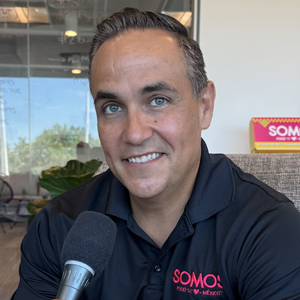
[00:00:10] Ray Latif: Hello, friends, I'm Ray Latif, and you're listening to the number one podcast for anyone building a business in food or beverage, Taste Radio. This episode features an interview When Miguel Leal, the co-founder and CEO of modern Mexican food brand, Somos Foods. When Miguel Leal and his co-founders were developing Somos Foods, they believed that they were creating, quote, Goya for millennials. It turns out that the brand was more suited to be, quote, Reos for all consumers. Miguel is now in his fourth year at the helm of Somos, which launched in September 2021. He founded the company with Kind Snacks founder Daniel Lubetzky and Rodrigo Zuloaga, who, like Miguel, is a former Kind executive. Somos marks clean ingredient simmer sauces, salsa, rice and beans that are produced in Mexico and made using traditional techniques, according to the brand. The products are distributed in over 11,000 retail stores, including Target, Publix, Whole Foods, Walmart and Albertsons. While their original vision, to re-envision Mexican food in the U.S. with a focus on authenticity, convenience, and sustainability, has remained consistent, the communication of that message has evolved. Somos is now positioned as a brand for quote, Mexican meal solutions. Miguel says that the shift required the company to rethink nearly every aspect of the business, including marketing and product development, an undertaking that was challenging and at times humbling for Miguel and his co-founders, each of whom have decades of experience in the food industry. In the following interview, I spoke When Miguel about the genesis of Somos, how he and his team came to the realization that the brand needed to adjust its positioning, mistakes that in hindsight were avoidable, identifying areas for improvement in how the products tasted and were named, and how their timeline for a potential acquisition has changed significantly. Hey folks, it's Ray with Taste Radio. Right now, I'm honored to be sitting down When Miguel Leal of Somos Foods. Miguel, great to see you.
[00:02:28] Miguel Leal: Ray, thank you so much for visiting us here at the Somos Foods Global Headquarters.
[00:02:33] Ray Latif: Yes, in beautiful Stanford, Connecticut. We're right on the water. here in your office, and this is just a beautiful, extraordinary view, actually. I'm happy I'm here.
[00:02:46] Miguel Leal: Yeah, we're totally locked out. It's a beautiful summer day in Connecticut. You know, we get all the seasons here, and we're just locked out today, so you brought really great energy with you.
[00:02:57] Ray Latif: Oh, thank you. Thank you so much. And you brought some really great products to the market recently with these new simmer sauces. I have a jar in my hand right now, the El Pastor Taco Simmer Sauce. I was on Instagram yesterday and I saw your partner, Daniel Lubetzky, doing a video segment where he was trying to get someone to say Somo Simmer Sauce five times fast. So I think I can do it. Somo Simmer Sauce, Somo Simmer Sauce, Somo Simmer Sauce, Somo Simmer Sauce, Somo Simmer Sauce. I did it.
[00:03:26] Miguel Leal: That was pretty good.
[00:03:27] Ray Latif: Yeah, yeah, I think I did pretty well there. But I was looking at this and then I'm thinking, Simmer Sauce is a great name, but this is almost like a starter sauce, right? Did you go back and forth between starter and simmer?
[00:03:38] Miguel Leal: Yeah, we did, we did. Our objective is to make Mexican meals easier. You know, our thesis is that Mexican food is the same size as Italian food, but Mexican food is much smaller at home. because we don't have a pasta sauce. We don't have a way to have like two or three ingredients that can make a magnificent meal. And simmer sauces has become a big solution for that. And as we were thinking of the name, a starter sauce we thought would signal to the consumer that it would be the thing that you use at the beginning of preparing your food. while simmer sauce you use at the end. And this is meant more of a finishing sauce. You can grill your chicken and then just at the end just simmer it, you know, with this sauce and it ends up being perfect and it's two ingredients and then you're ready to have an awesome taco Tuesday.
[00:04:35] Ray Latif: Convenience is the key these days because I have a hard time trying to figure out what to cook when I get home from work and do it in a very short amount of time so that everyone can eat when they're supposed to eat. So yes, making things easier and doing it in like 10-15 minutes, that sounds perfect to me. And, you know, you have been in the food industry for a long time. I want to say 25 years almost at this point.
[00:04:58] Miguel Leal: Yeah.
[00:04:59] Ray Latif: Yeah. Just about. OK. And, you know, thinking about all the experience that you've had over the past two and a half decades and all the changes that we've seen in the food industry, I imagine that you've seen a lot of through lines, a lot of commonalities to successful brands and how they've achieved their position on the market and then try to incorporate those through lines into SOMOS. But what have you seen? I mean, how has the industry changed and how are you applying that, those lessons, that experience into SOMOS?
[00:05:32] Miguel Leal: I mean, I think when I started my career, my first job was in 2001. I was an intern on the marketing department of Honey Nut Cheerios at General Mills in Minneapolis. And I think back then, as I think, you know, two, two and a half decades ago, There were a lot of convenient meals and there were a lot of delicious meals that you had to make from scratch. And what I've seen lately is the intersection that you were just talking about, you know, getting home and having, you know, 15 minutes and a few ingredients to make your full, but doing it with better than restaurant quality meals. has been an important change that I've seen across all of categories. You know, we were talking about, you know, Kind Bars just recently or Cholula Hot Sauce in the hot sauce aisle.
[00:06:27] Ray Latif: Both companies you work for.
[00:06:28] Miguel Leal: Yes. Like I, you know, from from my first job to my latest job, I just saw this you know, food companies and specialty high growth entrepreneurial companies bringing that solution to consumers. And we just, it was frustrating to us to not see it on the Mexican shelf. So we decided out of that frustration to start Somos.
[00:06:53] Ray Latif: Somos is also a really interesting brand in that it represents your background. You were born in Mexico, but as we talked about prior to this conversation, you spent a lot of time shopping in the United States. And what's interesting to me is that Mexican cuisine is viewed in a very different way here in the States than it is in Mexico. And introducing the flavors, the ingredients that you grew up with to American consumers seems like a great idea, but it feels like it can also be kind of hard because we grew up on, I don't want to say it, but Taco Bell and all that other nonsense. How did that impact your decision, your interest in introducing samos to the market?
[00:07:36] Miguel Leal: I mean, you're exactly right. I grew up in Monterrey, Mexico. My partner Daniel grew up in Mexico City. Rodrigo, our third co-founder, he grew up in Guadalajara. All of us worked that kind together in New York City. We were friends, then we worked together. And I think the biggest piece that influenced us, that is influencing the market today, is the restaurant to retail trends. Particularly with Mexican food, we saw this huge change in the restaurant scene. And it doesn't matter if you're in Boston, New York, LA, Chicago, Texas. I mean, you've seen the change from chichis to chipotle to even New York has Michelin star Mexican restaurants nowadays. So you can imagine us living in New York for the past 15 years seeing all this change in Mexican food, going from Tex-Mex, enchiladas, to pastor, and moles, and really complex regional dishes. But as people that have been working for almost 25 years with retail food, we did not see that change on the shelf. So more and more, this road from Tex-Mex to Real-Mex that was happening in restaurants was not the gap between the restaurant and the shelf, just was increasingly, you know, larger. And we thought that we should be one of the companies to address that gap. And as consumers are learning more from Mexican food from restaurants, that they can come to the shelf and do it themselves versus ordering from Uber Eats.
[00:09:26] Ray Latif: How long was this idea in planning? You all worked at Kindbar, as you mentioned, the three co-founders. Was this something you were thinking while at the company? And what did you see as the most important aspects, the most important elements of the brand during its development?
[00:09:40] Miguel Leal: Well, we always knew that there was a gap. And the conversation started probably five or six years ago, when we were still that kind. We were just really frustrated. We're like, how is this? Amazing food. My wife is American. She's from the Midwest. Daniel's wife is American as well. She's from the Mid-Atlantic. And we would introduce our wives and our friends to this amazing Mexican food at restaurants, and so frustrated that they didn't have the ingredients on the way to do it at home. So six years ago, we came up with the idea, but we were still working at Kind, and Kind was such an important personal project for all of us. that we just didn't have the bandwidth. I would say that Somos wouldn't have happened without our experience at Cholula because Cholula really gave us even more confidence in that and also showed us a way through supply chain to bring these great ingredients in a unique way from growers and chefs in Mexico and bring that quality into the US. So it was like the connection of those two things, the connection of the consumer that Daniel, Ellie, and I had this idea when we were working at Kine, plus the experience in Cholula, and then frankly, At the end of the Cholula journey, just sometimes necessity is the mother of all inventions, right? I ended up, you know, transitioning that business to McCormick, so I didn't have a job. I had a lot of time so we could actually work on what became Somos.
[00:11:23] Ray Latif: Where did the name come from?
[00:11:24] Miguel Leal: So it's interesting. So we have 200 different names. You know, Daniel has a very particular way that we would do, I think he talks a lot about it on LinkedIn, that we do ideation of kind. So we start with like a blank canvas and just put a bunch of names out there. And we were down to three names out of the 200. We did our research. Can you trademark the name? Can we get it on social media? Does someone else own it? Can people pronounce it was a big deal. We didn't want something that was like amigo. We wanted something that actually people could pronounce but also learn what it was. And Michelle, Daniel's wife, came up with the idea of Somos. And Daniel loved what it meant. It means we are. And when we started the company three years ago, there were a lot of conversations on immigration. And it really felt that people love more Mexican food, that Mexican culture. So we use the company as a bridge. Like, well, maybe we can show the best of Mexico through our food. So Somos was great. I love that because it is a very symmetric word. It's a palindrome. It's a palindrome. And I thought it would be beautiful to display on a label on the shelf. And for those reasons, you know, we ended up with the name.
[00:12:53] Ray Latif: I'm curious as to what the other two names were.
[00:12:55] Miguel Leal: I am ashamed to tell you. Right now, they don't make any sense. And we're like, why would we even consider them? Hard to pronounce, mean nothing, doesn't look great on the shelf. But you know, hindsight is 20-20 looking backwards, right?
[00:13:10] Somos Foods: For sure. Vibrant Ingredients is the natural ingredient partner powering food and beverage innovation, delivering flavor, function, and protection through a science-backed portfolio. Vibrant delivers purpose-driven solutions that help brands create extraordinary experiences. Discover what's possible with Vibrant today. Visit vibrantingredients.com.
[00:13:39] Ray Latif: You've talked a bit about creating restaurant quality food for American consumers, ones that they can use to make food instead of takeout. That wasn't always the plan. It wasn't always a business strategy. When we talked last, you told me that at the beginning, We thought we were launching Goya for millennials, but we realized we were creating Rayos for consumers. How'd you come to that realization? And did you have to rethink the entire business strategy as a result?
[00:14:11] Miguel Leal: Yeah, I mean, it was a great learning. I am a first time founder. So this is my first time going through a company that you create and you have a vision. And then at the end, consumers are always the owners of the brand. So you're exactly right. The first idea that we had is we see Goya, an incredibly successful company, mostly for the Hispanic population in the US. And a lot of the food that they have just, it's cooked through very traditional methods that take a lot of time to put on the table. So we said, well, we see the newest second and third generation Hispanics. You know, have more dual income households, have less time to let the beans soak overnight. Let's make something as convenient, but with even better ingredients than what Goya has. And what we realized was that a lot of our food was actually being consumed by mainstream consumers that have, for many years, gone out and picked Mexican food as a place of gathering in a restaurant, have ordered Uber Eats to take chipotle home. And now, because they've got married and started a family, they really want to cook. But they need, I don't know how else to say it, but something that graduates them from Old El Paso. The gap between Old El Paso and Goya is just too big. So we said, well, if we can put our vision at that point, what we pivoted to was five ingredient recipes that you can do under 10 minutes. What consumers told us was that is what I'm looking for. And that's what you told me at the beginning of the interview. I get home and I need to have something simple with what I already have on the fridge that I can make in less than 10 minutes. And that's when the story of Rayos really connected with us. What I see in parallels with the Italian food category, by the way, Mexican and Italian food are the one, two ethnic foods in the U.S., so there is a lot in common. What I felt that team did really well is it allowed consumers to not have to compromise between convenience and quality, and we felt like Somos could do that for Mexican food as well.
[00:16:50] Ray Latif: I love the idea of creating a Goya for millennials. And I think that is a great idea to try to execute upon. But again, going from that to, hey, we're going to be the restaurant quality brand for everyone. It's kind of a big jump. Was it something where you had to rethink your product line, your marketing strategy, how you communicated with consumers, or was it just tweaking here and there to get it to a place where people understood what you were now or are now?
[00:17:22] Miguel Leal: No, it was actually quite a big undertaking. It was a huge change in the business. What channels we are going against. So when you see Goya, yes, they sell in Walmart and yes, you know, they sell in Target, but A lot of what they do is in bodegas, the Hispanic channel, and that is a channel that we had to deprioritize in favor of doing more with the natural channel. So that was a big pivot. The product line was a huge pivot. We created picadillos, and we created chipotle mushrooms, and we created even our chips. And at the beginning of our journey, we had tortillas that we had to discontinue. Because what consumers kept telling us is that the story of the five-ingredient, ten-minute meals was very successful. And the marketing was probably the biggest piece of it. We went from telling consumers tips about visiting Mexico and highlighting old school cooking processes that have been passed around from generations to really focus on partnerships around recipes. We have partnerships with other brands on the shelves in shopper marketing. We do tons of partnerships on social media. Because we know in order to create these five ingredient recipes, they are not going to be five ingredients for samos. So we need to be that category leader or part of the category that comes and ideates in our route to market with our customers how to bring these ideas to life. But this is something that we heard loud and clear from the consumers. And the moment that we pivoted, Every quad week, we've seen a velocity growth. It is something that just seems resonated. And at this point, it's all about execution. How can we execute that in a better way?
[00:19:38] Ray Latif: That's a big undertaking. It's almost like you created a new brand in so many ways just with the same brand name, but it was the right thing to do in the end. I'm curious as to how you communicated with consumers, how you got that feedback. Was it just, you know, focus groups? Was it survey? Was it, you know, just them telling you on social media or via email that this isn't making sense to them? How did you get that information?
[00:20:03] Miguel Leal: I would say E all of the above to tell you the story. So it really started with social. So what we would look and we just have to be brutally honest with ourselves is what were the messages that were resonating. And any time that we would make Mexican meals made easy, we just saw a huge uptick in engagement and a huge uptick in shares, a huge uptick in likes. And just slowly by slowly, the data was telling us to go that direction. We did do some consumer research about it, a little bit informal, and then more quantitative formal, before we brought it with retailers. We went with a couple of our big retailer partners, and we told them that we wanted to bring that idea on the shelf, and to our surprise, They love that. They put us in contact with some of our bigger brands on the shelf that would complement our recipes. And the first promotion that we did on Mexican meals is Made Easy was at Meijer about 15 months ago. And just the lifts were incredible. We had a shelf blade. We had a couple of brands. I remember two or three brands that we participated. We put five ingredients. You could have a meal for four in under 10 minutes for under $15 or $20. And the lift was incredible. The repeat rates were incredible. And we felt, well, we just need to scale it up. Let's take it to other retailers. Let's take it with other brand partners. And I feel we're still at the beginning of the journey. But we just had our data drop on Monday. And we continue to see growth. And we're like, OK, this really feels like a place where someone can thrive.
[00:22:04] Ray Latif: I've had this phrase said to me and I've said it a lot over the past two or three days, which is keep it simple. And Mexican made easy, five ingredients, I'm sorry, Mexican meals made easy, five ingredients, 10 minutes, under $20. That all seems simple and really easy to understand. It's also important to name your products in a way that people are going to understand them. And that's something you tweaked as well. Talk about that process of renaming some of your products.
[00:22:30] Miguel Leal: Yeah, I think it's still part of the same journey, is just realizing what is the value that you bring to consumers. How are you making their lives better or their lives easier? And I'm sure there are a lot of other founders out there that can relate to what I was going through, but it wasn't my first idea and I had to put that ego aside for the benefit of the brand and, you know, of the company. And at the beginning, you know, we came up with really cute names, Picadillo or Salsa Matcha. And there were things that only You know, if you were a Mexican immigrant like me of my age, you would find that funny. The only ones on the inside joke were ourselves. We were actually too smart to be simple, you know? And salsa macha is another great example. Salsa macha is our product with our highest repeat rate, and it's the one that ranks the highest in velocity in their category. And it is a Mexican chili crisp, but in Mexico we call it salsa matcha. But for the U.S., for the consumer that we are serving, it's neither a salsa, because it has no tomato, and it's neither matcha, because it's not matcha tea. And we were just at a UNFI show, and we decided it was a two-day show on the way to Boston by Mohegan Sun about a year, year and a half ago. And we said, one name, we're going to sample this using the name Salsa Macha. And the second day, we're going to sample it using the name Mexican Chili Crisp. And we saw five times as more cases on the second day. And we're like, OK, sometimes you are wrong, and you just need to Be honest with yourself and move on and do whatever is the best for Somos and not whatever is the best for Miguel or for Rodrigo or for Daniel.
[00:24:33] Ray Latif: It's funny what comes up in A-B tests like that. It's typically very clear what a consumer feels or how a consumer feels about something when you do something like that. You know, one thing we haven't talked about is taste. I think people listening are gonna be like, oh yeah, everything that Miguel is talking about sounds amazing. But it's only when you actually get to make the product and then taste the food itself can you decide whether or not it's delicious. And you've prioritized taste via ingredients, via ingredient quality. And that's something I think we've talked about is sort of still an evolution. You're always trying to get better. But where do you start? I mean, how do you, what's a baseline for delicious for somos?
[00:25:17] Miguel Leal: Yeah, I mean, we had an amazing experience. I think Kind and Cholula were both great schools and great tests of quality. For us, it's on a blind test, what is your product superiority versus your competitor in that category. And we really participate heavily in three categories, rices, beans, and cooking sauces. and we compare versus them. And I think you touched on a couple of things that are super important that we had them very clear before we started our business. One was ingredient sourcing, you know, we just took one of our largest customers to San Miguel Leal Allende to meet with the farmers and the farm for our beans and our cooking facility are no more than two kilometers away. So we harvest the bean, we cook them immediately. The best thing everybody has said about our salsas is they don't taste that they come from a jar and that has to do with sourcing and that has to do with the process. But Ray, the toughest thing for us at Somos and the biggest piece of investment was not designing great food or buying great ingredients or using great process. The two hardest things was doing it in every production run and doing it in every production run when you go from one truck per month to five trucks per month. That was actually the hardest. And we had a lot of pain points last year. Scaling up from Q2 to Q3, we tripled our rate of sales, and that meant tripled our rate of supply chain. And some of the products that work great when you produce them on one shift did not work great when you were producing them around the clock. So we had to adjust processes and how we bring flavors, in this case, in particular, to the rise, that we could do one truckload that tastes amazing, but that we could do five truckloads. that tastes great. And we had to invest. We had to invest in equipment with our co-packers, with our partners in Mexico. We had to also invest in people. So now we have full-time quality people in Mexico that supervise every production run. We also had to invest in sourcing. We have a sourcing team in Mexico that works directly with the growers to make sure that we're getting the inbound of all the quality. And I am sure there are going to be, next time that you and I get together, many other learnings that we are going to encounter in our path to scaling up Somos. But we thought we knew everything at the beginning of the process. And we probably knew like 20%. And I think right now we're like at 50%. But what I'm very proud is we continue to see our velocities go up and our repeat rates go up. It's probably the single best investment that we've made.
[00:28:17] Ray Latif: Investing in consistency of quality.
[00:28:19] Miguel Leal: Exactly. In hitting the product design every single run, regardless on how many truckloads we're producing.
[00:28:28] Ray Latif: Yeah, I think if someone tastes your al pastor taco simmer sauce one time and then it tastes different the second time, especially if they're feeding it to their kids, their kids can be like, Oh, this is not the same samos that I remember. So it's really important. But as you mentioned before, it's also really important to compare yourself to what else is out there on the market. I think sometimes entrepreneurs like, Oh, we're our own competitors. We're only focused on ourselves and, you know, putting out the best product out there. Consumers don't see it that way. Consumers see everything on the shelf. They'll try a lot of different products. When you are comparing yourself to the competition, is it very much about ingredients and taste, or are you looking at other aspects of what's out there?
[00:29:07] Miguel Leal: I have a litmus test that we do, and I ask everybody at Sommers to do this, and I ask people in my family to do it. But we talked about two things. We talked about convenience, and we talked about quality. And when I sit down with some of our customer partners, the promise that we make with Somos is that we are going to remember Mexican meals, 82% is sold at the restaurant and 18% is sold at the retail. So we are all about closing that gap and bring the consumer that is eating Uber Eats from Chipotle, having them make something faster, quicker, cheaper, and better quality with samos. So what I do is I grab a bag of our cilantro lime rice, a bag of our pouch for our pinto and black beans, and a pastor sauce. And I order a pastor burrito for Chipotle to Uber Eats. And I cook it at home. And I see which one is done first. I am done in half the time. Then I compare the price. It's half of a third of a price buying it from Chipotle. And every time, that gap gets bigger and bigger. And then I try it. And I'm like, yeah. Is my chicken al pastor better than the chicken al pastor that an Uber driver is bringing me to my house? And it is 100% better.
[00:30:36] Ray Latif: And it's probably warmer too. It's warmer as well.
[00:30:40] Miguel Leal: And I don't have to tip either.
[00:30:42] Ray Latif: There you go. I mean, I feel like you should create a video and put it on social media, having the side by side of you ordering something on Uber Eats and then showing the actual food. It probably looks a lot, yours probably looks a lot better too. But I feel like that'd be a huge selling point. And I think there's also probably a misconception among people that if you're ordering it from a restaurant, it's probably more authentic because you have people who have been making for a long time. It might be a Mexican family that's owned the restaurant for some time, and they're just using their own traditional recipes to make the product. But, you know, Somos is at its heart an authentic brand, a brand that's authentic to Mexican cuisine. How much does that play into the communication too? On the one hand, you want to attract consumers by saying things like, and playing into the whole Taco Tuesday vibe, I would imagine. But on the other, you don't want to play into that, because you're playing into stereotypes sometimes.
[00:31:38] Miguel Leal: Yeah, no, that is an excellent point. When I think of communication, I think of bringing consumers through a journey. So we can tell about all those things, but it has to be, there is a sequence to a story. There is a chapter one, a chapter two, and a chapter three. Right now, going back to your idea of keeping it simple, the idea that is really resonating with the consumers is, better than restaurant quality food at home. We call it Mexican meals made easy. And I think the second chapter of the story is gonna be talking about that. You know, exactly what you're saying. Our food is more authentic than the food at the restaurant because we source close to 100% of our ingredients from farms and family farms in Mexico. There are a lot of ingredients that you just cannot get in the U.S. or cannot get as fresh in the U.S. in food service. And I think once consumers get the idea of the convenience, and we get them cooking with Somos and some of our other brand partners, And then we can start telling them that it's not only more convenient and cheaper and better tasting, but it's also more authentic because of the way that we do our sourcing and the dichotomy of those two ideas being true at the same time. I think it's going to be a great second chapter to write in this story.
[00:33:12] Ray Latif: You're still writing the story we spoke last. It seemed like perhaps you thought that the story would already be told and you'd be in a place where an acquisition could even happen. I'm just going to read from a quote from our last conversation. When we first had the idea of SOMOS, we thought that in three to five years it could be a great acquisition target. How long was kind of the market before it was sold?
[00:33:36] Miguel Leal: 24 years.
[00:33:37] Ray Latif: 24 years. So I'm curious as to why you thought three to five years could be a timeline for Somos.
[00:33:42] Miguel Leal: Yeah, I think entrepreneurs, we are, I mean, I have a wonderful group of food entrepreneurs that we get together for dinner in New York City every quarter. And I think a lot of us suffer from the same fault, which is this naiveness. And I think if we knew how hard it's going to be, probably none of these companies would exist. And yeah, when I look back before I started Somos, I thought with over 20 years in the food industry and also having the experience of kind and the partnership with Camino Partners, we would be able to cut that time in half or in a third of what it took Daniel. But the reality for anybody thinking about starting a food business is just There is a natural ramping up period for food. People have to try it. They have to try it several times before it becomes part of their routine. And there are no shortcuts to that. That's kind of what I found out. On the other side, this has been a lot more enjoyable than I thought it was going to be. the job of SOMOS. You know, every entrepreneur always told me, including Daniel, about all the sacrifices that they had to make at the beginning, and that's probably what you hear a lot of, and that is 100% true. But there is also, you know, the pride of myself, of my family, of my co-founders, of the team members at Somos, of seeing the product on the shelf and seeing a consumer put it in their cart or writing us, you know, a love letter via email or writing on our social channels and that just, you know, that fuel is super addictive and I don't see myself doing anything else, you know, I kind of miss my chance already age-wise and talent-wise to play third base for the New York Yankees. So this is, I think, the greatest job in the world for me right now.
[00:35:47] Ray Latif: Were you a baseball player growing up? I was a baseball player. Did you ever get into the minors at all?
[00:35:52] Miguel Leal: No, not at all. I was not that talented, unfortunately.
[00:35:56] Ray Latif: Well, my dreams of playing striker for Manchester United are also on hold for now. No, I was a defender actually, so I never, but all the strikers get all the plaudits. Yeah, I mean, entrepreneurship is a game of endurance for sure. And I want to go back to something that you and I chatted about a few weeks back, which is building Somos isn't like building Kine. It's more like building Legos or selling Legos than it is selling Kine bars. Why is it more like selling Legos?
[00:36:27] Miguel Leal: Yeah, no, I think it's great. So a couple of things that I want to mention for that. The first piece is, they say, when all you have is a hammer, every product looks like a nail. And I think all of us that are on our third or fourth project, especially if we were successful before, I think it's one of the most beautiful brands in food. Cholula was an incredible, successful deal. We want to make our next chapter, and we want to bring as much as possible from those successful experiences here. And the most important learning that I've had is to take a step back and say, OK, what is applicable and what is not applicable? So kind sampling was a big deal. And you can just give a bar to someone, and they immediately can try it. With some of us, that is not the case. You need a stove top for our cooking sauces. You need a microwave for our ricins and our beans. So we had to think differently. You know, the comment about the difference between advertising kind, which we would do a lot of sampling and we would do it very product focused, versus the way that another company like Lego comes to market. is when we unlock a new product with Samos, we are not unlocking the product. We're unlocking a new five-ingredient, 10-minute recipe that we can bring to market. So just continue with the same example of our al pastor sauce. So now you can make al pastor tacos with chicken. Now you can make al pastor tacos with pork. Now you can make a completely new burrito bowl or a burrito. And all of those unlocks of a new level, of a new experience that you can bring at home. It is not advertising the product, but it is really going to market of the recipe. And that was another big pivot that we have to do on the Samos 2.0.
[00:38:38] Ray Latif: You're being patient and more patient, I think, with the brand than you had originally thought you might. Investors aren't always as patient as entrepreneurs or as patient as the market goes. Camino Partners is the primary, is the sole investor in Somos?
[00:38:56] Miguel Leal: Yeah, it's our only partner in Somos.
[00:39:00] Ray Latif: So the pivot in particular, was that something, was that a, I'm sure it was a hard conversation, but was it something where Camino understood and the Camino partners understood that this was the right thing to do for the brand in the longterm?
[00:39:14] Miguel Leal: I have a lot of friends that are investors in food after being in this industry for over 20 years. And because of our relationship, a lot of them, we get inbounds on questions like, hey, when are you doing a round? When can we participate in SOMOS? And I always tell them the same thing. SOMOS is going to be a 15-year project. Are your LPs going to be able to hang out with us for the next 15 years? And I always get the same response. Well, why don't I call you in 10 years when you are like five years down the line? In the case of Camino, we were very lucky. Daniel, Rodrigo, and I started this company because we were friends and we were frustrated by the same thing, and we wanted to work together. The genesis of Somos was three Mexicans living in New York wanting to share more of their food with their friends. But we were very lucky that what started as a camino seed investment, we ended up with a great partner. And the reason for that is, You know, Camino is a single family, family office. You know, they don't have outside LPs. And I've realized, even though this is my first, you know, go at a founder, and I sincerely hope that it's my last because I'm enjoying it, it's very important to align with investors that have, to your point, the same view of the business that you have. And in the case of Daniel, Ellie, and the Camino team, they are incredibly patient. They also want to be in this for the long run, for 15, 20 years. I think at some point, I am going to pass the baton of Somos to someone else. Nothing lasts forever. And they'll probably keep owning the business after that. And maybe I will, too.
[00:41:13] Ray Latif: Miguel, this conversation has been a long time coming. I've talked on and off with your team. I've over the last year trying to make this happen. I'm so, so happy that I got to come out here to your office and sit down with you today. Thank you so much for taking the time.
[00:41:26] Miguel Leal: Thank you, Ray. You've been so supportive of SOMOS, of myself. It is just a pleasure to have you, your energy and the beautiful weather that you brought with you today.
[00:41:35] Ray Latif: I appreciate you saying that. Thank you so much again. That brings us to the end of this episode of Taste Radio. Thank you so much for listening. Taste Radio is a production of BevNET.com, Incorporated. Our audio engineer for Taste Radio is Joe Cracci. Our technical director is Joshua Pratt, and our video editor is Ryan Galang. Our social marketing manager is Amanda Smerlinski, and our designer is Amanda Huang. Just a reminder, if you like what you hear on Taste Radio, please share the podcast with friends and colleagues. And of course, we would love it if you could review us on the Apple Podcasts app or your listening platform of choice. Check us out on Instagram. Our handle is bevnettasteradio. As always, for questions, comments, ideas for future podcasts, please send us an email to ask at Taste Radio. On behalf of the entire Taste Radio team, thank you for listening, and we'll talk to you next time. you