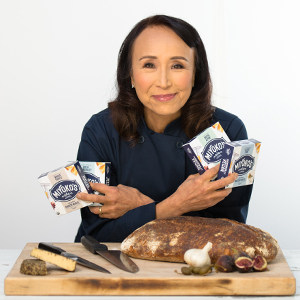
[00:00:10] Nick Guillen: Hello, and thanks for tuning in to Taste Radio, the number one podcast for the food and beverage industry. I'm editor and producer Ray Latif, and you're listening to episode 198, which features an interview with Miyoko Schinner, the founder and CEO of groundbreaking vegan cheese and dairy company, Miyoko's Creamery. Tune in on Friday, February 1st for episode 70 of our Taste Radio Insider Podcast, when we're joined by Nick Guillen and Nick Eshlooni, the co-founders of luxury hot sauce brand Truff. Just a reminder, if you like what you hear on Taste Radio, please share the podcast with friends and colleagues. And of course, we'd love it if you could review us on the Apple Podcasts app or your listening platform of choice. At one point prior to my interview with Miyoko Schinner, she pulled up her right sleeve and revealed a rather large tattoo just below her shoulder. Printed in block letters were the words, Phenomenally Vegan. It's certainly an apt description of Miyoko, whose passion for plant-based foods and compassion for animals is literally written on her body. They're also the guiding principles of her company, Miyoko's Creamery, which she founded in 2014. Amid growing consumer interest in vegan and flexitarian lifestyles, Miyoko's dairy-free cheese and butters are lauded for a texture and flavor strikingly similar to that of animal-based varieties. The brand is carried at over 12,000 retail locations across the U.S., including Target, Trader Joe's, Walmart, Kroger, and Whole Foods, and internationally in Canada, Australia, and Hong Kong. In the following interview, I spoke with Miyoko about her interest in veganism, how it led to the brand's genesis, and why she describes Miyoko's as, quote, a mission with a company. She also discussed the importance of empowering employees and ensuring their alignment with the brand's mission, why she believes that to change the world, companies have to work with the powers that exist, and why investors have to love you for who you really are. Hey, folks, it's Ray with Taste Radio. I'm at the 2020 Winter Fancy Food Show here in San Francisco, California. And sitting with me now is Miyoko Schinner, the founder and CEO of Miyoko's, or Miyoko's Creamery, more specifically. How are you?
[00:02:17] Nick Eshlooni: I'm doing great, Ray. Thanks for having me on the show.
[00:02:20] Nick Guillen: I'm really excited to speak with you, because Miyoko's has really changed the perception of what plant-based cheese and plant-based dairy can be. So congratulations on that. Well, thank you. So you've been in the San Francisco area for some time now. You've been in the Bay Area for how many years now?
[00:02:38] Nick Eshlooni: You mean the company? You specifically. Well, let's see. It's been several decades actually.
[00:02:44] Nick Guillen: Several decades.
[00:02:44] Nick Eshlooni: Yeah.
[00:02:44] Nick Guillen: How did you end up here?
[00:02:46] Nick Eshlooni: Well, I actually was born in Japan, immigrated to the US in the North Bay when I was about seven years old, and then I moved away for some time, went to school on the East Coast, and then I moved back to Japan. Then I came back around, I think it was 1989, so I've been in the Bay Area since then. Lots of things have changed here. Absolutely, 30 years, yeah.
[00:03:06] Nick Guillen: A lot more tech.
[00:03:07] Nick Eshlooni: A lot more tech. I mean, this whole area south of Market was just a desert back then. No man's land. And it's completely changed. San Francisco is a different city. It's lost some of its old charm, but there's some new exciting things about it.
[00:03:24] Nick Guillen: Well, I think the cool thing about tech and innovation is that we're not just talking about high tech or digital tech. We're talking about food tech as well. That's exactly right. Would you consider yourself a tech company? I mean, would you call yourselves sort of an innovation company based on modern technology?
[00:03:41] Nick Eshlooni: I would definitely say we're an innovation company that marries ancient technology with modern technology.
[00:03:47] Nick Guillen: OK.
[00:03:48] Nick Eshlooni: So it's a little bit different from just straight food tech. But definitely, you know, food technology has been around for 12,000 years. Just about everything that's been done in food has involved some sort of food science.
[00:03:59] Nick Guillen: So how do you create Miyoko's products? Because... Your products do taste amazing. I was speaking with a few folks from the team and other attendees, and there was some actually who came up here just before we started and was like, thank you so much for making these products. This is amazing. I think you're such an incredible entrepreneur and an incredible person for our industry. But as I always say, the proof is in the pudding. The products have to taste good. They have to have the same texture and flavor as the quote, unquote, real thing. So what's the secret behind the sauce?
[00:04:27] Nick Eshlooni: The secret is fermentation, and that is being used in food tech as well. But what we're trying to do is discover the powers that are inherent in plants. And through things like fermentation and enzymatic activity and lactic acid bacteria activity, we can transform them to have different textures and flavors.
[00:04:48] Nick Guillen: So cashews are one of the primary ingredients in your products.
[00:04:52] Nick Eshlooni: Well, it was the primary ingredient in our products. Everything that's in the marketplace right now is cashew based. But we're launching these new products this year, a couple of months, that are legume and oat based. So we've got a range of butters, spreadable butters, as well as cheddar, pepper jack. And there'll be more flavors to come that are oat and legume based.
[00:05:15] Nick Guillen: You've been a producer, an entrepreneur in vegan food for some time. How do you learn about the business? How do you learn about formulation of vegan food?
[00:05:22] Nick Eshlooni: I'm completely self-taught. Out of necessity is how I learned. I became a vegan in my mid-20s, back in the 80s. Why? Well, I was already a vegetarian for ethical reasons. And then I started learning about the dairy industry and I just decided, hey, if I'm going to do this, if I'm going to be in it for the ethics, I'm just going to go all the way. But also I had health issues. So I think I was pretty allergic to dairy and I had stomach issues all the time, which then they disappeared when I stopped eating dairy. But when I plunged into the vegan diet, I jumped into the exploration of food and tried to figure out, how can I recreate these flavors that I love? And I loved really, really rich foods. French, Italian cuisine. Cheese was my downfall. I loved fine European-style cheeses. And I had to figure out, how can I make something like that? And cheese was the holy grail. I couldn't really master that for a number of decades. But about 10 years ago or so, I decided, you know what, I'm going to figure this out once and for all. And I just started experimenting.
[00:06:29] Nick Guillen: Prior to launching Miyoko's Creamery, you were in business. You created a vegan food company and eventually decided to close it. Can you tell us a little bit about why you started the company and why you decided to shut it down?
[00:06:40] Nick Eshlooni: Sure. Well, I had no intention of starting the company. I mean, I thought I was done with businesses. I've had a number of businesses, everything from another natural foods company to restaurant to a bakery, and honestly, none of them had really done very well. Maybe I was a little bit ahead of my time, but I felt like I really didn't have the Midas touch, and I should just not even bother doing this. But I had written a book, Artists and Vegan Cheese, and that was the book that sort of determine my fate for the next, I don't know how much longer I'll be doing this, but I hope for a while to come. And there was another former industry competitor, Seth Tibbett of Tofurky, who really encouraged me. And he took me aside and he said, look, you've got to give this one last go. I know you feel like you didn't do well before, but I think this has legs. You need to give it a try. And he became my first investor.
[00:07:31] Nick Guillen: What did you learn from the experiences that you had before starting Miyoko's that you've been able to incorporate into your current business?
[00:07:40] Nick Eshlooni: Well, just about everything. But I think the most important thing is my lack of leadership. I really didn't know how to be a good leader. And if you can't lead your team and inspire them, if you can't create a culture that people want to embrace, then it doesn't matter how good your product is, what your sales channels are, you're just not going to succeed as a company.
[00:08:01] Nick Guillen: How did you learn to become a good leader? What were some of those characteristics?
[00:08:04] Nick Eshlooni: Don't presume that I am a good leader yet. I'm on my way. I'm getting better.
[00:08:09] Nick Guillen: Well, what were some of the characteristics? What do you think are the characteristics of a good leader and what were you lacking in your past company?
[00:08:15] Nick Eshlooni: Sure. I think I was a poor communicator. I hadn't managed to, even though I was very, very good at selling the product or the mission outside of the company, I hadn't really taken the time to communicate that internally and to inspire the team within. So that was one thing I had to learn. I also had to learn patience. I had to learn how to monitor myself and sort of, you know, when there's always going to be some sort of confrontation at work, issues that arise with personnel. And I've learned, I am learning, let me correct myself because I'm not 100% there yet, to remove myself from myself. And you know, it's that question, what would Jesus say? It's like, what would a good CEO say? How would a good leader think? And to become more intentional in everything I do. and think about the strategy of how to nurture that culture where people want to give to the company and they embrace it with passion and feel alignment with the mission and they too want to make a change and they feel empowered that they are effecting that change.
[00:09:25] Nick Guillen: It sounds like humility is an important characteristic of a leader as well. Humbling oneself is not something that I'm good at. It's a challenge for all of us. Yeah. Admitting what you don't know and admitting that someone might be better at a particular task than you are is really tough, especially if you're an entrepreneur and I'm not an entrepreneur. I assume that it is one of those things where I'm not going to release the reins because I think I can do this better than you can.
[00:09:50] Nick Eshlooni: Right. I was certainly like that in my last businesses. And that doesn't go very far. I mean, you have to learn to delegate. You have to learn to empower people. But then you also have to hold them accountable. You do have to have some sort of barometer. And you have to hold them accountable, but do it in a way that doesn't make them feel like, you know, they... screwed up or something. I mean, sometimes you do have to become the heavy. I mean, I'm not saying that, you know, it's all just holding hands and kumbaya. That's not how it is. Because at the end of the day, the business has to be successful.
[00:10:24] Nick Guillen: It certainly helps if you have a North Star, you have a mission where everyone's sort of swinging in the same direction. Did it help really identifying and specifying what the mission of Miyoko's was at the outset?
[00:10:37] Nick Eshlooni: Well, I think the mission was always clear. And the first few employees we had, they were also vegans. And so they also got the mission. So it was as if, nonverbal communication was all we needed. We didn't need to discuss it at all. It's when the company started growing and we had non-vegans joining that the mission got, not muddied, but nonverbal communication didn't work anymore. And although we tried to have education, we brought in speakers to talk about our mission and things, I don't think we did it in a way that I think it was off-putting to some people the way we did it. It was alienating, as it can be. Anytime you have some sort of mission like veganism or you're trying to, you know, promote animal rights or something like that, you can offend people. And so you have to figure out, how can I do this in a way that gets people excited about the mission rather than, you know, makes them feel like these crazy vegans? Well, what is the mission? The mission is to create a world that's based on sustainability and compassion for all living beings, human and non-human, so that they can lead lives of their own and not as commodities for us. So basically, it's creating a world where food comes from plants and not from animals.
[00:11:55] Nick Guillen: Are you sure Miyoko's isn't an NGO?
[00:11:58] Nick Eshlooni: I know, it seems... Well, you know, we have this joke. It's not really a joke, but we're really a mission with a company. But we never forget that mission. And, you know, the first few years, I think I was so afraid of speaking about our mission that I didn't the first couple of years to the world. And, yeah, I spoke about it to vegan communities, to our vegan consumers, but I never mentioned it to... you know, if I was at an industry conference or something like that, I would just say, Oh, we're making a plant-based cheese. And I was just sort of tiptoe around the subject. And I finally realized at some point you have to stand for what you believe in. You have to be true to your nature, to your soul, to the world, and you have to become transparent. And I found it was actually at a, some sort of new hope event, um, where I was giving a talk, I was on a panel and, just out of the blue, I started talking about Angel, who is one of our cows on, I have a farmed animal sanctuary. It's a 501c3 nonprofit. And I started talking about Angel and how she was a dairy cow that got out of the dairy industry. And now she gets to chomp on grass and live her life according to the way she wants. And I wasn't sure how I thought, oh my God, I put my foot in my mouth. I can't believe I started talking about her. And people came up to me afterwards and they were like, oh my God, I never thought about it that way. Thank you so much for sharing your story about Angel. I think I'm going to go vegan. And so I realized that if you talk about it in the right way, it doesn't matter what setting you're in. You can share your mission and not be afraid to turn people off. And that's my goal, is just wherever I am, I'm going to continue talking about it. I sneak something about animals into every talk I give. And I don't devote the entire talk to them. But just in a way to just sort of plant that seed to get people to start thinking, connecting about their food. And maybe the fact that that bacon came from, could have come from goober. Goober is this really cute pig we have.
[00:14:03] Nick Guillen: It sounds like a really cute pig.
[00:14:04] Nick Eshlooni: He is really, all you have to do is rub his belly. He's about 500 pounds, but if you rub his belly, he flops over and just breaks into this huge smile.
[00:14:12] Ray Latif: Nice. Guessing your margins? That's risky. Belay Financial gives CPG brands the clarity to scale smarter, faster, stronger. Get your free inventory ebook by texting TASTE to 55123 and start making data work for you.
[00:14:33] Miyoko Schinner: Tune in at the end of this episode for an exclusive interview with Matt Lin of Belay Solutions. He sits down with Melissa Traverse to break down the biggest inventory and accounting mistakes CPG founders often make. You'll learn how to bring clarity to your numbers so you can scale with confidence.
[00:14:51] Nick Guillen: I've spoken with a lot of entrepreneurs, including some of the ones here at the Fancy Food Show, and they are mission-based companies. Where they get tripped up sometimes is not understanding that even if you are a mission-based company, as you mentioned, business is business and you've got to achieve results. You've got- Otherwise you can't promote your mission. Right. So how do you marry the two in a way that puts a level of importance, the same level of importance on each?
[00:15:18] Nick Eshlooni: Well, I am a business woman, and so that is important to me that we're making the right choices in business. You know, of course, the mission part is part of the marketing messaging to the external public, of course. And so, you know, we have to do it in a way that's balanced with all the things that, you know, the data shows you that people care about, which are obviously flavor. I mean, it doesn't matter how, If you're saving the world with a product, if it doesn't taste good, no one's going to buy it. And that's the bottom line. I mean, food has to taste good. And that's actually one of our values. You know, I was a chef. I've cooked in restaurants, and I've written five cookbooks. I'm writing a sixth book right now. And food is our cultural heritage, it's really what distinguishes man from other animals. It's how we created culture. Man came around a table and broke bread together. In the old days when we discovered fire, someone would forage, somebody would hunt, somebody would fish, somebody would dig roots and they'd come together and make a big pot of soup. And we found that humans were stronger together over food. And so food, there's such a strong cultural heritage of food It has to not just nourish our bodies, but it has to nourish our souls. It has to taste good. I'm a foodie through and through. I love nothing more than cooking a big dinner for friends and gathering around the table and having wine and conversation. And so, yes, taste is number one. That has got to be king. But we have to balance it all. We have to balance taste with nutrition, with clean ingredients, and with mission.
[00:16:54] Nick Guillen: To run a truly sustainable company, some might say that you've got to incorporate higher standards for labor, higher standards for quality of ingredients.
[00:17:05] Nick Eshlooni: Absolutely.
[00:17:06] Nick Guillen: That inherently means a higher end cost for the product to the consumer and less accessibility for some consumers.
[00:17:15] Nick Eshlooni: Yes, absolutely. Well, let me just explain our model. I thought it was really important to come out with a very premium cheese initially, just because that wasn't available. And I wanted to show people that vegan cheese could really, really be amazing. So it was really setting the bar. It's like the Tesla model. You start out with the best to show people that electric cars can be amazing. sexy and fast and great. I wanted to do the same thing with vegan cheese. But the plan always was to create cheeses that were at a lower price point to reach a wider demographic. We're doing that at this show. You can go downstairs and have our new pepper jack and cheddar that are not made out of cashews. They're made out of oats and legumes. So they're going to have a $5.99 price point. So very, very competitive, too. you know, like even a Tillamook or something like that. Our goal has always been to reach as many people as possible and to be able to do it in a sustainable, clean label manner. And we can do that because our volumes have increased. You know, one of the things about not just sustainability for the planet, but a company has to be sustainable, which means that you have to have gross margins that are healthy. You have to have employees, you have to pay, you're talking about fair wages, you want to be able to pay them a fair wage, and we do all of that. We pay more than a living wage. Everybody down to the last factory worker gets PTO, 401K, matching 401K, full health benefits. We have a full meal program where we have a full-time kitchen staff that provides organic vegan meals to our entire staff of 125 people every single day. There are so many benefits that we try to provide. At the same time, we think it's important to give back to the community. And so we partner with a lot of nonprofits. We donate monetarily as well as product. Last year, we installed toilets and running water for local schools near the mountains where the cashews are grown. This year we're going to hopefully transition a California dairy farmer to growing crops to become an R&D hub and supply chain for us, and we're going to be funding that transition. So I think it is possible, it sounds crazy, to become a sustainable business. We haven't taken a lot of capital. We've got healthy gross margins now. We didn't initially, but we've gotten to the point where we do. You know, we're burning less and less each month. And I think a company has to eventually be able to stand on its own and become profitable. A lot of companies today are taking hundreds of millions of dollars of capital and that profit, you know, when they reach breakeven could be in the very distant future. We want to make sure that we can get there in a sustainable way sooner than later. But at the same time, we want to provide the best work environment for our staff and for the community. So I think, I know it sounds ridiculous, but I think if you know your cost of goods, try to create an efficient way of producing your products, then all of it's achievable.
[00:20:14] Nick Guillen: It doesn't sound ridiculous.
[00:20:15] Nick Eshlooni: That sounds like good business to me.
[00:20:17] Nick Guillen: There's a lot that you just said that you could communicate to that end consumer. fair wages, high quality ingredients, giving back to the community. How do you figure out what the hierarchy of communication should be for each one of those things? I mean, I guess, how do you figure out what the consumer wants to hear?
[00:20:38] Nick Eshlooni: I think today's consumer wants to know about what sort of company they're buying products from. They are really becoming very discerning. They're pushing away large corporations that had either poor quality standards or had unethical practices. You hear a lot about that. We've been criticized for for being in an accelerator with a large corporation. I have a different view about that, of course. But I think people want to know about who's behind brands now. And this is all because of social media. So we do try to communicate whatever initiative we're working on. I mean, we don't... you know, do a social media blast about every sponsorship we do or every donation we make, but the major ones, like the farm animal conversion, you know, that one has gotten some press. We haven't yet told the world about the Vietnam, you know, what we did in Vietnam with the toilets. There were a couple of social media blasts, but I'm going back to Vietnam to see the harvest next month, and then we're gonna be putting together some video footage, and then, you know, we'll share that with the world. So we do try to, through social media, you can hit on all these different points and emphasize some more than others.
[00:21:50] Nick Guillen: You mentioned you partnered with an accelerator, which is partnered with a large corporation. That corporation is Nestle. And there was some criticism, as we talked about before, we chopped on the mics of Miyoko's for partnering with a company that is deeply involved in the dairy industry. But for you personally, I mean, how do you reconcile working with a company like that?
[00:22:11] Nick Eshlooni: Well, you know, it's as if, if you're trying to change the world, and I don't think we have a whole lot of time. You know, we've seen the UN reports, there's something like 10, 11 years to start reversing climate change, or we're all sort of doomed. So we can be on our little high horse and criticize big companies, and we can continue to sell our products just at farmer's markets and be absolute purists, or we can go live on a mountaintop and grow our own vegetables. But if we're really trying to impact the world, We're going to have to work with the powers that already exist. I think Nestle USA is trying to make a lot of changes within the company itself. They just sold off their ice cream division. They sold off their candy division. They're investing heavily in plant-based. I've met many people there at Nestle that are from the inside trying to change the corporation, trying to change the trajectory of their company. And if they don't change it, they're going to become irrelevant anyway, because all of these disruptive companies are going to be the new Nestle's. But they've got such a large footprint right now. So if you can help them change, that's going to impact the world in a much bigger way than just being on your high horse and being a pure vegan company that, you know, if you try to avoid anything like that, you're just going to end up at the farmers market. And I just think that's not going to impact as many people. I think that's also important to be a local company. That's great. But I have a sense of urgency. I want to make impact fast and soon.
[00:23:43] Nick Guillen: Did you have any hesitation, I mean, in partnering with?
[00:23:46] Nick Eshlooni: Yeah, I did. I thought about it. I thought, okay, I thought about the optics. In fact, when they first called me up, the first thing I said to them was, why are you calling me? I said, do you know who we are? Do you know what we stand for? And I just went into this, I was, I think I was a little abrasive. And I said, look, this is what we stand for. And I'm not interested if you're just trying to follow a trend. And the person from Nestle said, no, that's why we're calling you. We know what you stand for. That's why we're calling you. So I think they are thinking about things.
[00:24:21] Nick Guillen: As part of this big. Hairy, audacious goal, as my CMO would say, one part of that is what you mentioned, converting animal farms into plant farms. Is your approach that of, okay, let's change the world together, or is your approach, hey, this is going to help you and your family's generations from now because you're going to have a more profitable, sustainable business going forward?
[00:24:44] Nick Eshlooni: It's really more the latter, but I think it can definitely get to the point where it's let's change the world together. As you know, dairy farmers are struggling. They're committing suicide at an all-time high. They're losing their land. They're in debt over their heads sometimes. You read about it in the paper constantly. And I don't think they ever thought about what the new economy is going to look like in food. But it's just like when the automobile was invented, and if you're a horse and buggy driver, If you were a whale hunter and, you know, getting whale oil before kerosene came along, I mean, there's going to be, or typewriters and computers, I mean, any point in human history, there's going to be a shift as technology advances. And right now, there is sort of a, there's not only an imperative for the climate, but I, you know, to me, there's a moral imperative for businesses to industry to lead the way to a more sustainable future. So I'm hoping that farmers will come along for the ride.
[00:25:44] Nick Guillen: I'm sure this isn't part of your message, but the phrase meat is murder is something that we hear some folks, animal advocates use.
[00:25:51] Nick Eshlooni: I don't think guilt really works. Guilt never works. I've learned that just from having kids. And if you make your kids feel guilty, they don't. respond as well. So nobody responds well to being shamed or made to feel bad. You have to empower them, let them feel like they can also be changemakers. And the reason I started cooking and making food, you know, starting the food businesses back in the 1980s was because Yes, I wanted the world to be vegan, you know, back in the 1980s, but I knew that holding picket signs wasn't going to make that change. My way was to entice people through delicious food, and that's always been the way that I've approached it.
[00:26:38] Nick Guillen: but sometimes the truth is really powerful.
[00:26:40] Nick Eshlooni: The truth is powerful and because of social media, there's lots of video footage out there right now about slaughterhouses and the truth behind your meat and people are watching them and converting to veganism at an all-time high.
[00:26:54] Nick Guillen: But they kind of have to get there on their own.
[00:26:55] Nick Eshlooni: They have to get there on their own. I mean, it's not a place for a food company to go and shove that, and people, you know, I don't think, it just would be poor business for me to do that.
[00:27:04] Nick Guillen: How do you talk to investors about your mission and your plan
[00:27:07] Nick Eshlooni: Same way I talk to everybody else. Because all money isn't green. So not all investors are the same and they're your partners. They're like, you're gonna be married to them. So if they can't get behind your mission, they're the wrong partners anyway. So it's just like when you're dating, we all try to be on our best behavior. Well, if you have to be on your best behavior by the second date and you can't be honest about who you really, really are, you're gonna have trouble being married to that person. So it's the same thing with investors. You have to be honest. They have to love you for who you really, really are. Otherwise, it's never going to work out.
[00:27:42] Miyoko Schinner: Do you want more repeat buyers on Amazon? Well, this free resource in collaboration with Straight Up Growth will help your brand turn first-time buyers into long-term subscribers. Download Winning the Repeat Purchase Game on Amazon now at Taste Radio slash SUG. That's Taste Radio slash S-U-G to start building retention-driven growth for your brand on Amazon. Scaling a beverage brand into major retail comes down to operational readiness. From packaging lead times to co-manufacturing strategy, the details can make or break a launch. In a new ebook in collaboration with Octopi and Asahi Beer USA, industry leaders share what they've learned in helping brands scale. Download it now at Taste Radio slash octopi. Do you need to scale your team faster without compromising on talent? Join Oceans for a live webinar on April 20th and learn how leading companies are hiring top global professionals who are ready to grow with your business. Register for the webinar now at Taste Radio slash oceans. That's Taste Radio slash oceans.
[00:28:53] Nick Guillen: You're not shy about talking about who you are. I think we've established that. You're also not shy about your political and social beliefs on social media. Your Twitter account is robust, shall I say, and it's great. I think some entrepreneurs and some executives might be kind of shy or afraid that what you say in public might affect how your company, the performance of your company on a sales level. Todd Carmichael from La Colombe is a great example of someone who says, well, I don't care. I want them as customers if they don't like what I'm saying, if they have a problem with what I'm saying. Do you fall into that kind of category?
[00:29:28] Nick Eshlooni: Yes, except for I am careful about what I say. I don't criticize people. I don't criticize other companies. I might criticize an idea or a principle or something, such as gun control, something that I'm, well, I would go so far as to say gun elimination is more in line with my beliefs. So I'm not afraid to, to talk about things like that, but I won't go out and criticize an individual. I think that's where I probably draw the line. And I also try to... empower and inspire rather than just criticize.
[00:30:08] Nick Guillen: Have you ever thought about politics?
[00:30:10] Nick Eshlooni: I'm sure I'm sure someone's asked you this because several people have said that. Not interested. Okay.
[00:30:16] Nick Guillen: Okay. Well, it's interesting because I think, you know, executives, we have seen business executives.
[00:30:21] Nick Eshlooni: Yes. For better or for worse. For better or for worse. Yes.
[00:30:24] Nick Guillen: Get into the political realm.
[00:30:26] Nick Eshlooni: More and more it seems. Yes.
[00:30:28] Nick Guillen: Indeed. Does business belong in politics?
[00:30:30] Nick Eshlooni: Basically, politics, a lot of industries feed food politics. I mean, I'm just going to talk about food right now, but the subsidies that go to dairy and meat are because of lobbyists, because of industries. And so right now with the rise of plant-based foods, we're having this battle about nomenclature, and it's a big one. And we're having to get involved and voice our opinion about what we think the future of food is going to look like and why we should be able to call our products cheese or milk or whatever. So yes, we do have to get involved politically. And I have walked Capitol Hill a number of times.
[00:31:12] Nick Guillen: Are you concerned at all that because of things like the Dairy Act or what now?
[00:31:17] Nick Eshlooni: No, First Amendment rights.
[00:31:18] Nick Guillen: Okay.
[00:31:19] Nick Eshlooni: I think we're going to win. And you know, consumers are, consumers are going to win.
[00:31:25] Nick Guillen: Consumers are going to win because they have access to better tasting food, or is it because they know?
[00:31:30] Nick Eshlooni: Well, they're driving the change. They know the difference, and they're driving the change. And it's not because plant. They're driving the change. I mean, dairy's been plummeting for a long time. And that's because consumers are making other choices. And they make those choices when better products become available. They're more educated than they've ever been. They're not confused.
[00:31:50] Nick Guillen: I'm not confused, but I work in the industry.
[00:31:52] Nick Eshlooni: So there's that.
[00:31:53] Nick Guillen: Earlier, you mentioned that you're not sure how much longer you'll be doing this as in running a company. Is there an end goal for you personally? And, you know, what does it look like?
[00:32:04] Nick Eshlooni: Well, I'm having a lot of fun, and we're growing, and we're in a fast growth mode, and I'm just going to stay focused on that for a few years and just see how far we can take this. We have lofty goals, of course, for the growth of the company. At some point, am I going to want to retire? No. I don't know, five, 10 years from now, you know, there is an exit, then I'd love to actually have a vegan restaurant. It'd just be a lot of fun to have a great place to eat in Marin or Sonoma County, because there isn't anything right now. And, you know, I do have this farmed animal sanctuary, and I'd love to be able to support that in a bigger way.
[00:32:44] Nick Guillen: How would you feel comfortable handing over the reins, handing over the keys to the company when its mission and you as a driving force behind that mission are so intertwined?
[00:32:55] Nick Eshlooni: Well, you know, it's so early in the game. I mean, we're not thinking about that right now at all. But I think the way you ensure that is by creating a team that's completely focused, that's aligned with the mission. So I think that's one of the, you know, a lot of companies, you know, we have about 125 employees, and I think we have so many employees that are, most of our employees are so committed to what we're doing. When I was about 40 employees, we were much smaller, but we didn't have the dedicated mission-based employees that we do today. So build that team that is... aligned with the vision of the company. And so if I'm not there, I know that no one's gonna compromise the values. And if you do that, then at the time that we are ready for some sort of exit, whether it's an IPO or a sale or whatever, there'll be people in place that are going to ensure that it remains values and mission driven. And maybe I'll still hang around, I don't know, we'll see.
[00:33:56] Nick Guillen: Would you ever hire a CEO to sort of handle the day-to-day?
[00:34:00] Nick Eshlooni: Well, I actually, not a CEO, but I am hiring a president. As I go around and become more of the outward facing, you know, persona of the company, the face of the brand, you know, we need somebody kind of staying at home and running things. And so we are actively interviewing and searching for a president and got some great candidates right now.
[00:34:22] Nick Guillen: Miyoko, I read something. It was an interview that you did a few years ago. And it said that at the outset, you wanted to build an empire, but you weren't communicative about that. You didn't want to say that to people. Why not?
[00:34:35] Nick Eshlooni: I didn't want to say that to people because I had failed so much that I didn't think, I didn't want to embarrass myself. I didn't want someone to laugh in my face and say, well, that's never going to happen. Because that had been done to, I mean, I had actually shared another dream with someone a few years back. And that person said, well, that's not going to happen. So what are you going to do? And I didn't want to embarrass myself. I was ashamed. I didn't have the confidence in myself. So I thought, OK, then I'm just going to start really, really small, see if it has legs. And now what I realized was nothing's ever going to happen if you can't say it to the world. You have to own your vision and be able to share your vision from the get-go. And you have to create that future for yourself. And the world will support you, but you know, as they say, it's kind of sounds new agey, but you got to put it out in the universe. So that's what I do now.
[00:35:24] Nick Guillen: It helps if you have a good strategy, though.
[00:35:26] Nick Eshlooni: Yes, that's right. Yes. Not just hopes and dreams, but a strategy definitely helps.
[00:35:30] Nick Guillen: Have you been able to execute the strategy that you guys have set up for yourselves?
[00:35:33] Nick Eshlooni: I think our strategy keeps getting more and more refined. So we're constantly... Intentionally? Intentionally. So we're, as a team, we are intentionally analyzing our strategy at all times. We're a very, very collaborative company. You know, we have these off-sites and weekly management meetings where we talk about strategy and what we're doing and everything from, you know, channel strategy to product pipeline to communicating with our audience, whatever it is, you know, we discuss it all. So everyone is on board with everything. Everyone understands what's going on. And I think that's really one of the keys to having made a culture that's so strong at our company.
[00:36:14] Nick Guillen: Literally.
[00:36:15] Nick Eshlooni: Yes. Yeah. Along with the lactic acid bacteria. But anyway, yes, the probiotics.
[00:36:21] Nick Guillen: These are key. Miyoko, it's been really fantastic speaking with you. The brand and the company seem like they are on their way to changing the world. And congratulations on everything you've accomplished to this point and everything that you will accomplish going forward. I hope we get to sit down and chat again really soon.
[00:36:37] Nick Eshlooni: Thank you, Ray. It was a lot of fun.
[00:36:39] Nick Guillen: Yeah. That brings us to the end of episode 198. Thank you so much for listening. And thanks for our guest, Miyoko Schinner. You can catch both Taste Radio and Taste Radio Insider on Taste Radio, the Apple podcast app, Stitcher, Google Play, SoundCloud and Spotify. As always, for questions, comments, ideas for future podcasts, please send us an email to askatasteradio.com. On behalf of the entire Taste Radio team, thank you for listening, and we'll talk to you next time.
[00:37:22] Phenomenally Vegan: Hello, I am Melissa Traverse here for the Taste Radio podcast, talking about some of the biggest tension points that CPG brands and founders face when they're scaling a brand, and those are financial accounting and inventory management. I am joined by Matt Lynn, inventory accounting guru from Belay Solutions, and he is going to shed some light on all of this that is going to help everybody out quite a bit. Matt, thank you so much for joining us today.
[00:37:52] Taste Radio: Thank you for having us, Melissa. It's great to be out here at Expo West and it's great to sit down and be able to chat this because it's kind of a passion project of ours, working mainly with CPG brands and hoping to help them scale.
[00:38:04] Phenomenally Vegan: It's been such a pleasure chatting with you and the team and learning all about what you do over there at Belay Solutions. Can you tell us a little bit about yourself and what your role is and the kinds of solutions that Belay gives to CPG brands and founders?
[00:38:20] Taste Radio: Yeah, absolutely. My role with Belay, I'm actually our inventory accounting manager. I run our inventory department, so we work with CPG brands, taking them from spreadsheets, putting them on inventory management systems, and really helping connect their tech stack between their sales online marketplaces to that inventory management system, even down to their financial systems like QuickBooks. Belay overall is kind of an outsourced accounting firm. And with that, we're helping teams. We have different levels with bookkeeping, controller level work, even high level into CFO type items. So we really help those brands in any way that they need financially. And then I just have a subset of a department where we're really just laser focused on inventory.
[00:39:02] Phenomenally Vegan: It's certainly a complex topic and there are plenty of places to go wrong. Let's start by going right and start super simple. Can you tell us what some of the biggest red flags are that would help a founder understand or, you know, the person running a brand understand that it really is time to get some help with some of these areas?
[00:39:23] Taste Radio: Yeah, absolutely. I think some of the early red flags is just everything is chaos. So when they're looking in their financial software, maybe they don't really have an accounting background, and they're kind of just piecing it together and doing their best. And what they'll see is that reconciliations take forever, if they even happen. They have a lot of transactions that don't get coded, or they just put them into placeholders to just get rid of it so it's not an eyesore. they'll notice they have revenue but no cash or they notice that they have a good amount of cash but their blind spot is really seeing the vendor invoices that are sitting there just needing to be paid and so they just lack that clarity that's going to really be around the corner.
[00:40:00] Phenomenally Vegan: You know, you were talking about one of the red flags that comes up that I think makes so much sense. When somebody asks you what your numbers are and you can't come up with the right number, that's a big problem because that's something that you really should be able to share with decision makers who, you know, you're ideally looking to do business with. What should you be able to call up at a moment's notice?
[00:40:25] Taste Radio: really at any time, you should be able to know an accurate margin. It's amazing how many founders we end up talking to that they can tell you their revenue numbers, they can tell you their selling price, and then the minute you start talking about cost or their cost of goods sold, they just get a deer in headlights look. So really it's very hard to tell, am I even making money? or if you don't know your entire landed cost. Maybe you know what the freight cost is, the duties separately, but you're not really getting that as part of your unit cost. So it's really hard to tell. Am I even making money or am I losing money from the very beginning?
[00:40:58] Phenomenally Vegan: And do you recommend that founders are able to call up a margin by channel?
[00:41:02] Taste Radio: Absolutely. And depending on the number of products and channels, you kind of want to know what are your best sellers, which ones are making the most and which ones maybe you're not making as much. But especially if you're branching out and you're doing D to C with B to B, absolutely want to know that.
[00:41:19] Phenomenally Vegan: Gotcha. You mentioned that when things feel really chaotic, that's probably a red flag. I would say that it probably almost always feels chaotic if you're running a CVG brand. And I know this may be hard to quantify, but is there a revenue number? Is there a number of doors number that would help a brand understand whether or not it makes sense to bring on a partner like Belait? Understanding that so many brands are bootstrapped or they might be tight for cash. What is that friction point?
[00:41:49] Taste Radio: 3 3 3 3 But as you're growing, as you're getting to those six-figure revenue numbers, and especially as you're approaching seven, you want to make sure you've got good financials. Because as you scale to that point, most likely you're going to be looking to raise capital. And investors, the first thing they're going to look at is your books. And are they clean? And do they show a clear picture of your business?
[00:42:22] Phenomenally Vegan: You know, another area that folks might look to to organize some of the chaos are their systems. So many folks stick with Excel spreadsheets for a good amount of time. How do you know that you need to outsource some of your accounting to an organization like Belay Solutions versus maybe signing on to a Synth7 or NetSuite or something like that?
[00:42:45] Taste Radio: Well, that's actually something we really help with when it comes to that cost question. That's something that trips people up. And sometimes if you just have a turnkey business, you buy and sell a finished good, you can maintain with spreadsheets. And we've had clients with million dollar revenue that can do that. But we see so many brands nowadays are using contract manufacturers. and they're just sourcing certain parts of their product. So when you start talking cost, they have no idea exactly what their unit cost is. So that's where we come in and we kind of understand, we'll speak with the customers and the clients and get their needs. And then if we think they're ready for a system, then we'll help put them on that system so they can get some of that clarity. And it's not something we force on anybody. There are plenty of times where founders come to us and we'll tell them bluntly, you're not ready for it right now, but we'll let you know when we think you are.
[00:43:31] Phenomenally Vegan: Sounds like excellent advice. What should a founder or somebody running a brand look for in an outsourced accounting partner? Are there certain checklist items that they should make sure that their partner be able to execute or be able to help them understand?
[00:43:48] Taste Radio: Absolutely. I think one of the keys there's, there's a lot of outsourced accounting firms out there. Some focus on service-based SaaS companies, but if you're a CPG founder, you really want to make sure that your accounting firm has CPG experience. I would ask them, you know, what kind of brands have they worked with? And even beyond that industry specific, because there's so many subsets of CPG. And that's something that I think is great about what we do with Belay is that we kind of run the gamut. It's kind of like the insurance commercial. We know a thing or two because we've seen a thing or two across a broad spectrum.
[00:44:18] Phenomenally Vegan: Probably getting references is always helpful, right? Absolutely. All right. So this all sounds great. I think we have a really good understanding of would it make sense to hire an outsourced partner? You know, what some of the things you should be looking for are. What does offloading this kind of work mean for the brand? What can this do for lightening the load of a founder or lightening the load of a brand operator? Like, how does that help them in their everyday business?
[00:44:47] Taste Radio: It just tries to really help quiet the chaos. So what we're looking to do is just take some of the weight off that founder's shoulder. Let them focus on building the brand, building the business, getting that exposure. If you don't have sales, you really don't have anything. So we want them to be able to focus on that while we take care of your back-end office work. And we can just present that to you on a monthly basis. You can help make decisions. You can take that to investors. And really, you can just focus on growing your business.
[00:45:12] Phenomenally Vegan: I feel like I felt founders and the folks who are running brands collectively sigh a breath of relief just hearing that. How can people learn more about Belay Solutions?
[00:45:23] Taste Radio: So people can text TASTE to 55123 for their free inventory guide to get started.
[00:45:29] Phenomenally Vegan: Matlin, inventory accounting guru at Belay Solutions. Thank you so much for joining me here at Expo West. It's been such a pleasure to chat with you and learn about what you all do over there to help founders and brands with their financial accounting and inventory management. For everybody else out there, thank you for listening to the Taste Radio podcast. I am Melissa Traverse and we'll see you next time.