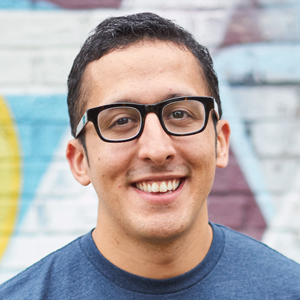
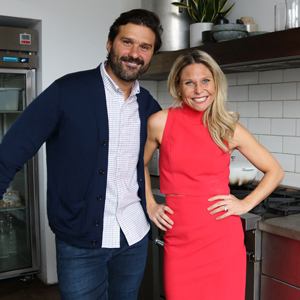
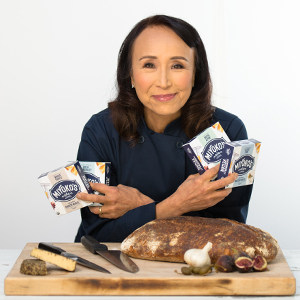
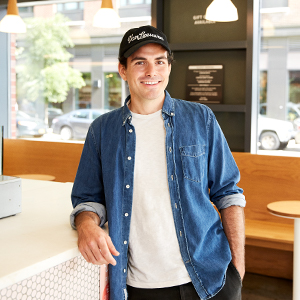
[00:00:10] Ray Latif: Hey, folks, thanks for tuning in to Taste Radio, the number one podcast for the food and beverage industry. I'm Ray Latif, the editor and producer of Taste Radio, and you're listening to Episode 221, which highlights interviews with a few of the leaders, innovators and entrepreneurs who joined us on the podcast during the first half of 2020, including Siete Family Foods co founder and CEO Miguel Garza, Nick & Elyse Oleksak, the co founders of Bantam Bagels, Miyoko's founder and CEO, Miyoko Schinner. Ben Van Leeuwen, the co-founder and CEO of Van Leeuwen's Ice Cream. Orgain, founder and CEO, Andrew Abraham. And Gail Becker, the founder and CEO of Colipower. Just a reminder, if you like what you hear on Taste Radio, please share the podcast with friends and colleagues. And of course, we'd love it if you could review us on the Apple Podcasts app or your listening platform of choice. Let's kick off the show with Miguel Garza, who we featured in episode 214. Miguel is the co-founder and CEO of fast-growing Mexican-American brand Siete Family Foods, which markets tortillas, taco seasonings, queso dips, and enchilada sauces, all of which are plant-based and grain-free. In the following clip, Miguel spoke about the importance of family in how the company operates, the hallmarks of its product development and innovation strategies, and why Siete avoids chasing trends. Everyone in your family works for the company. A lot of folks can't work with members of their family, uh, usually out of fear that money will muddle the waters. And you know what, sometimes it does. How do you make it work? Uh, I, I don't know if we necessarily have a playbook, but I can, I can tell a story about how we grew up. So we grew up in a household where as a family, we were all very close and My mom had this thing that she would do where if we ever fought, right, and we're not like any Like, we're not unlike other siblings. Like, we would fight as kids. And if we ever fought, my mom would occasionally make us, like, do one of two things. Either, like, we had to sit on a couch and hug each other until, like, we were, we stopped fighting. Or, you know, you would put on, like, the big like a very large shirt and you would have to like hug it out with your sibling in that shirt. And I remember a few times where the power, and I think that's why there's, you know, just in the time that we're in, why it's so difficult. There is a power that comes with hugs and love that kind of overcomes. So you mentioned family first, family second, business third. Do everything with love. is our seventh core value. And I think that that's how we're able to do it. If you're rooted in love and in this idea that Siete Family does come first, then there's an underlying trust that gets you through working together on a day-to-day basis, where we all understand that we're trying to grow a Mexican-American food brand for this generation of consumer. And because we all know we're striving towards that goal, we can trust that even in our disagreements, that we're actually all doing it for Siete Family, for the team, and not for ourselves. So to tie it back to that hugging story, like I think there was just this, you're in a fight, and then 15 minutes later, after a 15 minute hug, and you're like, Oh, this is, this is my family, this is my blood. And That's more important than anything. It's more important than ego. It's more important than aspirations. And so I think that that in itself laid a foundation for how we would love each other, even through the difficult times of running a business. And I say that we don't have a playbook because We're still growing and I think that we still have many challenges to come. But I do know that if we continue to stay focused like we have on family first, family second, business third, and doing everything with love, that we'll have a good shot at it. Your mom sounds like a genius. One of the most striking things about Siete and its growth is the amount of innovation that you guys have pumped out over the years. The company markets no less than five product lines and also has seasonal products. Can you talk about the hallmarks of your product development and innovation strategies? Yeah, heritage inspired and fundamentally innovative. And I think that's the cornerstone. So if we're going to make a product, has to be heritage inspired. And then on the flip side it has to be fundamentally innovative. And I think that my sister my sister could probably speak to this much better than I could. She leads our innovation. But it's often rooted in solving problems with the idea being that that's what we're supposed to do as a business. We're supposed to solve problems for the consumer. And so the initial product was solving a problem for herself in that she wanted to continue enjoying in the foods that were culturally relevant to her, in this case, tortillas, and that she couldn't anymore on the diet that she was on. this being like a grain-free paleo-type diet. So then she made an almond flour tortilla. And it needs to be heritage-inspired in that we're not trying to make things that aren't culturally relevant for us and authentic to us. So we're not making traditional Mexican products as much as we're making authentic Mexican-American products, where we feel like We are well positioned because we are Mexican-American. We do our best to not chase trends. And that's mainly because we're focused on solving problems. And we feel that chasing the trends would be inauthentic and that it's often hard to forecast and predict anyway. So for us, it's How can we be focused on creating something that's an authentic expression of ourselves but solves the problem? And the thesis is that if we solve a problem, that we're not the only ones with that problem in the marketplace, and that hopefully it solves problems for others as well. That's not to say that we don't look at data and that we don't understand the marketplace, because we definitely do. But I think that we're not, in our innovation, we're not driven by the external macro trends because we're trying to build something that is and that feels authentic to who we are as Siete. Next up are Nick & Elyse Oleksak, the co-founders of bagel and breakfast bite company Bantam Bagels. Launched as a retail concept in 2013, Bantam Bagels has since evolved into a sprawling platform brand that includes mini stuffed pancakes and egg bites that are sold at Safeway, Target and Costco, and also in pastry cases at Starbucks nationwide. In this clip from episode 208, the Olix-X explained why investing in PR has been crucial to the brand's success and how they define the phrase, fake it till you make it. Oftentimes PR is overlooked, especially with early stage brands, early stage entrepreneurs, it's expensive. Why did you feel the need? I mean, what, what compelled you to invest in PR early on? Honestly, I think we felt like there was so much to this idea that we wanted to do it right from the beginning. And you know, you asked the question of like, kind of how did we know what the next step for the business would be? And where should we go next? And I think The fact that we had Erica, who's our publicist, she's been our publicist from day one. The fact that we had her bringing the brand out into the marketplace in a unique and different way, to Elise's point, allowed us to make those decisions in a much more strategic analytical way than if we didn't have someone who was sharing the brand with the media, getting the brand out there, allowing our story to grow. in both like the conventional media channels, but also in like a very holistic way, like through blogs and Instagram and influencer posts, like having that public relations side to growing a business, we knew we had to do it, we knew from the very beginning, we had to have an outlet to share what we were doing, because what we were doing was so different and unique, like no one had done this before. With such an iconic food, we knew that we needed the support to get it out beyond New York City. And I think That is when we realized we needed to get the product beyond New York City. We were getting all of this national media exposure and this buzz around the brand and the product. And there was just such a demand to get it outside of that little retail shop in the West Village and to go explore the wholesale route. Our first major wholesale customer was QVC. And we baked all the bagels for QVC out of that small little bakery. It was insane. We were running 24-hour baking shifts. It was madness. But we got that opportunity because we had got placement in Specialty Food magazine. And that's where the QVC buyer saw it. And that's how she called our phone to ask us if we could get her 30,000 bagels two weeks after that. That was driven so much by our focus on PR and our focus on spreading the brand and spreading awareness of what the product does and what we were trying to do. So I think as you look at entrepreneurs, maybe PR isn't on the top five list of things to include when you start, but from our perspective, it had to be. And I think it changed the way that the brand grew and it allowed us to be in a lot more places a lot faster than if we didn't have it. Getting into places a lot faster helps when you are running 24 hour shifts and baking bagels all the time.
[00:10:37] Bantam Bagels: Well, you got to get the sale and the demand before you can create the supply when you're on a budget. So you got to elicit that demand and marketing is not to be overlooked. Everybody thinks if I build it, they will come. But the truth is when you build it, they often don't come unless you tell them to come.
[00:10:57] Ray Latif: There's another, we'll call it an adage that I've seen associated with Bantam, which is fake it till you make it. And that's prevalent in the food and beverage industry, that notion of we've got to make it look like we're making it until we actually do. But I think it's a misunderstood phrase sometimes. I mean, what does it mean to you guys? I think it means present the product and the brand in a way that people will say yes to you. Present yourself in a way where you show up like you are backed by this 24-hour, 7-day-a-week production facility that you are the brand that they can rely on to stock their shelves, to be the product that can meet the partnership with a retailer. When we did our first retailer selling, it was out in the West Coast in 2016, I think. And we, again, had never done retail before. We didn't really understand the landscape. But we went in with confidence. We went in that we could be the product that they needed. And it worked. And we sold in. And I think it was just like, that first taste of just having this confidence in how the product can be successful and kind of sharing that with the people that you're pitching or the potential partnerships that you may be going into business with, I think is kind of how we look at, I guess, the fake it till you make it adage, is really doing everything you can to present yourself that you can handle anything, and then figuring out how to actually handle it if the opportunity comes through.
[00:12:35] Bantam Bagels: While we may have presented, yes, we got this, we got this, and then behind the scenes been learning as we take that next step and been growing along with our growth, at the same time, we've never let a customer down. We've never literally in three years, 8,000 stores plus, 500 million bagels shorted in order, missed production, you know, fallen short on anything that we've promised. So I do think like maybe the fake it till you make it wouldn't be well received if you don't deliver on what you're promising. We never promise something that we don't literally fall on our sword to make happen.
[00:13:19] Ray Latif: Guessing your margins? That's risky. Belay Financial gives CPG brands the clarity to scale smarter, faster, stronger. Get your free inventory ebook by texting TASTE to 55123 and start making data work for you. Tune in at the end of this episode for an exclusive interview with Matt Lynn of Belay Solutions. He sits down with Melissa Traverse to break down the biggest inventory and accounting mistakes CPG founders often make. You'll learn how to bring clarity to your numbers so you can scale with confidence. Let's continue with Miyoko Schinner, the founder and CEO of pioneering plant-based cheese and butter company, Miyoko's Creamery. In a clip from our wide-ranging interview, which we featured in episode 198, she spoke about how poor leadership led to past failures and early struggles with Miyoko's, and why she describes her business as, quote, a mission with a company. What did you learn from the experiences that you had before starting Miyoko's that you've been able to incorporate into your current business?
[00:14:28] Taste Radio: Well, just about everything. But I think the most important thing is my lack of leadership. I really didn't know how to be a good leader. And if you can't lead your team and inspire them, if you can't create a culture that people want to embrace, then doesn't matter how good your product is, what your sales channels are, you're just not going to succeed as a company.
[00:14:49] Ray Latif: How did you learn to become a good leader? What were some of those characteristics?
[00:14:52] Taste Radio: But don't presume that I am a good leader yet. I'm on my way. I'm getting better.
[00:14:57] Ray Latif: What do you think are the characteristics of a good leader and what were you lacking in your past company?
[00:15:04] Taste Radio: Sure. I think I was a poor communicator. Even though I was very, very good at selling the product or the mission outside of the company, I hadn't really taken the time to communicate that internally and to inspire the team within. So that was one thing I had to learn. I also had to learn patience. I had to learn how to monitor myself and sort of, you know, when there's always going to be some sort of confrontation at work, issues that arise with personnel. And I've learned, I am learning, let me correct myself because I'm not 100% there yet, to remove myself from myself. And you know, it's that question, what would Jesus say? It's like, what would a good CEO say? How would a good leader think? And to become more intentional in everything I do. and think about the strategy of how to nurture that culture where people want to give to the company and they embrace it with passion and feel alignment with the mission and they too want to make a change and they feel empowered that they are effecting that change.
[00:16:13] Ray Latif: It sounds like humility is an important characteristic of a leader as well. Humbling oneself is not something that I'm good at. It's a challenge for all of us. Yeah. Admitting what you don't know and admitting that someone might be better at a particular task than you are is really tough, especially if you're an entrepreneur. And I'm not an entrepreneur. I assume that it is one of those things where I'm not going to release the reins because I think I can do this better than you can.
[00:16:38] Taste Radio: Right. I was certainly like that in my last businesses. And that doesn't go very far. I mean, you have to learn to delegate. You have to learn to empower people. But then you also have to hold them accountable. You do have to have some sort of barometer. And you have to hold them accountable, but do it in a way that doesn't make them feel like, you know, they... screwed up or something. I mean, sometimes you do have to become the heavy. I mean, I'm not saying that, you know, it's all just holding hands and kumbaya. That's not how it is. Because at the end of the day, the business has to be successful. We have this joke. It's not really a joke, but we're really a mission with a company. But we never forget that mission. And the first few years, I think I was so afraid of speaking about our mission that I didn't the first couple of years to the world. And yeah, I spoke about it to vegan communities, to our vegan consumers, but I never mentioned it to people if I was at an industry conference or something like that, I would just say, oh, we're making a plant-based cheese. And I would just sort of tiptoe around the subject. And I finally realized at some point, you have to stand for what you believe in. You have to be true to your nature, to your soul, to the world. And you have to become transparent. And I found it was actually at some sort of New Hope event. where I was giving a talk, I was on a panel, and just out of the blue I started talking about Angel, who is one of our cows on, I have a farmed animal sanctuary, it's a 501c3 nonprofit, and I started talking about Angel and how she was, a dairy cow that got out of the dairy industry. And now she gets to chomp on grass and live her life according to the way she wants. And I wasn't sure how, I thought, oh my God, I put my foot in my mouth. I can't believe I started talking about her. And people came up to me afterwards and they were like, oh my God, I never thought about it that way. Thank you so much for sharing your story about Angel. I think I'm going to go vegan. And so I realized that if you talk about it in the right way, it doesn't matter what setting you're in, you can share your mission and not be afraid to turn people off. And that's my goal is just wherever I am, I'm going to continue talking about it. I sneak something about animals into every talk I give. And I don't devote the entire talk to them, but just in a way to just sort of plant that seed to get people to start thinking, connecting about their food. And maybe the fact that that bacon came from, could have come from goober. Goober is this really cute pig we have.
[00:19:15] Ray Latif: It sounds like a really cute pig.
[00:19:16] Taste Radio: He is really all you have to do is rub his belly. He's about 500 pounds. But if you rub his belly, he flops over and just breaks into this huge smile.
[00:19:24] Ray Latif: Nice. I've spoken with a lot of entrepreneurs, including some of the ones here at the Fancy Food Show, and they are mission based companies where they get tripped up sometimes is not understanding that even if you are a mission based company, As you mentioned, business is business and you've got to achieve results. Otherwise you can't promote your mission. Right. So how do you marry the two in a way that puts the same level of importance on each?
[00:19:52] Taste Radio: Well, I am a business woman, and so that is important to me that we're making the right choices in business. Of course, the mission part is part of the marketing messaging to the external public, of course. And so we have to do it in a way that's balanced with all the things that the data shows you that people care about, which are obviously flavor. I mean, it doesn't matter how, If you're saving the world with a product, if it doesn't taste good, no one's going to buy it. And that's the bottom line. I mean, food has to taste good. And that's actually one of our values. I was a chef. I've cooked in restaurants. And I've written five cookbooks. I'm writing a sixth book right now. And food is our cultural heritage, it's really what distinguishes man from other animals. It's how we created culture. Man came around a table and broke bread together. In the old days when we discovered fire, someone would forage, somebody would hunt, somebody would fish, somebody would dig roots, and they'd come together and make a big pot of soup. And we found that humans were stronger together over food. And so food, there's such a strong cultural heritage of food, It has to not just nourish our bodies, but it has to nourish our souls. It has to taste good. I'm a foodie through and through. I love nothing more than cooking a big dinner for friends and gathering around the table and having wine and conversation. And so, yes, taste is number one. That has got to be king. But we have to balance it all. We have to balance taste with nutrition, with clean ingredients and with mission.
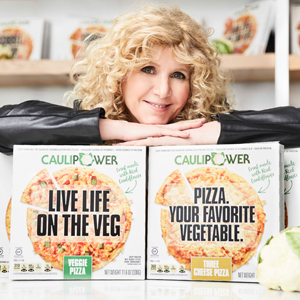
[00:21:31] Ray Latif: Next we have Ben Van Leeuwen, the co-founder and CEO of Van Leeuwen Ice Cream. Launched in 2008, the premium Ice Cream brand and retailer has evolved into a broad platform with 22 Ice Cream shops in New York and California and a wholesale pint business with more than 1,500 accounts across the US. In an interview included in episode 203, Ben discussed launching a business in the midst of a recession and why running lean was just the default when building the company. You mentioned that you launched in June of 2008. If I recall, that's when the recession was really coming into being, really coming into focus. People were starting to get really worried. Not the best time to open a business. How do you make it those first two years? Well, I mean, we didn't know any other climate because we hadn't run the business in any climate other than that. And so, you know, we were lucky we did well. But I think part of that, too, is that launching an Ice Cream business during a recession works because it's an affordable luxury. I think then we were charging like 350 for a cone. So that's something that especially if you're feeling really bad, you might even be more inclined to buy. 350 a cone. Yeah, that was early on. It felt like there was some growing interest in sort of handcrafted artisanal products at the time, even 10 years ago, 12 years ago. Did you see other brands popping up that you could take influence from? Were there other Ice Cream brands like yours? There actually weren't. One of the reasons we wanted to do Van Leeuwen is because there was nothing else in America like it. So there was no one else making Ice Cream using the best ingredients and using a really great base formula. So meaning lots of cream, lots of organic egg yolks, no stabilizers. So some people were doing some of those things, you know, a few good ingredients here, sometimes a good recipe here, but no one was doing everything. So we were inspired more by sort of ingredient producers and farmers and chocolate makers than we were other Ice Cream makers. We did have some really good Ice Cream in Italy that was made with pistachios from Sicily and, you know, chocolate from Domori, a really good chocolate maker. And that inspired us a little bit, but it was the ingredients that inspired us because the experiences that still move me a lot and move me even more than when I didn't have the stress of running a business on my shoulders were sort of tasting something that was incredible, that was made with a ton of care. And not necessarily something fancy, but sourdough bread that was fermented with a ton of care and time and chocolate that was made with beans from farms that were carefully cultivated and responsibly managed and there was a lot of attention on the fermentation of the beans and the roasting. So to us it was really exciting learning about those processes that make great ingredients great and then tasting those ingredients and saying wow that really is something. So early on one of the One of the biggest tests we did when we were doing the product development for Van Leeuwen was chocolate. We love chocolate and there were a decent amount of choices for chocolates for us to use. We didn't want soy lecithin. We wanted it to be completely traceable. We ended up going with Michelle Cazell chocolate, but they had like seven different single origin or single farm chocolates. And we tested, I think, 35 different batches of chocolate and tasted all of them. But before we tested them, we were talking to experts in Ice Cream production. And the advice from them was you don't need to use really good chocolate in Ice Cream. It's a waste. You're using cream and eggs, and those are going to completely cover up the chocolate. So don't do it. So we did not heed their advice and we, well, we said, let's try it. We're just making samples at home. And we tasted it and we were like, oh my gosh, this is the best chocolate Ice Cream we've ever had. So a lot of these norms in manufacturing that you would normally apply to a consumer packaged good, we sort of veered away from and said, no, let's try using the best chocolate. Let's try bringing the butterfat up to 19% and the egg yolks up to 8% and see what happens. Because these were things that, and still nobody in Ice Cream does these things. Nobody on the scale that we're doing it, restaurants do, but no manufacturers do. The Series A, what went into that decision? How did you assess your financial needs at the time? felt like we were in a place where we had learned enough about running a business and learned enough about sort of our business and how we can optimize it. And we finally felt comfortable taking money because the growth path and the path to creating a lot more value in the business was clearer than it ever had been to us. Additionally, running a business starting with $60,000 and going 10 years on that is incredibly stressful. So to us, the dilution was kind of worth the peace of mind and a slightly less stressful existence. It sounds like you've been running pretty lean over the years. Was that just intentional or? And I ask this because I read about an investor, when you announced the Series A, one of your investors said, described you guys as incredibly profitable. And this is a well-known investor, at least in the food and beverage industry. And when he says something like that, I mean, that says something. Was lean about turning a profit or was lean just the way you knew how to run the business? To us, running lean was just the default. were under the impression then that to grow a business, you wanted to try to spend as little as possible and make as much as possible. I think that's the basic economics of running a business. A lot of businesses aren't run like that anymore. It shouldn't be old-fashioned, but maybe I think it's coming back into fashion. But yeah, that's just how we could survive by doing it that way. We're very, very thoughtful about everything. oftentimes, I think, oversimplifying things, but saying, OK, if we hire this person, will they pay for themselves? And someone, a hire that might take four years to pay for themselves, we couldn't afford to do that higher than a piece of equipment that would take six years to pay for itself. We couldn't do that. So we were just really, by default, we ran the business in a super lean way. Do you want more repeat buyers on Amazon? Well, this free resource in collaboration with Straight Up Growth will help your brand turn first-time buyers into long-term subscribers. Download Winning the Repeat Purchase Game on Amazon now at Taste Radio slash SUG. That's Taste Radio slash S-U-G to start building retention-driven growth for your brand on Amazon. Scaling a beverage brand into major retail comes down to operational readiness. From packaging lead times to co-manufacturing strategy, the details can make or break a launch. In a new e-book in collaboration with Octopi and Asahi Beer USA, industry leaders share what they've learned in helping brands scale. Download it now at Taste Radio slash octopi. Do you need to scale your team faster without compromising on talent? Join Oceans for a live webinar on April 20th and learn how leading companies are hiring top global professionals who are ready to grow with your business. Register for the webinar now at Taste Radio slash oceans. That's Taste Radio slash oceans. Let's continue with Andrew Abraham, the founder and CEO of protein-centric brand Orgain. Introduced as a first-to-market brand of organic protein beverages, Orgain has since grown into a thriving platform for protein drinks, powders, and bars. In this clip pulled from episode 197, Andrew discussed learning the ropes of the food and beverage industry, why entrepreneurs that are not well capitalized from the outset might be in for a bumpy ride, how he convinced his family that despite significant losses, the brand was on a positive trajectory, and why he believes that the best defense is a super aggressive offense. How did you learn about the business? Because, you know, you bootstrapped, you were a doctor, you know, maybe getting on shelf at Whole Foods, you get on there once, but if nobody's buying it... Yeah, you're in trouble. I mean, you've got a lot to learn and quickly. What was that process? Was it reading 120 books on business? No, I mean, it's learning the hard way, right? I mean, I think one of my favorite quotes that I've heard is that Ben Van entrepreneur is jumping off a cliff and building a plane on the way down. Oh, nice. I like that. And that's exactly what it was. So I jumped off not knowing it was a cliff, and then quickly realizing it was. And, you know, you just kind of have to figure things out. And you make a lot of mistakes. I made a tremendous amount of mistakes. What were some of the mistakes that you made that you felt like maybe with the right training, you could have avoided? Well, you know, there was things that never crossed my mind, like you should really do a shelf study on a protein beverage that has 20 plus ingredients. I didn't do that. Our shelf study happened on shelf. So we made the product and put it on shelf. And I learned very early on that protein can congeal and can, you know, it turns into pudding. Your formulators didn't tell you that? You know, they told me, but I think we just didn't take the proper steps to make sure that we were going to do a 12, 18 month shelf life study. It was first to market. We wanted to be aggressive. And we learned the hard way that, you know, you should do your due diligence, be careful. And we learned early on that that was a key mistake. Otherwise your customers are going to be drinking sludge and drinking pudding. Yeah. I mean, I got a, I got a call that the drinks were not pouring out and I, you know, I, I never, I never imagined that I would see that day, but I went to the store and bought a couple of shakes and I opened them and they truly did not pour out. Yeah, so that was the thing. Do you attach a spoon? What do you do? And obviously we had to do a withdrawal and figure it out. So there's a lot of mistakes that you learn, but because of those mistakes being so extreme and could have put me completely out of business, you learn. And today, you know, the due diligence we do is completely different. Who was your first hire? Who was the first person to kind of help you along this journey? You know, it's interesting. I was the sole employee for about five years and built the business to a decent size. It was someone that was doing demos. It was a guy that was doing demos. His name was Todd. I saw him at Whole Foods and asked him to join us. And he started doing demos for us full time and helping me with events and so forth. And then from there, the first more senior hire was a vice president of sales. So that was our first hire. How do you run a company for five years by yourself, especially when you are into something? I mean, you must have known that this notion of a clean, organic protein shake, you were on the right track. I mean, why'd you wait five years, I guess? Yeah. It's a great question, and I think it's not because it was heroic on my side. It was more being naive. I didn't know any better. I thought, jeez, I have to hire someone. It's a six-figure hire. There's a bonus involved. There's all these things I just can't afford to. So I just kind of put my head down and just did it myself. Everything from customer service to ordering ingredients to logistics, all of it. But, you know, looking back, I could tell you that that wasn't smart. It's smart when you're early on to get help, get people that are smarter than you, surround yourself with people that are smarter than you. And, you know, looking back, I think, you know, while it worked for me, I think a vast majority of the time, that's not a good path to take. It's good to get people in early that can help you. I think it's important to realize that whatever dollar amount you have in your head that you think it's going to take to launch a company, you should multiply that. By? By three to five, I think, honestly. It really takes a lot more money, time, resources. You know, it takes a lot more bandwidth, everything. So I think as long as an entrepreneur goes into this venture knowing that it's going to be expensive and only get more expensive, I think you'll be OK if you go in saying I have $20,000 and I'm just going to have a cash flow. I think you're in for a bumpy ride. How do you eventually convince your wife that this was going to work? Families are extremely important in this business. I mean, if your family is not on board, I mean, that's that makes things doubly difficult, right? It's very difficult. I mean, and I started Orgain when Kathy, my wife, was pregnant with our first child. So it's very, very difficult. And then we had our son, our second son, 15 months later. Wow. That's pretty quick. Yeah, it was quick. It was quick and very difficult. And it was during that time when I had started Orgain. And at certain times, it didn't make sense, not only to her, but to me. You know, there's some dark times there where you kind of lock yourself in a room and ask yourself, is this really going to work? But, you know, I was seeing the letters come in from our consumers. I was seeing the feedback that we were getting. And I knew that if we could just weather the storm long enough, that Orgain would succeed. I believed it a bit more than my wife, so I had to convince her. But I think eventually she understood and was willing to take the risk with me. And I think that's really important. I mean, it's you're going kind of on this journey and it's important to have the support of someone that believes in what you're doing, not necessarily to the same degree, but is willing to support you. So, I mean, what was your approach? So my approach is and continues to be today to run as quickly as possible every day, to constantly innovate, to always be aggressive. I think the best defense is having a super aggressive offense always. At the same time, while you're being relentless in making sure that you're growing and doing everything that you can to build the business, you want to make sure that you also have that infrastructure that you mentioned. and make sure that, okay, it's wonderful that you have this growth, but is your quality there? Is your operations team built for this? Can you support it financially? So it's really twofold. One is keeping your foot on the gas, and the other is trying to make sure that everything on the car is in place, right? Because a lot of times, and to your point, there are a lot of companies that grow and quickly realize that they're missing a wheel along the way. So it was a combination of both, but certainly the mentality has always been grow aggressively and do whatever you can to further the business, but be strategic and smart. One thing I'll point out is to always be cautiously optimistic, meaning I've been in the business now 11, 12 years, and I've always maintained an attitude of making sure that you remain down to earth and that no matter how quickly you're growing, you can realize things can absolutely go wrong. And I think if you maintain that healthy fear, it helps tremendously. After just three years on the market, the company generated an estimated $100 million last year. As part of an interview featured in episode 196, Gail discussed the value of taking risks, breaking traditional rules for packaging and retailing of a food brand, what she learned about the food business from working at her father's store as a five-year-old.
[00:37:11] Siete Family: I think one of the biggest mistakes that a lot of entrepreneurs make is that they're afraid to admit what they don't know. And when you do that, you lose out on so much. I'm a big believer in hiring people smarter than I am, experts in their field, and listening and learning to what they have to say. There are some things I brought to the table. Obviously, I worked in marketing, and I ran a lot of businesses, so I knew that end of it. But I didn't know anything about food. And so I think it's really important to admit what you don't know and hire around it. And I'm a big believer in saying that I learn every day because I do. I'm a big believer in saying as great as Kali Power is, it's never easy. And I sort of hate when I look at Instagram and everything looks so wonderful and so easy. And as all your listeners and anyone in the food industry knows, it's hard every day. It is hard every single day. Worth it, but really hard.
[00:38:11] Miguel Garza: Now, you did bring a lot, you're right, to the business. You had a background in marketing and PR. How do you think that benefited you starting out?
[00:38:20] Siete Family: two things that actually really helped. So one, I had worked in marketing for many years. I actually, and working at an agency was really interesting because it was my job to counsel other companies. And there were so many occasions when you'd go into a company and you'd say, well, we think you should do this or you think I should do it. And half the time they'd listen to you and half the time they wouldn't. Well, the great thing about Kali Power is I get to take my own advice. It's not always the right advice, of course, but I do get to listen to my own advice and it's worked out well and we get to take risks. And I think that's one of the greatest things about being a young company that's growing quickly is you do get to take risks. And you should take risks. And they're not always going to work out. But it's really what defines this industry. I mean, this industry has evolved because big food hasn't brought what people were asking for. So it's really up to this industry to listen to people and take the necessary risks in order to bring those things to market.
[00:39:23] Miguel Garza: breaking rules is kind of your MO. What are some of the rules you've broken along the way?
[00:39:29] Siete Family: Well, I don't know how much time you have allotted in this podcast. But so some of the rules I broke, one is I think I broke a rule on the packaging, I would say, you know, I think we broke a lot of rules with our packaging, you know, don't put big black letters on the front, you know, keep it clean. And I think that going into Walmart very early for us was something that I was really counseled against, but decided to do. Moving out of pizza, I think was something that a lot of people said, you shouldn't do that. You know, just make pizza 16 different ways and don't do anything else. I didn't listen to that. By the way, I did listen to a lot of advice. I listened to more advice that I didn't listen to. But there were some things that I just followed my gut. I'm not a young entrepreneur. And I think one of the things about starting a business later in life is that you have a bit more confidence to, you know, follow your instinct and do something differently. And for me, if I was going to give up what I had in corporate America, and I had a very nice existence there, but if I was going to give all that up, it was going to be for something pretty meaningful. And in order to be something meaningful, you have to do what your heart tells you to do. And that's all I've ever done in building Kali Power. So in a world that is divided by so many things today, and in a food universe where there are so many foods that are, don't eat this, or don't eat this, or this is free of X, Y, and Z, how about if we just put the food on the table and all eat it, and not feel separated, but feel united? I love that about food. It's funny, sometimes people ask if I'm a foodie. And you know what? I'm not really a foodie, but I love meals. I love cooking. I love feeding people. My parents were both children of war. They had no food. And even when I was growing up, and even when times were tough, the one thing they would never skimp on was food, because that is how you showed someone you love them, is you cooked for them. And of course, you saved all the leftovers and put them in the freezer, because you would never want to throw those away. So I think I was destined to be in the frozen food.
[00:42:00] Miguel Garza: You're throwing that away? Exactly.
[00:42:01] Siete Family: It's just a tiny cup. Oh, that's lunch tomorrow. I wish my mother could have known that I entered the frozen food business. She'd be very proud. That's what it's about. It's about how food can bring people together. And that is what I love about this industry. And that is what I love about the people in this industry. And that is why I love being a part of this and helping people in some tiny, tiny little way.
[00:42:34] Ray Latif: That brings us to the end of episode 221. Thank you so much for listening, and thanks to our guests, Miguel Garza, Nick & Elyse Oleksak, Miyoko Schinner, Ben Van Leeuwen, Andrew Abraham, and Gail Becker. As always, for questions, comments, ideas for future podcasts, please send us an email to ask at Taste Radio. On behalf of the entire Taste Radio team, thank you for listening, and we'll talk to you next time.
[00:43:09] Nick & Elyse: Hello, I am Melissa Traverse here for the Taste Radio podcast, talking about some of the biggest tension points that CPG brands and founders face when they're scaling a brand, and those are financial accounting and inventory management. I am joined by Matt Lynn, inventory accounting guru from Belay Solutions, and he is going to shed some light on all of this that is going to help everybody out quite a bit. Matt, thank you so much for joining us today.
[00:43:40] Ray Latif: Thank you for having us, Melissa. It's great to be out here at Expo West and it's great to sit down and be able to chat this because it's kind of a passion project of ours, working mainly with CPG brands and hoping to help them scale.
[00:43:51] Nick & Elyse: It's been such a pleasure chatting with you and the team and learning all about what you do over there at Belay Solutions. Can you tell us a little bit about yourself and what your role is and the kinds of solutions that Belay gives to CPG brands and founders?
[00:44:07] Ray Latif: Yeah, absolutely. My role with Belay, I'm actually our inventory accounting manager. I run our inventory department, so we work with CPG brands, taking them from spreadsheets, putting them on inventory management systems, and really helping connect their tech stack between their sales online marketplaces to that inventory management system, even down to their financial systems like QuickBooks. Belay overall is kind of an outsourced accounting firm. And with that, we're helping teams. We have different levels with bookkeeping, controller level work, even high level into CFO type items. So we really help those brands in any way that they need financially. And then I just have a subset of a department where we're really just laser focused on inventory.
[00:44:50] Nick & Elyse: It's certainly a complex topic and there are plenty of places to go wrong. Let's start by going right and start super simple. Can you tell us what some of the biggest red flags are that would help a founder understand or, you know, the person running a brand understand that it really is time to get some help with some of these areas?
[00:45:10] Ray Latif: Yeah, absolutely. I think some of the early red flags is just everything is chaos. So when they're looking in their financial software, maybe they don't really have an accounting background, and they're kind of just piecing it together and doing their best. And what they'll see is that reconciliations take forever, if they even happen. They have a lot of transactions that don't get coded, or they just put them into placeholders to just get rid of it so it's not an eyesore. they'll notice they have revenue but no cash or they notice that they have a good amount of cash but their blind spot is really seeing the vendor invoices that are sitting there just needing to be paid and so they just lack that clarity that's going to really be around the corner.
[00:45:47] Nick & Elyse: You know, you were talking about one of the red flags that comes up that I think makes so much sense. When somebody asks you what your numbers are and you can't come up with the right number, that's a big problem because that's something that you really should be able to share with decision makers who, you know, you're ideally looking to do business with. What should you be able to call up at a moment's notice?
[00:46:12] Ray Latif: really at any time, you should be able to know an accurate margin. It's amazing how many founders we end up talking to that they can tell you their revenue numbers, they can tell you their selling price, and then the minute you start talking about cost or their cost of goods sold, they just get a deer in headlights look. So really it's very hard to tell, am I even making money? or if you don't know your entire landed cost. Maybe you know what the freight cost is, the duties separately, but you're not really getting that as part of your unit cost. So it's really hard to tell. Am I even making money or am I losing money from the very beginning?
[00:46:45] Nick & Elyse: And do you recommend that founders are able to call up a margin by channel?
[00:46:50] Ray Latif: Absolutely. And depending on the number of products and channels, you kind of want to know what are your best sellers, which ones are making the most and which ones maybe you're not making as much. But especially if you're branching out and you're doing D to C with B to B, absolutely want to know that.
[00:47:06] Nick & Elyse: Gotcha. You mentioned that when things feel really chaotic, that's probably a red flag. I would say that it probably almost always feels chaotic if you're running a CVG brand. And I know this may be hard to quantify, but is there a revenue number? Is there a number of doors number that would help a brand understand whether or not it makes sense to bring on a partner like Belait? Understanding that so many brands are bootstrapped or they might be tight for cash. What is that friction point?
[00:47:37] Ray Latif: 3 3 3 3 3 But as you're growing, as you're getting to those six-figure revenue numbers, and especially as you're approaching seven, you want to make sure you've got good financials. Because as you scale to that point, most likely you're going to be looking to raise capital. And investors, the first thing they're going to look at is your books. And are they clean? And do they show a clear picture of your business?
[00:48:09] Nick & Elyse: You know, another area that folks might look to to organize some of the chaos are their systems. So many folks stick with Excel spreadsheets for a good amount of time. How do you know that you need to outsource some of your accounting to an organization like Belay Solutions versus maybe signing on to a Synth7 or NetSuite or something like that?
[00:48:32] Ray Latif: Well, that's actually something we really help with when it comes to that cost question. That's something that trips people up. And sometimes if you just have a turnkey business, you buy and sell a finished good, you can maintain with spreadsheets. And we've had clients with million dollar revenue that can do that. But we see so many brands nowadays are using contract manufacturers. and they're just sourcing certain parts of their product. So when you start talking cost, they have no idea exactly what their unit cost is. So that's where we come in and we kind of understand, we'll speak with the customers and the clients and get their needs. And then if we think they're ready for a system, then we'll help put them on that system so they can get some of that clarity. And it's not something we force on anybody. There are plenty of times where founders come to us and we'll tell them bluntly, you're not ready for it right now, but we'll let you know when we think you are.
[00:49:18] Nick & Elyse: That sounds like excellent advice. What should a founder or somebody running a brand look for in an outsourced accounting partner? Are there certain checklist items that they should make sure that their partner be able to execute or be able to help them understand?
[00:49:35] Ray Latif: Absolutely. I think one of the keys, there's, there's a lot of outsourced accounting firms out there. Some focus on service-based SaaS companies, but if you're a CPG founder, you really want to make sure that your accounting firm has CPG experience. I would ask them, you know, what kind of brands have they worked with and even beyond that industry specific, because there's so many subsets of CPG. And that's something that I think is great about what we do with Belay is that we kind of run the gamut. It's kind of like the insurance commercial. We know a thing or two because we've seen a thing or two across a broad spectrum.
[00:50:05] Nick & Elyse: Probably getting references is always helpful, right? Absolutely. All right. So this all sounds great. I think we have a really good understanding of would it make sense to hire an outsourced partner? You know, what some of the things you should be looking for are. What does offloading this kind of work mean for the brand? What can this do for lightening the load of a founder or lightening the load of a brand operator? Like, how does that help them in their everyday business?
[00:50:34] Ray Latif: It just tries to really help quiet the chaos. So what we're looking to do is just take some of the weight off that founder's shoulder, let them focus on building the brand, building the business, getting that exposure. If you don't have sales, you really don't have anything. So we want them to be able to focus on that while we take care of your back end office work. And we can just present that to you on a monthly basis, you can help make decisions, you can take that to investors. And really, you can just focus on growing your business.
[00:51:00] Nick & Elyse: I feel like I felt founders and the folks who are running brands collectively sigh a breath of relief just hearing that. How can people learn more about Belay Solutions?
[00:51:11] Ray Latif: So people can text TASTE to 55123 for their free inventory guide to get started.
[00:51:16] Nick & Elyse: Matt Lin, Inventory Accounting Guru at Belay Solutions. Thank you so much for joining me here at Expo West. It's been such a pleasure to chat with you and learn about what you all do over there to help founders and brands with their financial accounting and inventory management. For everybody else out there, thank you for listening to the Taste Radio podcast. I am Melissa Traverse and we'll see you next time.