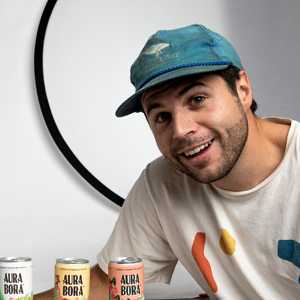
[00:00:10] Ray Latif: Hello friends, I'm Ray Latif and you're listening to the number one podcast for the food and beverage industry, Taste Radio. This episode features an interview with Paul Voge, the co-founder and CEO of Aura Bora, a fast-growing brand of artisanal sparkling waters infused with herbs and botanicals. Just a reminder to our listeners, if you like what you hear on Taste Radio, please share the podcast with friends and colleagues. And of course, we would love it if you could review us on the Apple Podcasts app or your listening platform of choice. Paul Voge wasn't too worried about Ouroboros' first large-scale production run. The brand, which markets zero-calorie sparkling waters made with real fruit and botanicals, was born out of his belief that there was room for an artisanal option within the carbonated water category. If, however, the brand failed to get off the ground, Paul was comfortable with the idea of having 35,000 cans for himself to drink over the next few decades. Ouroboros has indeed resonated with sparkling water consumers, and over the past two years, the company has expanded beyond its original focus on the natural channel and e-commerce, and into conventional retail stores. The brand is now available at 3,000 locations, including nationally at Sprouts, and is also sold at 7-Eleven and Raley's, along with Harris Teeter and United Supermarket, chains operated by Kroger and Albertsons, respectively. In the following interview, I spoke with Paul about how he sought to differentiate Ourobora from other sparkling water brands in name, package design, and formulation, why he was inspired by artisanal food brands, the clever way he landed a meeting with a Whole Foods buyer, and how he was ahead of the curve on pricing. He also discussed his tension-filled yet ultimately successful experience on Shark Tank, why investors were at ease with an evolution of Ouroboros' retail strategy, why sales data has been critical for planning, and how he's been able to hire accomplished industry veterans and place them in key positions within the company. Hey folks, it's Ray with Taste Radio. Right now, I'm honored to be sitting down with Paul Voge, the co-founder and CEO of Ourobora. Paul, how are you? I'm well, thanks for having me.
[00:02:36] Paul Voge: Love this podcast, great to be on it.
[00:02:38] Ray Latif: Yeah, love that you're on it with us here in Newton, Massachusetts, in person. You were in the area for a canning run, is that right?
[00:02:47] Paul Voge: Production run, sales blitz, and of course, just for this interview, more than anything.
[00:02:53] Ray Latif: Yeah, and you're from San Francisco, so this was a nice little trip for you.
[00:02:56] Paul Voge: It was. I probably come out to the East Coast like once every six weeks. I have family out here and friends who I see in between store visits. So it's fun to be back.
[00:03:06] Ray Latif: You mentioned to me that you're from Rye, New York. Where's Rye?
[00:03:09] Paul Voge: Rye is 20 miles north of New York City. Okay. You know, Westchester County, if you're familiar with Westchester. Sure. But certainly went to the city a bit. And now I realize how not New York I am, because we hired a great New York salesperson named Sal. And Sal, also from outside the city, but his accent, the way that he conducts himself, his attitude, like his name is Salvatore, but he goes by Sal. So I'm from New York, but I always feel like I'm not as New York as Sal. is what I'm conscious of now.
[00:03:38] Ray Latif: Yeah. Please don't take this the wrong way, but I always thought you were from California.
[00:03:41] Paul Voge: No, not the wrong. Hey, I'll take that. I'll take that in all the positive ways and I won't take it in any of the negative ways. UCLA for undergrad? I did.
[00:03:49] Ray Latif: Yeah. Yeah. So you've experienced the best of the West Coast of California.
[00:03:54] Paul Voge: I think so, yeah. Now I live in Northern California, previously was in Southern. I actually lived in Colorado in between. So I don't think I'll leave. I like California.
[00:04:02] Ray Latif: Yeah, it's really nice. I think the first photo I ever saw of you was the backdrop of San Francisco. Okay. And you were with your wife. Yeah. And that was the first time I saw you with a baseball cap on. And I'm a big fan of baseball caps. When I'm not all dolled up like this, I'm usually wearing a baseball cap, a button down blue shirt, jeans and sneakers. And your baseball cap said math.
[00:04:24] Paul Voge: Yes, that was my math hat from actually was from when Andrew Yang like just started running for president. That was like math hats that he was handing out at events. That's probably at an event in San Francisco, but I am often in a hat for sure.
[00:04:37] Ray Latif: The one you're wearing right now was at Seaside Market, Cardiff.
[00:04:39] Paul Voge: Yes, this is actually one of our retailers. If you sell Ouroboros in your store and you sell hats, I will wear your hat. Okay. This is one of our best stores. It's one of my favorite hats. I wish every grocery store had to sell this exact hat with their logo on it. But depending on hair length, this is like a soon closer to the haircut. style hat.
[00:04:57] Ray Latif: Yeah, it's a nice looking hat for folks not watching the video. It's a blue hat, blue trucker-ish type hat.
[00:05:03] Paul Voge: Trucker-ish for sure.
[00:05:04] Ray Latif: And the seaside market is in cursive. It's all in orange and white. It's a nice looking hat.
[00:05:09] SPEAKER_??: Thank you.
[00:05:10] Ray Latif: Yeah, I need more of those myself. We don't have any BevNET hats. I gave you a Taste Radio t-shirt before we got started.
[00:05:15] Paul Voge: No, you need, if John Craven listens to this, you need to make hats. We're gonna need hats here as soon as possible and I'll wear it.
[00:05:21] Ray Latif: Yeah, I've never thought about that We've never had in all the years. I've been with Bennett. We've had Hoodies pullovers t-shirts. We've never had I think it's cuz John's a jailed hair guy. Yeah as a result He's never gonna wear that hat. I never thought about that.
[00:05:35] Paul Voge: He always has his hair in place That's a problem for the hat hat community.
[00:05:40] Ray Latif: We need that. Yeah.
[00:05:41] Paul Voge: Yeah. Do you have any Ouroboros hats? We do. I should have brought one with me. That's the hat I wear. It's like a little bit of a not as deep a hat. So I wear that like just after getting a haircut, but it has our eye logo on it. It's a very popular hat. We were given away a ton at Expo. So I'm sorry you didn't get one.
[00:05:59] Ray Latif: I apologize for not being at your booth long enough to get one. So it was a crazy, crazy shift. It was crazy. Do you guys have a good Expo West?
[00:06:06] Paul Voge: We did. It was like one, obviously our first Expo West, everyone's first Expo West in a couple of years. And we wanted to meet with like 15 buyers. I feel like 12 came by, which is a pretty good ratio in my book. Yeah, it was like chaotic. I almost remember none of it. That's how busy it was. Yeah. It was a blast.
[00:06:23] Ray Latif: Did you close any deals with any buyers?
[00:06:25] Paul Voge: We did. We got some deals closed.
[00:06:27] Ray Latif: Congratulations.
[00:06:28] Paul Voge: Yeah. Thank you. Really excited for the year ahead for a lot of new distribution and hopefully more SKUs in existing distribution as well.
[00:06:35] Ray Latif: Yeah, you guys are doing well. So congratulations on all the success that you've had over the past couple of years. Your LinkedIn profile says that you started the company in 2019. Yeah. But you first launched or you first got into stores in January of 2020, right?
[00:06:50] Paul Voge: Yeah, so we actually, the very first can we sold November of 2019. Now these were all canned by me and my wife Maddie. We borrowed this machine, there were like a thousand of them, and we sold it to a grocery store a block from where we used to live in Denver. You canned in your home? No, we actually, we eventually used this facility as our first co-packing facility, but we were asking to do a laughably small run of a thousand cans. And the gentleman that ran the facility was like, Hey, I'll just teach you how to use the machine. And I'm not going to do this. This is, doesn't make sense. But if you get a PO, like, great, let me know. By the way, how much do you lose per can when you're only doing a thousand cans? Yeah, I know. Yeah. A lot. It's probably, you know, 24 ounces for every ounce that goes in the can. Something like that. So, we did that first production run, sold all 1,000 of those cans to one grocery store called Lever's Locavore. If they made a hat, I'd wear that hat because they were the first store. Cool name. Got to give them a good shout out. Yes. Great store in Denver. And that was just before a trade show. So, we were making it for a trade show. Ended up being a successful trade show. We didn't know it'd be our last trade show for two and a half years. And then from there, did our first big production run and kind of kicked off January of 2020.
[00:07:59] Ray Latif: Getting into stores in January of 2020 must have been great for you guys, giving you a leg up on all the other brands that didn't have a chance in March or that launched in March or April. So how much of a foundation, how much of a buffer did it give you to get through the rest of the year?
[00:08:17] Paul Voge: I think more than any buffer was just, you know, the first kind of eight weeks of the pandemic, distributors didn't know, should we all just drop all of our products and only, you know, sell canned goods and toilet paper? So there was a number of weeks where no distributor was taking on a single new product, no matter how hot the product was. So for us, yeah, there was about a 12 week period where we luckily got local distribution and somehow, I mean, I checked the email a few weeks ago, I think we got our email saying we were getting our first national distributor like on March 7th. Of 2020? Yeah, of 2020. So we had a local distributor January, February, March in San Francisco. And then we had this first national distributor first week of March. And then the second week of March, they said no new customers. And they didn't open up a new customer for like four months. So in that period, yes, super grateful. We got so lucky. And of course, grocery stores didn't close. I know plenty of beverage companies that were based, you know, had food service distribution or office distribution or event distribution, all of which obviously vanished. So luckily we just happened to choose grocery to focus on and happened to get with distributors, you know, days before. So certainly helped.
[00:09:27] Ray Latif: You landed with a national distributor, but you were, I'm sure, not ready to be nationally distributed.
[00:09:32] Paul Voge: No. Yes. Sorry. Good distinction. By that I mean we had the paperwork in and we could accept purchase orders and then turn on their warehouses. Yeah. Right.
[00:09:41] Ray Latif: I gotta think that there were people who were drawn to various aspects of Ouroboros, those people being the distributors and retail buyers that you were speaking with. You know, when I first saw the can, it just looks like a beautiful thing that you wanna pick up. Thank you. For lack of a better phrase. You know, and I think this is something, when I first met you, it was an episode of our Elevator Talk series in July of 2020. And our co-host for that episode was also talking about how striking the can was, how interesting your flavors were. I think she was a big fan of the coconut one. It's also your favorite one, right?
[00:10:15] Paul Voge: It is my favorite, yes.
[00:10:16] Ray Latif: Wow, good memory, yeah. You know, what was your experience selling this into retail? How were people viewing Ouroboros? What was their interest in your brand? Was it the packaging? Was it the flavors? Was it the fact that you were called an herbal sparkling water?
[00:10:34] Paul Voge: Gosh, I think, so for the first, I'll say first 100 stores, which I would say more than anything, they just wanted me to stop harassing them. So it didn't matter what we were selling. It was just like, get out of my store. I would come three, four times a week and do the same pitch with various employees. And this was even pre that local distributor. Let's call this like January. And this is with independent retail stores? Independent retailers, yes. Independent retailers in San Francisco and Berkeley and Marin and Silicon Valley. And I would say this with any product you're selling. At first, they're mostly just selling it because you're passionate about the product, which is a nice way of saying, like, you're annoying them. And they're running a store, and that's a very stressful thing to do. I think thereafter, once they got past how annoying I was, The first and foremost was, wow, okay, we can see this in the single-serve beverage set. It's in a funny gray area where it's more expensive than other single-serve sparkling waters, not quite as expensive as a cold brew or kombucha or anything with CBD in it. And then of course, yes, the packaging hopefully sells it the first time and the flavor and product sells it each time thereafter. But certainly at the start, it was not the product, it was not the margin, it was just get this guy out of our store, Unfortunately for them, once we were on the shelf, actually only came more frequently to merchandise the set. So that didn't work for them. But yeah, we're grateful to those first 100 stores.
[00:11:53] Ray Latif: That's what a good entrepreneur does. They hustle, right? Yeah, sure. Yeah.
[00:11:56] Paul Voge: That's good spin.
[00:11:57] Ray Latif: Let's back up for a second, because I think your story of how you created the flavors and the idea for Ouroboros is not too dissimilar from those of other entrepreneurs and sparkling water. Started out with a soda stream. I think, you know, this story's been told a number of times in your kitchen, messing around with some herbs. You know, so I think, again, that story is relatively common. I think the story about your packaging, however... is not as common. Sure. And, you know, in your press release, your first press release on BevNET, you talked about, I knew our cans could be tributes to the ingredients inside. And I think that's an amazing statement. The colors, landscapes, and cheeky haikus on each can help Ouroboros jump off shelves the first time, and the taste sells the product each time thereafter. Brilliant, right? That's a case study. That's a Harvard case study. We'll take it. Well, those are your words. Yeah. So the packaging, I think some people would say, you know, some old school beverage veterans might call it busy because there's a lot going on in the can.
[00:13:04] Paul Voge: I've heard that before.
[00:13:04] Ray Latif: Yeah. But what did you want to include? What were some of the things that you said, okay, this is going to jump off the shelf if we include this?
[00:13:12] Paul Voge: So I think in one, I'll say, I say this to anyone that asks for the packaging, I married well. So that was like the first bit of advice is like, marry well. Here you go. My wife and co-founder, Maddy, is a creative director now at Ouroboros full-time, previously at various software companies, and is extremely opinionated about, I say that kind of like in a negative way, in a good way, extremely opinionated about packaging and branding and kind of what's being expressed on any sort of box, barrel, bag, can, you name it. So for us, we thought, and this is not that dissimilar from craft beer, say 15 years ago, of there's all these sparkling waters that are branding themselves like a commodity. And sparkling water kind of is a commodity. Just that phrase alone is a commodity. If we were going to use these whimsical, strange ingredients, could we have the can be as whimsical and strange as the ingredients inside? So our first kind of brief with some illustrators we worked with was, can it be delightful but peculiar? And I think we, both myself and Maddie, we met at a summer camp in New England. We're very outdoorsy folks. Felt like, okay, we're using these earthly ingredients. That was kind of what I mentioned about a tribute to the ingredients inside them. This can in front of us is basil berry. Could we create this kind of surreal world where, yeah, strawberries the size of, you know, an apartment building and hedgehogs pick strawberries? You know, it was just something to get you to do exactly what you just did, grab the can off the shelf. And we knew, yeah, when you're grabbing the can off the shelf, like the second it's in your hand, we now have about a 70, 30, 70% chance it goes in your cart, 30% it goes back on the shelf. So that was the goal, to get you to pick that can up. And then more importantly, yes, we're a 1% for the planet company. We purposely use infinitely recyclable aluminum. We're giving profits away of all our LTOs to environmental charities. And the idea was, how can we communicate that without being so obnoxious about communicating that? So the hope is that the packaging leads you to think, okay, this is kind of a Earth-friendly, clearly Earthly business. Obviously, that is not Earth, but some close simulation of it.
[00:15:13] Ray Latif: Well, for me, the best part of it is when you pick up the can and then you take a closer look. Yeah. You want to pick it up just because it's cool, but then you take a closer look and you see one of those cheeky haikus. Yeah. These herbaceous hills bursting with fresh strawberries. I wear them as hats. Yeah. Nice. That's a good one.
[00:15:29] Paul Voge: There's actually, if you grab our five core SKUs, four of them were written by Matty. One of them was written by me. I won't tell you which. It's evidently clear that four of them were written by a professional, amazing writer, and one of them by some schmuck, me.
[00:15:42] Ray Latif: I would never call you that, Paul. You know, I think the other amazing thing about Ouroboros is that you're in a SlimCam. Yeah. How is this possible that you weren't of only a handful? I can't think of many right now off the top of my head, sparkling water brands that are in a SlimCam. Why'd you make that decision?
[00:15:59] Paul Voge: You know, it was actually one of our earliest investors who has invested in a lot of CPG businesses. So this was like, before we had a name, we had to the SodaStream story earlier, you know, I was forcing him to drink things out of plastic bottles. And I'm sure he was wondering, what are the contents of this can or this bottle? He gave the suggestion of, hey, I think more and more kind of natural companies are going lean towards a slim can, and it kind of communicates in some instances, like low sugar, low calories, obviously for us, zero sugar, zero calories. There's an argument to be made, oh, doesn't it communicate Red Bull energy, et cetera. That was kind of a risk we were willing to take. And then we loved that, okay, we're launching with five SKUs, which is like one or two SKUs more than most beverages launch with. If we do a slim can, you can fit five of them on the shelf where typically kind of three or four squatter cans would fit. So maybe retailers won't balk at taking all five because it doesn't take up as much room. So whether that's true or not or just a theory, I don't know, but that was the thought.
[00:16:58] Ray Latif: I mean, no offense to folks that are in wider 12 ounce cans, but I think that sleek can, I mean, it's in the name, right? It's a sophisticated package. And I think we're seeing more and more beverage brands move to that package, whether it's because of the can shortage or because it represents premium.
[00:17:14] Paul Voge: Yeah.
[00:17:14] Ray Latif: Yeah.
[00:17:15] Paul Voge: I hope that's what it communicates. I've certainly had retailers say like, oh, you know, this is very few instances. Oh, this is too tall for where we put other sparkling waters. But for the most part, I think it just gives you more for the eye to look up and down at too.
[00:17:29] Ray Latif: The first time we spoke, again, in that episode of Elevator Talk, I asked you toward the end of our conversation, I don't know why this was at the end, but what does Ouroboros mean? And I think your response was, it doesn't mean anything, but it's come to mean something. It's come to represent something, I think, more than you originally intended it to. So talk about where the name came from.
[00:17:50] Paul Voge: Sure, so where it came from, and I always say, like, it doesn't mean anything, because I think people are looking for, oh, you know, it means peace in this language, or joy in another. Sorry to lie. Which is not a negative towards anyone that names their companies with other languages. For us, we really loved the word aura. And I was reading a book on marketing at the time, talking about the power of rhyming. So, you know, when you're an early stage beverage company, which we still are, unless you live in San Francisco, you're not going to see this can more than once a week in various stores you go into. So, okay, how can we make it memorable knowing that you're only gonna see it, let's say, at 20 times a year? Hopefully the first couple of times you remember the name. So we wanted something very memorable. We liked the word aura. We liked that there was a tongue-in-cheek aspect of it almost sounds like Bora Bora, which beverage companies like naming themselves after, water companies, after springs or valleys or mountains or islands. That was one piece. And then the other piece was, hey, we have this earthy brand, People kind of have Aurora Borealis in the back of their brain. I would say most people don't know why. Obviously, it's the Northern Lights. Right. So it sounds like something that you should know or you have in your brain somewhere. So that was the hope was, is this a fun thing to say? Does it rhyme? Matty, of course, loved that, made a nice square with the two four-letter words. Oh, yeah, I like that. And hopefully memorable enough that if you see us a couple of months after the first time you saw us, you remember the last time.
[00:19:12] Ray Latif: Well, because, I mean, you talked about the rhyme scheme. Yeah. And there's a pretty big cola company that has a rhyme scheme like that.
[00:19:18] Paul Voge: There is a big cola company with two four-letter words that they always put horizontally. We put up and down. So Coca-Cola was definitely I would say one of the inspirations of, hey, that's a really memorable name. Sure. And of course, it's hard to distinguish now, like, is it memorable because you've heard it a million times in your life or is it memorable on its own? But they were certainly mentioned in that marketing book of two almost rhyming phrases with the same kind of vowel. I'll say, so I grew up in New York. I have a number of friends with Long Island parents where actually we met Orabora to rhyme, Long Island parents, Ourobora doesn't rhyme. It's, you know, Ourobora and two different vowels, but it's meant to rhyme for the most part.
[00:19:57] Ray Latif: I just did an interview with Sandro Rocco from Sand Zone. He was talking about how he really wanted his brand name to end in an O. He wanted it to be short, but he also wanted it to end in an O because I think he said a lot of the great brands out there have a vowel at the end of their.
[00:20:13] Aura Bora: Pepsi, Coca-Cola. Sure. Guessing your margins? That's risky. Belay Financial gives CPG brands the clarity to scale smarter, faster, stronger. Get your free inventory ebook by texting TASTE to 55123 and start making data work for you. Vibrant Ingredients is the natural ingredient partner powering food and beverage innovation, delivering flavor, function, and protection through a science-backed portfolio. Vibrant delivers purpose-driven solutions that help brands create extraordinary experiences. Discover what's possible with Vibrant today. Visit VibrantIngredients.com.
[00:21:04] Ray Latif: Going back to when we first spoke, you mentioned that the hope was that Ouroboros would be more of a treat, more of an exciting, sparkling water, and it would be more of an interesting experience for consumers. within the sparkling water set is a lot to ask, right? Totally, yes. Because people are expecting value, even with great flavor. They want great flavor, but they want value. Where did you see that opportunity to deliver something that was at a premium price point with a great ingredient profile within that sparkling water category?
[00:21:45] Paul Voge: Consumers are seeing premiumization of almost everything. And in some instances, it's laughable premiumization. Like, did I need that to be a premium thing or not, is probably a question we should all be asking ourselves when you're shopping at Whole Foods. For me, and for Maddie, We were kind of hooked on sparkling water. We were both working in office buildings where it was the most popular item in the fridge pantry area, but probably the least enjoyed, which is just kind of a weird dichotomy. Why is everyone drinking, I'll say for me, I was drinking like 10 to 12 cans a day of LaCroix, Waterloo, Polar, you name it. You had a sparkling water habit. A little bit, yeah. I would say I was, you know, some would say addict, I would say aficionado, depends what word you want to use. Tangent, how many cans of Aurobori do you drink a day now? You know, it's about the same number. I would say I probably drank slightly fewer, only in that the office that I was working at paid for the fridge. Now I know exactly the cogs going to each can. So somewhere subconsciously I think I should only have seven, not 10. But all I have to say, still drinking a lot of sparkling water. And I kind of felt like, okay, in this office pantry, we have Kettle Potato Chips, and Justin's Peanut Butter, and Jenny's Ice Cream, and RX Bar, and all of these kind of premium versions in very commodity categories. You know, there's probably a time where no one would think about launching a new ice cream business. But Jenny's, you know, Jenny's in the Midwest, Van Leeuwen's on the East Coast, Salt and Straw on the West Coast, did an amazing job of taking something that was commoditized and making it premium with better ingredients, different flavors, and a brand that people cared about. So that was kind of our playbook. Okay, could we do the same thing with sparkling water? Bring in flavors, you know, from another medium with ingredients that you don't typically see in this category or omitting ingredients that you do typically see in this category and a brand that people cared about. So all that to say... I selfishly and Maddie selfishly, we were making this for us. And we used to joke of, hey, worst case scenario, our first production was 35,000 cans. We're like, worst case scenario, I drink 10 of these a day. Like, I'm going to get through all of these. No doubt about it. I was just doing the math. Like, okay. Like it almost doesn't expire. So yeah, I could drink this the next 80 years and call it a life. I tried my best, but I'm just drinking the last 25,000.
[00:23:48] Ray Latif: They're your cans. They're yours to do with whatever you want to do with them. You know, I think talking about premium ingredients and premium products within a commodity category is interesting because you mentioned examples of how it works or where it works. There's also this notion of premium beverages and how Ouroboros fits into that matrix. I think you brought this up actually during the New Beverage Showdown when you participated in that competition where you said, you know, we think Ouroboros at the $1.99 price point almost competes with a kombucha or a probiotic beverage or something like that. But people are buying those products for function more than they are for flavor, right? Certainly.
[00:24:33] Paul Voge: Yeah, I'd say two distinctions there. So one, certainly not a functional product. I'm also the son of two lawyers. So even if it was a functional product, I would lie to you and tell you it wasn't just to be safe, but not a functional product. You'd have to drink a whole lot of lavender cucumber to feel any sort of relaxation or sleepiness. Some of that is, the way we're using the ingredients, we're using the herbal extracts we use for their strong flavor profiles, more so than any sort of functionality. I would say as to the kombucha consumer, yes, some of those kombucha consumers are buying it because they want the gut health benefits, absolutely. What we have found, and some of this is anecdotally, some of this is survey results of maybe you were going to that shelf, you just bought a sandwich and you're gonna buy a $4 kombucha and you instead decided, you know what, I'm kind of looking for nuance of flavor more so than function, I'll buy this $1.99 sparkling water. So that was one piece of consumers realizing, hey, I could probably make my lunch $2 or $3 cheaper if I just pick this one beverage and still get, you know, an outstanding taste, zero calories, zero sugar, et cetera, which is not a function, but is more so, I would say consumers are thinking of it in the same way they think of functional beverage, i.e. I get hydrated and I don't have to sacrifice sugar, calories, et cetera. For us, I would say the $1.99 price point was important because I did feel like a lot of folks in the food and beverage industry were just, no offense to Erewhon, they're an outstanding retailer we're excited to be in, but they're sometimes a perfect stereotype of, hey, this is a very, very small percentage of the population can afford to shop there on any sort of regular basis. In this country, we have this huge divide between natural and conventional retailers. What if instead we made a product that we thought we could sell in both? Because one, we have not seen any sort of difference between consumers' average salaries and their taste profile, like consumers that make $200,000 a year like our basil berry flavor, consumers that make $30,000 a year like our basil berry flavor. And I think sometimes there's that notion, and a little bit of it is elitist if we're being honest, The second aspect was, hey, you know what are the cheapest drinks? Our unhealthy drinks. You can buy a huge two liter thing of Coca-Cola and it costs not much than a can of sparkling water. Can we make a price point such that consumers are not tempted by price? Can we be competitive on price but still hold our premium ingredients? So for us, I would love a day where we came down on price on shelf. I think Spindrift has done an outstanding job of that, often will be a single can at $1.99 and spindles will be on the shelf at $1.59. I think that's an even more inclusive price point for a single can.
[00:27:03] Ray Latif: Well, I think your theory has been proven correct because if you go to the grocery store, I think, you know, when Spindrift is priced at $1.59, I always see that as like promo pricing because they're priced around $1.99 for a can. I mentioned Sanzo, I think they were on special, not on special, an everyday price of $2.49. So it's almost like you were ahead of the game and thinking, okay, there is a premium tier, premium price tier for sparkling water. convincing investors that there was this opportunity, though, might have been, I think, a little more of a tough sell.
[00:27:39] Paul Voge: Absolutely, people are, I'll say, people are hitting end caps. And if Waterloo is on the end cap, they'll buy Waterloo. If LaCroix is on the end cap, they'll buy LaCroix. We did want to play that game for a few reasons. One, yes, we have weird, unusual flavors. I.e., do you just want to try lavender cucumber once? Or do you want to commit to a flavor you've never had before in sparkling water and buy eight of them? That's a little bit of a harder sell. So no doubt it was a harder sell for me to investors, convincing them that that would be the case.
[00:28:04] Ray Latif: And if you do the math, eight cans of Orabora. Yeah. at two bucks, that's $16 versus that.
[00:28:10] Paul Voge: Absolutely.
[00:28:11] Ray Latif: Even if it was a Waterloo, like it's seven bucks. I mean, that's still- Huge, huge difference. Yeah. Yes. Also a huge, huge difference between the ingredients, but we won't get to that. I mean, like it's clear.
[00:28:19] Paul Voge: Yes. But the consumers that are shopping deals are not as worried about ingredients, or so we've seen. So I'll say the convincing investors piece, we had kind of like two shining lights. Topo Chico is probably the most insane example today of I'm sure that Whole Foods near us right now, I bet they sell a 12 pack of Topo Chico for roughly a dollar a bottle, which is a lot when you compare that La Croix at that same store is probably like 50, 40 cents a can, same number of ounces. So we knew there were instances of premium sparkling water drinkers. I think our unique flavor profiles, our hope was, hey, can we pull in other consumers? So I mentioned soda consumers. Yes, we are certainly seeing people switching from soda. And they don't want the boring sparkling water flavors that they're used to from some of the big conventional companies. So can we pull them from soda? Can we pull them from more expensive functional beverage? More and more, and this is a group that I totally underestimated, people drinking Ouroboros as a 5.30 mocktail as totally standalone. And then, you know, the Mike Schneider of the world that are mixing it as a cocktail, as a mixer. We wanted to create a beverage that could live in that white space between all of those things, pull from mocktails, pull as a mixer, pull from soda drinkers, and hopefully be all things to all those consumers. I think that is what sold investors more so than, hey, we can convince someone to spend three times as much for a similar product to Waterloo LaCroix. I don't think it is that similar of a product, but if you're grabbing it the first time, you might think that. I think more so investors saw the opportunity of this is a huge category already, growing fast, and the adjacent categories are growing fast as well, and this product can kind of play in multiple. So I think we had that benefit going for us.
[00:30:01] Ray Latif: It's interesting how you talk about the opportunity for the category of sparkling water on its own and then touching the adjacent categories because it's, I think you once mentioned that there was a new opportunity or that there was an opportunity for a subcategory within sparkling water, but it almost feels like that subcategory is bleeding into everything else now, right?
[00:30:22] Paul Voge: Yes, yes. I always mention this. My father lied about his age to get a job at a grocery store when he was like seven or eight. He used his brother's ID or his brother's birth date so he could get a job because he wasn't 10.
[00:30:34] Harris Teeter: Oh boy.
[00:30:35] Paul Voge: So he worked at a grocery store for like 11 years, and there is one good photo of him in an aisle. And you can see behind him, there's three different brands of orange soda. And I use this anecdote a lot because I don't think there's a grocery store in America today that has three brands of orange soda on the shelf. But back in the 70s, Yeah, if you asked a child of the 70s, what's your favorite soda? They'd probably ask you, do you mean my favorite root beer, my favorite orange soda, my favorite cola-based product, et cetera. And they probably had six different favorite soda brands. We're slowly shrinking that set for the better. So now you probably just answered that question, you have one favorite soda. My hope is, and obviously I would say this, I'm extremely biased at answering this question, but my hope is 10 years from now, if you ask them what their favorite sparkling water is, they're gonna ask for another layer of nuance. Like, hey, do you mean my favorite craft sparkling water, that's Ourobora, my favorite Poland Spring water, my favorite mineral, my favorite CBD sparkling water, my favorite juice-based sparkling water. And as you take sugar out of beverages, yeah, most of them that are carbonated become some version of sparkling water. And that is kind of the bet that we're placing here of, hey, as this category grows and more people come to it, can we own this little subset of probably artisanal consumers looking for a different taste palette they haven't found elsewhere, and probably flavors they know from other categories.
[00:31:51] Ray Latif: That subset could be worth millions, if not many more millions than that. Herbal sparkling water is at the top of the can. That's how you describe the brand. Is that the subset? I mean, is it as much artisanal or is it herbal?
[00:32:04] Paul Voge: I've said craft and artisanal most often. One, because there's some distinction of like, yes, we have certain flavors that are, you know, not technically herbs, they're flowers or roots or spices. So that's me. The two lawyer parents. There you go, the lawyer parents and the, I have four older siblings that all might as well be lawyers. Actually, one of them is a lawyer in that they have pointed out that distinction a few times. So I would say, yes, the first five flavors we launched all had mostly some herbal element. not dissimilar from what you might find in a cocktail or a tea or Jenny's ice cream. The subset of craft or artisanal, I think the difference I mean there is this is probably not something, like to my point earlier being in the office drinking 10 to 12 cans of LaCroix every day, I was drinking like pamplemousse and lime. We now have our own twist on both of those flavors. The lime one, I think at the time this comes out, will probably be out, so I'll just say it, is a lime cardamom flavor. So we did throw an herb in there. Very cool. Yep. And then we did an elderflower grapefruit flavor as a limited time flavor, and then it's just now graduating to retail. So that'll be in every Sprouts in the country starting next month, exclusively for 90 days, and then roll out to other retailers thereafter. Long way of saying, I think it is more so craft. Yes, we've used herbs to kind of make those craft beverages, but in the future, you know, we might launch a SKU that has no herbal element, but is similar, a probably more refined palate would enjoy.
[00:33:23] Ray Latif: You've had some good success in retail almost from the get-go and now through today. You mentioned Sprouse being national at that retailer. There's a great story about getting into Whole Foods that I'd love for you to share with our audience. This is not an encouragement for folks to do what Paul did. But this is gonna sound horrible. It's almost like he kidnapped someone. That's not what happened. But this is a pretty amazing story.
[00:33:50] Paul Voge: So I'll say, yeah, one distinction I'll make before I tell the story is there were no lies told in this story. There were omissions of the truth, which, again, lawyer parents, is that a lie? Is that not a lie we could argue about for 10 to 12 hours?
[00:34:03] Ray Latif: We're not endorsing anything, but we're not lying about it.
[00:34:05] Paul Voge: That's right. That's right. Now I know all the lingo to say. At the time, I just thought, like, show up with a logo and cans and try your best. And all of it had been filled that morning by myself and this 16-year-old high school student who did an outstanding job. His name is Colin. Thank you, Colin. Luckily, we had heard, you know, there's a buyer from Whole Foods here. And I now know this. I didn't know at the time that buyers from Whole Foods kind of notoriously, like, turn their badge or wear a sweater so you can't figure out who they are.
[00:34:46] Ray Latif: Lots of retail buyers do that.
[00:34:48] Paul Voge: Yes. And it's for a very simple reason, they don't want to get harassed and like I would annoy them if they had it the other way. So I saw someone who looks like a buyer from Whole Foods and by that I mean her badge was flipped and she was trying samples and wasn't necessarily like smiling and giving compliments immediately. She didn't come by my table but I kind of really wanted her to. And she went to the first couple rows, then went to the Pitch Slam and left. The next day I drove to the Denver Whole Foods office and said, hey, I was just at the Pitch Slam and the buyer from Whole Foods was there. And the person behind the desk said, oh great, Darcy, you saw Darcy at the Pitch Slam. And I was like, yeah, I did. I saw Darcy at the Pitch Slam, which I did see her at the Pitch Slam. And the first man at the desk said, oh, great. And she wanted you to bring samples. And I very carefully was like, I've got samples. Yeah. She's like, great. Well, her office is the second door on the left. Go ahead and leave it on her desk. So I did. I left it on her desk. And on the way out, luckily, the one behind the counter said, hey, here's the email to the whole buying group. You can send her an email, let her know you left the samples on the desk. And I now know this is definitely true. At the time, it was kind of conjecture of these things are so crazy. You're meeting so many people so fast, particularly if you're a buyer from Whole Foods and you're probably the most popular person in the room. I'm just gonna pretend like we had an interaction and assume she saw our booth because there weren't that many. Hey, so great to meet you at the Pitch Slam. I guess this part was kind of a lie. So good to meet you at the Pitch Slam. I left samples on your desk. Please let me know what you think. And she responded right away. Paul, thank you so much. Great to meet you. Can't wait to try the samples. She probably doesn't remember. I know we didn't meet. She probably thinks we met. Didn't matter because the next week she said, we loved the samples. Let's talk. So that was. I guess, November of 2019. We were supposed to launch in the store in March of 2020, and then obviously everything got delayed by a few months. But that was the first region of Whole Foods in the Rockies, so in Colorado and Utah.
[00:36:38] Ray Latif: You know, I love this story because it showed the perseverance and the hustle it takes to get your product in front of a buyer. But the buyer could just knock it off their desk and be like, I don't want anything to do with this. This is terrible packaging. This is so not on trend. This is too complicated. For whatever reason, they may not like it. But you got in front of that buyer and the buyer actually liked what you made because what you have is fantastic. I mean, so there's two parts to the story. Yes, do whatever you can to get in front of a retail buyer, but make sure that you have something fantastic to present.
[00:37:11] Paul Voge: Yes, I think I have to imagine that the reaction to that tactic would probably be so negative if she really, really didn't like the product. This person had the audacity to come to my office, leave, et cetera. So certainly helped out by a good product. Yeah.
[00:37:26] Ray Latif: Yeah. I want to jump over the Shark Tank story for a second because the Shark Tank story has a lot of these similar nuances of how you made your way. Yeah. with Ouroboros and talk about your seed round. In June of 2021, you launched a $2.5 million seed round. And I was surprised by something you talked about in discussing the financing in that You talked about finding operators that know 21st century CPG. They know how important direct-to-consumer is. They know what the modern millennial or Gen Z consumer looks like. And talked about COVID vastly changing the landscape. direct-to-consumer seemed to be a big part of your business early on. Now it feels like it's retail, brick-and-mortar retail full steam ahead. So when you were initially talking to investors and like, okay, direct-to-consumer is really important, but now, you know, the focus is very much brick-and-mortar retail. Has that thrown anyone off or is that very much like, this is the evolution of our business. It's the good evolution of our business.
[00:38:38] Paul Voge: I would say two things there. So one, you know, like a lot of entrepreneurs listening to this podcast, we started direct to consumer in March of 2020 for obvious reasons of, okay, well, we have a website. At the time it was actually, you couldn't buy anything on our website. Our website on March 1st of 2020 was like five pictures of our cans, quick description of them. And it was just for retailers. So you could find which stores we were in. It wasn't even a math, it was just me listing the names of the retailers in California and Colorado where you could buy it. But very soon thereafter, of course, like switched it to a Shopify site and was just once a week I'd drive to the post office and ship, you know, 10 or 15 boxes. Quickly that picked up steam as a result of Shark Tank. But to directly answer the question, I think, yes, direct-to-consumer is a smaller piece for a business than it once was. At one point it was 50-50, now it's like 25-75. That is not because Reckoning Summer has gotten any smaller, just we've gotten into more retailers. Obviously, this is a heavy drink. You know, we ship 12 cans. It's a 10-pound box. The postal rates are only going up. Gas prices are making postal rates go up. What I would say is direct-to-consumer gave us a really good foothold in what I'll call like in-between retail and online. So either that's GoPuff or Instacart or FreshDirect or any of the 15-minute grocery stores, Gorillaz, Popcorn Van. There's like 50 of these things. It is a lot of the consumers that are used to direct-to-consumer because they are buying these in a weird way, kind of direct to themselves. They're not going to a store, et cetera. And I think a lot of the investors that we got in our seed round were familiar with that of, hey, there is this weird COVID opening to find consumers in a cheaper way than you could otherwise. Not via an ad to your website, that's still going to be very expensive, but you can find them in places where you know there are consumers that try new things because they're on a new app. Like they're buying something from GoPuff, that's a relatively new way to buy something. If someone is already used to a new way to buy something, maybe they're interested in a new way to taste sparkling water. That was our hope and our theory. So no, I don't think it was a big twist for investors. The evolution now has been, hey, we want consumers to, I would say, like ping pong between retail and online, online and retail. And by that I mean, let's see if you have one of these cans. All right, this is one generation can too few. Now we have a QR code on that can that takes you to our website. So when you're in a retailer, maybe you're reading that haiku you just read. Oh, what is this brand? And you can see the other flavors we have online or vice versa. Maybe you're online and you can find what retail is close to you because you don't want to commit to 12 cans totally reasonably. Our hope was, okay, how do we keep consumers engaged? That's, I mentioned this earlier, we have these limited time flavors every other month starting last August. We've come out with a new flavor. So in August we did, sorry, in June we did Ginger Meyer Lemon, in August we did Elderflower Grapefruit, in October I'm blanking on it. In December, we did chai cranberry for the holiday season, and we'll keep doing it every other month. And what's great about that is we've now been around for a little over two years. We started this company because we were tired of conventional sparkling water flavors. Ironically, some of our hardcore consumers are getting tired of our first flavors. So I was like, oh my gosh, you know. We need to keep innovating, which a lot of those, you know, I keep using ice cream as an example. One, my sister owns this amazing ice cream parlor. It's in San Diego. It's called JoJo's Creamery. Highly recommend. But her and a lot of her ice cream constituents do an amazing job of they have their core flavors and then they have seasonal flavors that are in and out. And when a seasonal flavor has a great reaction, they graduate it to retail. We're doing a similar thing. So Elderflower Grapefruit and Ginger Meyer Lemon were both flavors we had in 2021. Both are graduating to retail this summer. All that to say, investors knew, okay, Direct-to-Consumer won't be as big a piece of this business, but we will use those customers as cheaper R&D. We will get reactions from those customers. Those customers will hopefully be our evangelists. And to be honest, we kind of work for them. I want those customers to say, I'll use the Ginger Meyer Lemon one. When we knew we were getting a rerun on Shark Tank last March, we quickly put up a survey like very last minute of, hey, we're going to get a few thousand consumers on our website. Let's put up a quick survey and say, hey, you've seen our five flavors. Which flavor would you want? We had a list of like 50 different fruits and 50 different herbs and 50 different spices. And ginger was by far the most popular. And lemon is by far the most popular. We kind of felt like, OK, can we do our own twist? Hence the Meyer lemon. But yeah, that was one small way of using a direct to consumer marketing tactic to build a retail flavor.
[00:42:56] Ray Latif: It definitely works for some of the brands that you mentioned earlier, particularly the ice cream brands, Jenny's. Jenny's did an everything bagel flavor that we talked about last year.
[00:43:05] Paul Voge: Did you enjoy it?
[00:43:06] Ray Latif: Yeah, it was great.
[00:43:06] Paul Voge: I agree. I love it.
[00:43:08] Ray Latif: Yeah. Van Lewins recently launched a new pizza flavor. Did you hear about that one?
[00:43:11] Paul Voge: I did not see that, but we have an employee named James who I've forced to try all the new Van Lewins with me. So James and I will be buying that pizza flavor and we'll see what we think.
[00:43:20] Ray Latif: Yeah, and I think some of these were specifically sold at a retailer like a Sprout. It's only available at a Sprout or only available at some retailer. You know, shipping ice cream across the country is very expensive. Talk about shipping costs. But it did get them engaged. And I think we also saw this approach, Dean Eberhardt from Hoplark talked about this exact same model where we keep the consumers engaged. We learn more about what they want. some of the things that we should be tweaking with these limited edition flavors. And they've had a lot of success doing that.
[00:43:49] Paul Voge: So Dean does an amazing job. I mean, he also does all the production in-house. So I'm like blown away by Dean. Dean has been a huge help, fan, friend. He was actually at, he won that Boulder Pitch Slam. Dean won the Boulder Pitch Slam while we were, you know, stealing addresses from buyers, same day. So yes, there is definitely a cohort of beverage founders that have been so helpful to one another. And I think Dean is a perfect example of had no problem sharing like, hey, here's what I was trying to figure out last summer. Hey, we've done two of these LTOs now. How do we do this and not have it be so operationally difficult? And how do we get our consumers to have a say? And Dean was super helpful in that regard.
[00:44:29] Ray Latif: Yeah, HopLocker is an amazing brand. Dean actually won our New Bedford Showdown. Of course. When was that? Four years ago now, I think. You didn't win the New Beverage Showdown.
[00:44:37] Harris Teeter: I didn't, no.
[00:44:38] Ray Latif: But I will say that Ourobora is probably the most successful brand out of the brands that participated. I'll take that. I mean, it sounds like a consolation prize. No, it's not a consolation prize. I think, you know, we've had Liquid Death in our New Beverage Showdown. They didn't even make it to the final round.
[00:44:55] Paul Voge: So there's that. They've done okay.
[00:44:57] Ray Latif: They've done okay. They've definitely done okay. Yeah.
[00:45:01] United Supermarket: Do you want more repeat buyers on Amazon? Well, this free resource in collaboration with Straight Up Growth will help your brand turn first-time buyers into long-term subscribers. Download Winning the Repeat Purchase Game on Amazon now at Taste Radio slash SUG. That's Taste Radio slash S-U-G to start building retention-driven growth for your brand on Amazon. Scaling a beverage brand into major retail comes down to operational readiness. From packaging lead times to co-manufacturing strategy, the details can make or break a launch. In a new ebook in collaboration with Octopi and Asahi Beer USA, industry leaders share what they've learned in helping brands scale. Download it now at Taste Radio slash octopi.
[00:45:50] Ray Latif: How much of your direct-to-consumer business was important or a factor when you were on Shark Tank and pitching to the Sharks? Gosh. And this was recorded in August of 2020, right? It was, yeah, good memory.
[00:46:04] Paul Voge: Yeah, we recorded in August. It was August 10th, 2020, and then it aired January 19th or something, 2021. So five months later. At that time, I'm guessing our business was like 90% retail, 10% online, only because I was just fulfilling the orders. And I know when we filmed the Shark Tank, we had not paid a single ad dollar. It was like, as you can imagine, my siblings and their friends ordering from our website and probably abusing discount codes, if I remember right. So I'll say on the show, it didn't come up very much despite the pandemic. I think maybe there was a quick mention of it in the part that was not edited in the show. We probably talked about exactly what we just said. It's a great way to have a deeper relationship with your consumer. Obviously, if someone is going to your brand's website, they are so much more bought in than someone that was just, hey, I saw you in the aisles, I threw you in the cart, and then we'll go from there. However, as a result of airing on the show, yes, we like made sure our website wasn't going to crash and let's start some advertising. Let's get a pop-up so we can collect email addresses. Let's get that survey I just referenced. So that was certainly maybe the biggest benefit of going on the show was we knew we had these targeted consumers from mostly the coasts, mostly natural consumers. And you already heard me, you know, earlier say, hey, we wanted this beverage to be like an approachable price point and sell just as well in the middle of the country at lower income brackets than it does in the coasts, in the higher income brackets. And Shark Tank kind of proved that. You know, we had a great repeat purchase rate from those that found us on Shark Tank. And those that found us on Shark Tank got a 20% discount the day they found us. So in their mind, the price went up by 20% soon thereafter. And we see them, you know, they make up a non-zero sizable number of our online orders every month. And it's been a great, to be honest with investors, it's been a great way to say, hey, this is not just a natural beverage company that's only gonna work in Whole Foods and Sprouts. For example, look at all of our orders from Missouri, from Kansas, et cetera, from Shark Tank audience that come back month after month.
[00:47:55] Ray Latif: So was the investment that you got, $200,000 for a 15% stake, was that less valuable? I don't know if less valuable is the right phrase, but was it sort of a bonus to all the attention that you got and the ability to share that story with investors that you just shared?
[00:48:13] Paul Voge: Yeah, I would say, so certainly it was at a lower valuation than we got elsewhere, but You know, you can't put a valuation on like national television. There's a, of course, huge benefit to that. I would say investors that knew, because we filmed and for five months, we actually don't know if you're going to air. So one, I'm sure even just talking about it right now, I've signed something saying we won't, like you signed a hilarious number of pieces of paper.
[00:48:35] Ray Latif: Because they film more segments than they actually air.
[00:48:38] Paul Voge: They do. I think they film roughly like two for every one that they air. So half the people in this year in particular was kind of brutal in that you were quarantined for 10 days. So not only did you do all of the prep to get there and then quarantine for 10 days, some people had 10 days of their summer just ruined and then not air. So when we were in that hotel room, Maddie and I were thinking like, This needs to air like this. You couldn't even leave your hotel room. No, no, true quarantine, like, wow, knock on the door, there's a tray outside of food, and they're like running away. Okay, there was actually the most impressive thing was one, they built the entire set within the Venetian. So the set you've seen on TV hundreds of times, like all within this huge warehouse room, and they had tape on the floors. Like the sharks walk in this aisle, entrepreneurs walk in this aisle, the crew walks in this aisle, and never the two shall meet. To be able to keep people properly quarantined, because the sharks were not as quarantining as thoroughly as the entrepreneurs. The crew was quarantining the most thoroughly and they had masks on or like the big visors. So anyway, all that to say, investors definitely, once they knew we were going to air, like that seed round was, I guess, four or five months after we aired. Of course, love the email addresses we collected, love the data we had from that audience. And yes, there's some power to, you know, people smile when you say Shark Tank. They think it's so fun because it's a really fun show and we have a fun brand. I love being able to tell people, hey, maybe you've seen us on Shark Tank. And I'll say I made a mistake at the end of the Shark Tank episode that we don't have to go into except to say that retailers now in every single meeting In the show, I didn't listen right at one point. I misheard something. And I've had at least 10 retailers now, after we discuss like promo plans or when we're launching, et cetera, they'll make some sort of tongue in cheek remark of like, are you sure you heard that right?
[00:50:22] Ray Latif: And- It is really funny. Folks should watch that little, it's on YouTube. It's like a three minute clip. when- It's memorable, for sure. Paul goes through run and hug, pauses, not because of COVID, but pauses because he didn't hear the number correctly.
[00:50:37] Paul Voge: Didn't hear the number right, yes. Didn't hear the number right, or some sort of slip where I wanted the number to be a lower number. But anyway, all in good fun. I think investors were drawn to it. Retailers love talking about it. And of course, consumers watch the show, so it works.
[00:50:51] Ray Latif: Well, it's great that you and your wife have a good relationship because being locked in a hotel room for 10 days without being able to move outside of that room, that you learn a lot about each other, I'm sure.
[00:51:01] Paul Voge: So what's funny is we thought this at the time and I haven't watched enough of that season to say for sure. We obviously could talk to one another and we were like drilling each other with questions and watching as many episodes as possible. Maddie asking me our gross margins, me asking Maddie, you know, tell us about the packaging, like, very, our kind of areas of expertise. We thought, man, any solo entrepreneur that's going on this show this season probably will look different from previous seasons, because for 10 days they talked to no one. Right. And then they talked to, you know, high-powered billionaires yelling at them on a TV set. So, yeah, it certainly was a sensory experience I don't think I'll ever have again.
[00:51:39] Ray Latif: I'm glad that you brought up gross margin when you were talking with Maddy about some of the points that you wanted to share with the Sharks. At one point during your pitch, I believe you had said, we can get 70% gross margins at scale. We can be profitable in 2021. Yeah. Okay. TV is fun, right? Okay. If you're in the beverage industry, you're like, This is outrageous. Yeah. You know, being profitable essentially year after you launched. Right. And getting 70% gross margins. Okay.
[00:52:12] Paul Voge: They say the TV adds 10 pounds, right? The TV adds a few points of gross margin too, or so I'm told. No, so I'll say one, yes, there was certainly some naivete there.
[00:52:22] Ray Latif: And I'm asking this because the investors, the retail buyers that watched the show and saw this, they were like, okay, this guy is completely full of it.
[00:52:29] Paul Voge: That might be right. That might be right. And that might be why I keep getting mocked about not knowing numbers. I'm actually, it's funny you say that. I'm amazed that none of the sharks called us out on that. So the quick answer is no, we are not profitable. We do not have 70% gross margins. I think, one, if you'd asked me in that day, like, hey, Paul, what's your freight as a percent of net revenue? I'd be like, I don't know what that means. Today, I know what our freight is percent in revenue. Is there like, well, what's your trade spending conventional versus that of natural? Now I know the answer. On that day, thankfully, none of the sharks were former beverage entrepreneurs. Daniel Libetsky was there, so he probably could have dug into some of those unique CPG accounting numbers. Thankfully, he didn't. Thank you, Daniel, for being so kind. No pun intended. So yeah, the quick answer is no, ignore those numbers. I'm so glad we didn't. There was actually a couple instances, I'm not sure if they got edited in the show, but we watched every Shark Tank episode that had a food or beverage company in it, in almost every episode, period. We watched the good ones a lot. So I actually just had the great fortune of meeting the team from Pipcorn. Oh, yeah. Amazing. And I got to tell them, like, Teresa, Jeff, like, Jenny, I watched your clip 15 times. Like, don't want to be creepy, but like, I know when you sneeze, like, it's two minutes in. And like, you have this retort at this time. And we studied Alex Bear from Genius Juice, same thing. So all that to say, when we were watching a lot of these episodes, we realized, okay, what gives the sharks like the most angry, you know, visceral feedback is when you don't know your numbers. So Matt and I were like, hey, if they ask a question that is not one of the numbers we've memorized, so get 25 numbers memorized, just say a number. Say any number. And we were like, okay, there's a chance that you say, so there was one instance, I can't remember what the question was at this point, but Mark asked a question. I'm not sure if it's in the clip. And I had no idea what he meant. I didn't know the number. I'm sure now I know this number. And I just said 12. I was like, I can't say about 12. And a piece of me is wondering, should this be a fraction? Should this be a percentage? I don't actually know, because I don't know what he just asked. And there's just, in my mind, a year of silence. A moment of silence, Mark goes, That's actually not bad. And I was like, great, awesome. I don't know what I just told you we have 12 of, but let's just keep moving, not get anybody off track.
[00:54:39] Ray Latif: Well, it might've been one of the reasons that Mark passed. Might've been. That, you know, he saw that you really didn't know the answer to that question. Might be right. Actually, you know, it's funny, when I saw Mark pass, I was heartbroken for you guys, because you looked like you were heartbroken. Totally.
[00:54:55] Paul Voge: Yeah. If you're watching that show, I mean, Mark and Daniel were, of course, the top of the list. Mark has a ton of CPG investments. Daniel, of course, is a CPG legend of sorts, but yeah. We had heard Mark gives like big lines of credit and he's really involved. And I love basketball, like let's watch the Mavericks. So I was disappointed for a lot of reasons.
[00:55:13] Ray Latif: No, I'm just, I'm literally thinking about that and it's actually making me sad. I saw you guys, like, it almost looked like, you know, your favorite teddy bear's head just got ripped off.
[00:55:22] Paul Voge: Totally, yeah. I also remember thinking, cause there's so many cameras. I mean, we have three cameras here today. There was like, Easily 10. And some of them kind of like the NFL, like something like swooping down in front of you, right in front of you. And Maddie and I remember thinking like, you just can't, if you make a single facial expression that they can grab onto, that's in every commercial break, they're gonna edit it in a way that's not totally favorable to you. So when Mark passed, I remember that being the one time where I made a facial expression where I regret it. And immediately after that, it's like, nope, smile, like smile. And I was just so bummed, I was like, And of course, it's edited in every promo clip, et cetera. So certainly, yes, we were disappointed with Mark.
[00:56:01] Ray Latif: It all worked out.
[00:56:01] Paul Voge: It worked out.
[00:56:02] Ray Latif: Yeah. It's continuing to work out from an investor standpoint. You guys are about to raise a Series A, right? We are. Just kicked it off last week. Yeah. So, you know, from this conversation, I'm gathering that you know your numbers really well now and that data is a huge part of everything that you do now. And I think that's something that can get overlooked is the amount of data that you collect on your customers, on your retail sales, on your online sales, all of this is critical to presenting a story to investors, right? What are the data points that you're finding that investors today are most interested in hearing about and how are you bolstering them as best as you can?
[00:56:40] Paul Voge: Yeah, so I'll say first, yes, we, definitely numbers are super important. If you're running a, I always tell people this that are like not in the industry, if you go to your pantry and pull out everything owned by General Mills, Model E's, Kraft Heinz, Coke, Pepsi, Nestle, et cetera, Keurig Dr. Pepper, what's left in there are probably majority non-profitable companies. So it's a really challenging industry to be profitable in, not at scale. So it feels like, OK, if we rely on investors to continue to grow, continue to operate this business, the least you can do is know your numbers really well and know, hey, why are we losing this many dollars in this particular piece of the P&L, profit and loss statement. I'd say that is probably the bigger driver of it is in the way that I felt like I was kind of caught without an answer from Mark. I never want to happen again. Like that is shameful and on TV, etc. Definitely in the future, not going to be the case. And I think the second piece, you're mentioning numbers, even though numbers can feel like kind of stale and intimidating for those of us that didn't like math. They reveal a lot about the customer. So I'll say, yeah, we have really great engagement with our customers, both in email and in social media. There's a way to spin that and say like, oh, you know, this isn't a brand that cares about me. They only care about my number. No, the hope is no different from like, yeah, a doctor that's getting an EKG reading. Yeah, that's a number. The hope is that it can inform them on your overall health. That's our hope of, hey, we're not using these numbers to like extract from our customers. No, gosh, no. The goal is we want to make sure our customers are engaged because we want them to like the product. And if they don't like the product, well, then that's the whole point of this thing. Like, let's just pack it all in and call it a day if they don't like the product. So our hope is in revealing, yes, what is their, to your question, return purchase rate? You know, how many of them engage when we ask for new flavors via text? What percentage of customers try our limited time flavors? Like I can say right now, We've launched six limited time flavors. I mentioned Ginger Meyer Lemon, Elderflower Grapefruit, Chai Cranberry, soon to be Lime Cardamom. I can tell you the few hundred customers that have bought all of those. There's a lot of them. Like you'd have to be a hugely dedicated fan to have bought at this point all 11 of the flavors we've released. But if there are a few hundred people that are in that camp, I want to call him up. I found her via a number, like, oh, okay, she has the smallest number of days between orders on average, which is a silly data point, except that it reveals exactly what we found out on the phone. She has a pantry full of Ouroboros. It's almost the only thing she drinks. I'm so grateful for her support. When we have any sort of customer service problem, like, without going into details, we had cans explode last summer. Oh, no. And my first thought is, of course, what about the cans in our warehouse? Because I want to make sure we're not shorting retailers on orders or not having anything get to the shelf. The second one was, did Maria order in the last couple of weeks? I cannot lose Maria's trust. So I think more so than just having data for data's sake, I think illustrates a story and allows us to have deeper connections with consumers.
[00:59:49] Ray Latif: But it also helps you get into retailers. I think one of the things that you talked about was that the buyers aren't even asking for samples anymore. They just want to see your data story.
[00:59:57] Paul Voge: Yeah, I think I kind of said like step one is you annoy them enough such that they take the meeting or take the samples or put it on the shelf. So that's where you're kind of selling yourself more so than a product. The next step I think is you're selling a product of, hey, do you like basil berry? Do you like peppermint watermelon? They have zero calories, zero sugar, zero sodium. You might notice that lavender cucumber is a little more aromatic. All of the sales things I could say. The next level, and this is kind of new-ish for us, is, hey, we saw your data at Whole Foods or at Sprouts or at, you know, Lassen's or at Bristol Farms, and we want you to do similar numbers in our store. And in some instances, yeah, I've been like, great, where can I send the samples? And I've sent them samples after they've been on the shelf already. Like, the data absolutely tells a story that Retail buyers are like trained to de-risk their shelves. They're holding all this inventory. They need to know that they can sell it. So anything you can de-risk that for them, data is probably the best way of doing it. They certainly like to see.
[01:00:55] Ray Latif: And are they getting that data from Spins or where are they getting it from, IRI? Both, yeah.
[01:01:00] Paul Voge: Sometimes we're providing it, sometimes, as we, I'd say, it's so expensive to get this data. So obviously, as we get into bigger retailers, they are giving us the data. Hey, here's what we saw, you did it, such and such. But in the start, for some of these small independent chains, we provided Spins data for them.
[01:01:15] Ray Latif: Yeah, folks have talked about why investing in Spins Data has been so valuable to their company and its growth, but it is very expensive.
[01:01:24] Paul Voge: Totally.
[01:01:24] Ray Latif: Is it worth the investment for you guys?
[01:01:26] Paul Voge: So I, to be honest with you, I wasn't sure when we signed the contract because there's only so much you can, you know, I'll say this and this is probably, I'll just say this. Jacob is the name of our Spins rep. I think every entrepreneur does this where like once a quarter you can talk to Spins or Ira or Nielsen and they'll kind of give you a walkthrough of their data. What's great about it is you can glean a lot of insights from that. And you're like quickly trying to write down what you see on the screen without looking too frantic about it. Probably the equivalent of if you like cars, maybe you take a lot of cars for a test drive, but you never buy one of them just because you want to experience that. So I would say we were test driving this car of Spence for a while until we committed. And oh my gosh, now my phrase is like, it's like I was driving without glasses for so many months and starting in 2022. And this year, yeah, we have the ability to see How are we doing on the shelf? Which retailers do we need to support more? Which retailers are doing amazing? Which SKUs do people like the best or the worst depending on geography? All sorts of insights.
[01:02:18] Ray Latif: Yeah. Well, I mean, good entrepreneurs want to squeeze the most out of a dollar for sure. It can hold you back though, because I think this is something we talked about when I saw you at Expo West. I asked you about how many employees do you guys have now? And I think you mentioned a number that I was like, oh, wow, you guys are growing that quickly. And I think you'd said, yeah, for a long time, I was doing a lot of this on my own. And then I realized by hiring these folks, by hiring really competent folks, our business could not only grow, but really thrive.
[01:02:44] Paul Voge: Totally. Yeah, I'd say I certainly made a mistake of, I was so worried to the point about this being a very not profitable industry for the most part. Again, I should say, at the high end, it's extremely profitable. You can go look at what Coke made last quarter. They made hundreds of millions of dollars in profit. But here at the smaller end, us, I thought, oh, I can save money by just not having weekends and just working. And there was probably like a couple hundred day period. I'm not saying this glorifying it, because this is not a good way to live, where like, yeah, I didn't take any days off, and we had no employees, and I wasn't paying myself. And I felt so good about all the dollars we were saving. But it was certainly holding us back in more ways than I knew at the time. Now I can look back at that time and realize how foolish I was. So today, yeah, we're a team of 11, myself included. At Expo West, it was probably like five or six.
[01:03:28] Ray Latif: But even then, I mean, I think five or six for a company that's a year and a half old, you must be doing something right.
[01:03:32] Paul Voge: Yeah, I would say, you know, for the first seven, maybe I was overcorrecting. For the first 17 months, it was just me. But no, I think probably what I told you at Expo West is like, I want to be the least competent person in the room. by a huge degree. So yeah, we went out and hired folks with amazing CPG backgrounds that are certainly more competent than me and certainly better, especially the specialists we hired. Like I'll mention our outstanding, you know, field sales team. Like Amy, who we hired for Northern California, I mean, she had worked at two really high-end natural distributors. She both knew the competition, knew the retailers. Every manager loves her. She's amazing at promo planning. Greg worked at Harmless Harvest previously and at Voss, and now he works at Ouroboros in the Mid-Atlantic. Sal, who I referenced at the beginning of this, he worked at Super Coffee previously. So these are folks that have exponential more beverage experience than me, and that was the goal. On our calls, I'm asking them questions, not vice versa, trying to figure out, hey, with that particular retailer, Greg, have you seen two for $3 work better as a promo or is it better to be on an end cap? And he knows because he's done that for the last 10 years.
[01:04:36] Ray Latif: You also have a guy on your team. I think he's the head of your sales, the director of your sales.
[01:04:39] Paul Voge: Director of sales, yeah, Anthony Figueroa.
[01:04:41] Ray Latif: You hired him from GT's Kombucha or GT's Living Foods.
[01:04:44] Paul Voge: Yes. He, I think I promoted like five times at GT's. He knows Kombucha well.
[01:04:50] Ray Latif: GT's gonna get mad at me for asking this and maybe there's some other brands that will as well. How do you hire someone away from a GT's Living Foods where they're gonna do good business no matter what? Your job is to make sure that you continue to do good business versus bootstrapping a startup beverage brand. What was your pitch to him or how did you get him on board?
[01:05:13] Paul Voge: Yeah, I've said this to investors recently. Of course, you're always selling in this job. You're selling investors. You're selling retailers. You're selling co-packers to work with you, because eventually the POs will get larger. You're selling truck companies. Hey, please pick up earlier than you would otherwise, just because it would mean a lot to me, and I'll give you a pallet for free, and you can take back to your families. So there's a lot of selling. I would say what was new to me in 2021 was selling to employees, because you just said it. Yeah, GTs, I think, is the largest kombucha company in the world. Anthony had a far more stable job and a much larger team and way more developed product in, you know, 10, 20 X the number of retailers. So selling someone like that, and we've since done this to other employees, have, you know, awesome designer named Jesse and awesome biz ops person named Scotty, a huge group of people that it took selling. Anthony in particular, though, I think it was kind of an inflection point for me where it was after he said yes, and we like agreed on terms and signed a contract, I definitely sat down and thought like, Whoa, that was maybe the most important sale. That was a sale I hadn't done before. Oh my gosh, we just sold someone that had a very comfortable, great career at GTs and has been promoted a number of times, et cetera.
[01:06:22] Ray Latif: It could probably go to a lot of other established brands as well.
[01:06:25] Paul Voge: Oh my gosh, totally. can only imagine the number of offers he had. We sold him on our future. Like, we sold him on the plan similar to what we were selling to investors of, hey, this is what Ouroboros looks like today. Here's what it's going to look like in a year. Here's what it's going to look like in five years. And I want you to build it with us. I want you to be an integral part of that. And I think That's kind of the fun, right? That's the one advantage startups have over the competition. Like I already mentioned that. We don't have profits going for us, and we don't have distribution going for us. We have almost nothing going for us, except it's exciting. And if you can find an employee that wants to wear a lot of hats and have a probably more exciting job than what otherwise, that can actually be a benefit of, hey, we're growing fast. We want you to be a part of it. You're going to leave your unique mark on this business. Not saying that GTs or other large companies don't let you leave a mark, but certainly at a startup, where there's only, at the time, I think there were seven of us, Like, yeah, Anthony was one-seventh of the workforce. He was the most experienced salesperson. He has been my boss in a lot of ways, far more so than vice versa. So I think that was appealing to him. I certainly hope this year we have similar luck, you know, getting other employees to believe in the vision we have for Ouroboros' future.
[01:07:30] Ray Latif: How many folks are you planning to hire this year or trying to hire this year?
[01:07:33] Paul Voge: I think we'll probably hire four or five. Yeah, probably in the year 15-ish employees.
[01:07:38] Ray Latif: That's impressive stuff.
[01:07:39] Paul Voge: Thanks.
[01:07:41] Ray Latif: You talked about your one-year plan, your five-year plan, your 10-year plan. Given that nothing goes according to plan in the first couple of years of starting a beverage company, how much do you actually rely on that planning versus saying, we hope this happens?
[01:07:58] Paul Voge: Hmm. Good question. I would say. Even though a lot doesn't go according to plan, you kind of do have to have a plan. So you have reasons for making whatever decisions you're making. For us, I would say the next 12 months is really important. As to what happens 36 months from now, you know, there's a million different roads we could take. But as you're pitching investors and retailers, like, yeah, they ask you to put in a 12-month promo plan. Like, we know how many dollars will go to support Sprouts, how many dollars will go to support Whole Foods, etc. And some of that, too, is just, yes, employees like being a part of exciting business, but they kind of want to know what you're doing. Like, you know, Ouroboros is not going to be selling concrete in 24 months.
[01:08:35] Harris Teeter: We're gonna be selling beverages. Please, I hope not. Yeah, yeah. They were freight cars, right?
[01:08:39] Paul Voge: Oh my gosh, seriously. Maybe it would mix better in a big concrete truck. Anyway, all that to say, certainly things deviate from the plan. We, for the very first time, because a lot of this was me just like back of the napkin, kind of shooting from the hip for so many months. Now that we have a more formal team, we got to have like our first team offsite. This must have been just before the holidays where we like, hey, here's what we're trying to do in 2022. Our hope is by the end of 2022, we've set ourselves up to do all of this in 2023. I feel pretty good about those 24 months. Beyond that, who knows? Could be concrete.
[01:09:11] Ray Latif: Well, it could be concrete. As you mentioned, I don't think it will be, but no matter what happens, I'm just so blessed and so excited to have sat down with you today, Paul. Thank you. This is the best part of my job. This is absolutely the best part of my job when I meet someone for the first time, you know, in an Elevator Talk or in the New Beverage Showdown. And then, you know, a couple of years down the line, they're doing so well, and there's just so much opportunity to continue to do well and get up and become a great brand. Not that you're not already a great brand, but an even greater brand.
[01:09:44] Paul Voge: Well, thank you. Now, I'm sure you guys are tired of compliments, but I'll pour it on this podcast. is no doubt, I mean, there's not a second or third, like this is first by a huge margin in terms of helpfulness of, I've gone back and listened to almost every episode and get my hands on that involves a beverage entrepreneur, because there's so much insight. So thank you for doing what you do. My hope is always to try to pass it on to an entrepreneur that just launched their beverage, like paul.orabora.com, shoot a note. I know how many cold emails I have sent to, I already mentioned Dean, but to pretty much every beverage company one to seven years ahead of us. I've done the exact same thing. So thank you for facilitating that conversation.
[01:10:25] Ray Latif: Thank you so much for those kind words. And thanks so much for paying it forward to other entrepreneurs. We all need each other. This is an ecosystem where everyone needs to help each other and there will be great things to come out of it if that happens.
[01:10:39] Paul Voge: Totally. Yeah, it is laughably collaborative. I had an investor the other day say like, oh, you know, seems like you're really friendly with other beverages. Why is that? And I was like, I don't know what industry you're used to investing in, but like, that is how this one works. Like we're all, there is plenty of, you know, water melting off the icebergs of Coke and Pepsi that the smaller beverages do not need to be bickering with one another. So I have been just constantly blown away how collaborative CPG has been.
[01:11:06] Ray Latif: That's such a good point, Paul. And thanks so much again for taking the time. We really appreciate it. And thanks so much for coming into the office here at Newton. Of course. Newton, Mass. The best place on earth. Best place on earth. All right. We'll see you soon, I'm sure. Thanks, Brian. Thank you. That brings us to the end of this episode of Taste Radio. Thank you so much for listening, and thanks to our guest, Paul Voge. As always, for questions, comments, ideas for future podcasts, please send us an email to ask at Taste Radio. On behalf of the entire Taste Radio team, thank you for listening, and we'll talk to you next time.