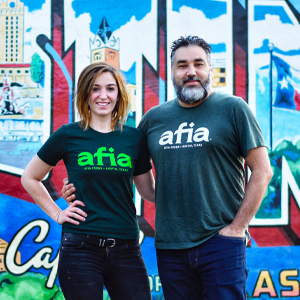
[00:00:10] Ray Latif: Hello friends, I'm Ray Latif and you're listening to the number one podcast for the food and beverage industry, Taste Radio. This episode features an interview with Farrah and Yassin Sibai, the co-founders of fast-growing Mediterranean food brand, Afia. Get access to limited swag and exclusive content by becoming a Taste Radio VIP. It's easy for you to join that group of very important people. Just head to Taste Radio slash VIP and take one minute to sign up. On the cusp of opening a new 21,000 square foot manufacturing facility, one capable of producing a half million falafel balls a day, Afia remains grounded in its roots of empowering others through food. Reflecting upon the brand's humble origins, co-founders Farrah and Yassin Sibai point to a little black book filled with family recipes passed down by generations and which has long served as the foundation for Afia's products, including falafel, kibbeh, and a new line of ready-to-heat entrees. They recall long days in the brand's first commercial kitchen, which was located in the back of a bar in downtown Austin, learning how to engage with and sell to consumers at local farmers markets, their big break with Texas-based grocery chain H-E-B, and subsequent deals with Sprouts and Whole Foods that brought Afia to stores across the U.S. Throughout their six years in business, the Sibais have always leaned on their vision of creating a brand of nourishing, better-for-you food as a means of empowering consumers seeking healthier options and their team, which includes a number of Syrian refugees who have fled war in search of a better life for their families. In this interview, I spoke with Farrah and Yassin about why they have always been adamant about self-manufacturing, how adversity placed Farrah in the right place at the right time, why brand and product awareness are equally important, the effectiveness of Instacart ads and instant redeemable coupons, and the completion of Afia's Series A funding round. Hey folks, it's Ray with Taste Radio. Right now I'm in Taylor, Texas at the new headquarters and manufacturing facility of AFIA. And sitting in front of me right now are the founders of AFIA, Yassin and Farrah Sibai. Thank you so much for having me.
[00:02:41] Farrah Sibai: I'm so excited. Thank you so much for coming. It's probably a bit of a drive for you to get out here as well, right?
[00:02:45] Ray Latif: It was a little bit of a drive. I happened to be in Austin for a couple of days. And I think when we originally met, we were thinking about meeting at your former facility or your, I guess your current, this is the future, but your current facility in Austin. You're now about 40 minutes outside of the city, just about.
[00:03:02] Farrah Sibai: Yep. I mean, it's the same distance that we drive from where we live to our current facility to this facility, it's just in a different direction.
[00:03:10] Ray Latif: It's also a very different size.
[00:03:13] Yassin Sibai: Yassin, how big is this place? So this one is 21,000 square foot. Our current facility is a 5,000. So that's a big upgrade. You know, it will come with the scale of the business that we're at at this point.
[00:03:23] Ray Latif: Yeah. Why did you feel like the timing was right to build this kind of place?
[00:03:28] Yassin Sibai: This was actually planned back in 2020 with our projections for where the business would be in terms of sales and scale. We are already a year behind given COVID and supply chain issues. There was a lot of delay with the construction. and I would say I cannot wait to be here and start production because we are running, you know, through the seams where we're at and it's overdue for the move.
[00:03:56] Ray Latif: I was very lucky to get a tour of this new plant. And even though not everything is online yet, there is a lot of amazing things that are about to happen as soon as you flip the switch, so to speak. One of the things that really blew me away is that you'll be able to produce, and I hope I'm not giving away any industry secrets here, a half a million falafel balls a day in this plant. That's true. And to put that in scale, it's almost a truckload a day worth of production. Wow. The demand must be there. I mean, it's not just a question of, oh, we're just going to do this and just hope the demand is there. The demand is coming from retailers and consumers at this point, right?
[00:04:34] Yassin Sibai: Yeah, some of it is. And with our projections, we see that, I mean, today it takes us about a week or so to produce the truckload. So this would give us, you know, 6 to 10x of capacity and allow us to grow into more retailers and other channels.
[00:04:50] Ray Latif: Let's talk about where the demand is coming from and why it's happening. And I think we have to sort of go back to the start on this. Afia is a beautiful name. Farrah, what does it mean?
[00:05:00] Farrah Sibai: Alfea means to your health or a toast to your health. And, you know, there are several reasons why we called Alfea Alfea. And it really stems from why Alfea started. And again, the reason why we started Alfea wasn't because of one reason or two reasons. It was several reasons that came together. It really all started with adversities and events that happened in my life. And I truly believe that You never know the future. You never know what's around the corner. My background is in business. I don't have any food or CPG background. So you tell me 10 years ago or 15 years ago that I was going to be running a CPG company and manufacturing as well, I would have told you. No, that's a joke. I wouldn't have believed it. But the adversities that I'd faced and the events that happened in my life put me in the right place at the right time. It's like a jigsaw puzzle where all the pieces were all separate, but then they all came together. whether it was from the loss of my children or when the war broke out in Syria, we had lost absolutely everything that we had and we built. And I was living in England at the time and everything around me just reminded me of my children that I'd lost. I was introduced to Yersin and I needed to start a new chapter in my life and my daughter's life, who was suffering from a life-changing kidney disease. And this new chapter in my life meant that I wanted to be in a new place and start from the ground up. So when I moved here to the States, with my daughter. You know, we speak the same language as we do in England, right? But a lot of things are different here. So it took me a bit of time to assimilate and to get used to different things. And whilst I was here, when I first moved over, I also volunteered a lot of my time to help with a huge influx of refugees that were coming into the city. mainly because I really empathized with all the pain and the struggle that they went through because I'm not a refugee myself, but going through some similar type of pains and struggle, whether it's loss of kids, whether it's loss of everything back home, whether it's moving to a new country with new culture and new language and starting from the ground up. I mean, I know how difficult that is, but I'm already 10,000 steps ahead of them because I speak the language. So I offered all my time with them to help them just stand on their feet and help them in as many ways as possible. And at the same time, I always used to tell you, you know, I wish there was more than, something more than just giving my time to them. I wish I could do more. I wish I could help support them. But, you know, I wasn't able to. At the same time, my mother-in-law was also going through her struggles. She had hours to pack her life in the bag before the borders in Syria closed. And when, you know, she packed her bag, she packed her most sentimental items and personal belongings. And one of those items was her generational black recipe book. And this recipe book travelled continents with her to arrive here in the States. And just like these refugees, she struggled. She missed home. She missed her life. She missed her family. But she found comfort in our kitchen when she took out her book and she'd cook us the most amazing, authentic meals. And so I'd go to our local supermarkets to try and find some frozen Mediterranean, Middle Eastern food. And although Mediterranean was and still is the fastest growing cuisine in the States, it's the number one diet for six years straight in the States, its presence in the freezer section was missing. So at that point, I had these amazing generational recipes. I saw this white space and this gap in the market. I had an opportunity to be able to start a business, to be able to support refugees, give them an environment and a home that reminds them and takes them back home with foods that they know and they enjoy. And I also had a chance to stand on my feet, start from the ground up and show my daughters and Nusin's daughters, between us we have five girls, to show my girls that life is tough, but no matter what comes your way, you can start from the ground up and build something great. So all those reasons came together and we started our fear.
[00:08:48] Ray Latif: Farrah, thank you so much for sharing that story. It's a beautiful story and it's a very personal story and I appreciate you sharing it with our audience. Thank you. When you launched the brand, I think you had said that initially it was food for your people. It was food for people who were looking for these types of flavors, the flavors they remember from home. But it's since grown way beyond that. Now Afia is a brand seemingly for all people. How did you get the word out about what you were selling? Because hummus and tabbouleh and baba ghanoush in some ways, it's all kind of ubiquitous in the United States. Falafel, not so much.
[00:09:24] Farrah Sibai: When I saw this gap in the market, Yassin and I, I went to him with the idea and we sat it through and we did a business model. We looked into it. We looked into really what type of Mediterranean, Middle Eastern food is out there in the frozen section. And we found nothing. at the time. So we built our business plan and we barely had any money. We started out with $20,000.
[00:09:43] Ray Latif: But you had a business plan.
[00:09:44] Farrah Sibai: We had a business plan. That was a great start.
[00:09:46] Ray Latif: That's important. A lot of people don't have a business plan.
[00:09:48] Farrah Sibai: I think it would be so funny if we look back at it now. I mean, on a high level, we had a business plan, but looking back at it now, you know, there was a lot of gaps that we should have thought of.
[00:09:58] Ray Latif: Did you envision having a manufacturing facility in the first business plan?
[00:10:01] Farrah Sibai: Yes.
[00:10:01] Ray Latif: Okay.
[00:10:02] Farrah Sibai: From day one.
[00:10:02] Ray Latif: Why?
[00:10:04] Farrah Sibai: We wanted to stay in control of our product, number one. Number two, my mother-in-law's black recipe book has gone through a lot. It's a generational recipe book and... You're not just going to hand it over to someone else? the product that's going out there tastes great, you know, is what my mother-in-law and what's in that recipe book. And in addition to that, when we first launched, yes, we launched with Fela-Efel, but we also launched with another product called Kibbeh. And if we thought to find somebody that's going to manufacture Kibbeh, I actually don't think we would have been able to find anybody that will actually make that because it's a very difficult product to make. It's not well known. So it was a decision that we made day one and, you know, the consistency of the product is really important to us and making sure that our consumers are getting a great product all around. Self-manufacturing means that, you know, we can see the product, taste the product, ensure every single bag that goes out there has passed Not only my mother-in-law's approval, but all of our approval. But yeah, when we first started out, you know, we had this business plan and we wanted to test it. We wanted to see, you know, is this really viable? So with our $20,000, we started out of a commercial kitchen. We handmade absolutely everything. And then the best way to test it for us, and I would, you know, I tell this to every startup out there, the farmer's market made a night and day difference for us because, you know, it really validated for us our products, the market demand for it. And it also gave us a lot of constructive feedback early on in the day. So when we started out at the farmer's market, our kids were young at the time. We used to take them with us to the farmer's market. They used to sell out even more than Yassin and I did. But the feedback that we would get there from, you know, our customers and our consumers was, Finally, you know, there's a frozen Mediterranean, Middle Eastern product out there, and we love how convenient your product is. We love its great attributes. We love that it's vegan. We love that it's gluten-free. We love that your ingredients are just clean, and I know what every single ingredient is. And then selling out on a weekly basis also validated to us, OK, well, there is a demand, but there's no supply for this type of a product and all its great attributes that come with it. At that point, Yassin and I, we decided, OK, well, our goal eventually at the beginning was to be in retail and was to be the go-to Mediterranean, Middle Eastern brand in supermarkets all over the country. And we started out with HEB. amazing partners. We applied for an HEB Quest for Texas competition in 2018 and were chosen as finalists, which launched us into 200 HEBs in 2019. And that was our first entry into retail. At this point, we did not know what to expect. At the time, I remember we sat down with our buyer and we were like, what do we expect? What's a good, you know, amount of sales or velocities? He just said, you know what? I don't know. There's nothing like this on the shelf. And bear in mind that when we launched into the 200 HUBs, we were just doing farmer's market locally here in Austin. So we'd made a little bit of a noise, a little bit of a buzz. People knew us here slightly, but nobody knew us in Houston or in San Antonio. So going out to 200 stores with No brand awareness or recognition. Our hearts were racing. We didn't know what to expect. But straight off the bat, the product was selling off of the shelves and we were shocked. We were surprised. But then it also, yet again, validated, OK, there is a demand for this, but there's just no supply for it.
[00:13:22] Ray Latif: Where was the demand coming from? Who was your consumer? Who was your customer? Who was buying the product?
[00:13:26] Farrah Sibai: So in all honesty, day one, I mean, with the limited amount of funds and money that we had, we just did not know. But with its great attributes at the time, you know, we contributed it to being, you know, it could be the vegans, it could be the gluten-free, it could be, you know, the people that are looking for a great plant-based alternative because it's a great source of plant-based protein.
[00:13:47] Yassin Sibai: And also I can probably add to that, during the first initial days when we launched, we would do, I would personally at least do marathons of demos. I'll go to different HEBs, sometimes two HEBs in a day, four hours each, and I would just like sample out the product to different people. And I can say that the majority were millennials, young people that were eager to try something new, and mothers. Usually they end up doing a lot of the shopping, but they were interested and many of them tried it and ended up liking it. And some of them had their kids with them. They would sample the falafel to their kids and be like, oh my God, my kid's very picky and he's loving this. So that kind of created that whole initial consumer base around it's healthy, it's good, and it's being accepted by the little kids that are trying it.
[00:14:42] Ray Latif: You can put it in an air fryer, you can put it in a toaster oven and have a great meal in about 10 minutes.
[00:14:47] Farrah Sibai: Yeah, they can frozen ready-made. All you have to do is heat them up, air fryer or the oven, 8-10 minutes and you're done. But funny story about the demos, actually, I'd like to say. So Yacine was running these blitz of demos. And at the time it was just him and I, by the way, it was just, you know, it was both of us and we were running the show.
[00:15:03] Ray Latif: Just going to all the H-E-B stores that you were in. And doing the production.
[00:15:06] Farrah Sibai: And doing production and figuring out sales and there was nothing. So we were wearing all the hats at the time.
[00:15:10] Ray Latif: You were literally just the two people running the company.
[00:15:12] Farrah Sibai: Just the two of us at the beginning. So whilst he was out doing demos, I was running, you know, the production, making products and stuff and sorting out some other stuff. And he would come back every single day from his demos and he'd be like, I just sold the end cap. in a two, three hour demo. And I'm like, really? So he's like, yeah, so we do it again. And I was like, okay.
[00:15:33] Yassin Sibai: That's like 400, 500 units in two to three hours. Wow.
[00:15:37] Farrah Sibai: Wow. I mean, if you can do that, I bet I can do that in half the amount of time. So we're like, okay. I mean, we had to make it a little bit fun at the beginning because there was so much hard work going on. So we decided that I would do a demo instead of him on any one day. And I came back and I told half of the end cap, And I said, why is it that you're doing different? So he said, oh, you know, you know, I'm just I'm just a better seller. And I was like, I was like, no, OK, I'm going to come and watch you. So Yassini actually, and I did, I went and I watched him. And the great thing about it is he explains the product, but then he goes straight in for the sale. I realized when I was doing demos, I'm a very talkative and conversational person and people really like my accent. And, you know, I go into a lot of detail about the story in the background and everything, which would mean that, you know, I'd have the same person sit at my demo table for 10 minutes. And then, you know, he would go through 10 people in 10 minutes and I'd still be speaking to this one person. I was like, that's what it is. At the end of the day, that one person still ended up buying. I just had a very long conversation with them.
[00:16:34] Ray Latif: At that point, Yassin had already put the products into five people's shopping carts. Well, you know, that conversation is really important. The backstory is important, too. We hear that all the time from consumers that they're looking for something that they can connect with. They want to know the history behind a brand. But again, at the end of the day, it has to be better for you. It has to be made with better for you ingredients. The question is, can you scale what you're doing? Can you scale it in a way that is going to lead to strong unit economics, that is going to lead to a profitable business at some point? And, you know, owning your own manufacturing could go either way. I've heard horror stories about manufacturing, self-manufacturing. I've heard some very big success stories. So when you're thinking about taking that next step from commercial kitchen to your own manufacturing facility, what was that conversation like?
[00:17:25] Yassin Sibai: When we took that step, we stepped back and thought about this strategically. Part of writing our business plan was evaluating CPG as a whole. And we looked at what are the rates of success for CPGs and what makes them successful, what doesn't, what does it mean to be manufacturing? So we addressed a whole list of questions before we embarked on this journey. And even then, when we talked to different people in the industry, knowing that both of us are not from the food industry, we said that we wanted to do our own manufacturing, and they would laugh us off. They were like, oh, you guys are crazy. I mean, running a CPG is a big undertaking by itself, let alone you starting manufacturing alongside with it. And it's very capital intensive.
[00:18:07] Ray Latif: As we talked about, it's two different businesses, sales and marketing and manufacturing. You essentially own two different businesses. Correct, yeah.
[00:18:14] Yassin Sibai: It's literally that level of work. But in hindsight now, when looking back through COVID and supply chain, A lot of the same people that were, laughed us off, looked at us and said like, that was very insightful. That was very smart what you guys did. Because the position we are in today, even though we are in over 3,000 retail doors, With all of COVID supply chain issues, we have not shorted a single retailer, a single case to date. We are in 100% control of our production, our supply chain, ingredients, the whole line. Not to mention it's a higher margin business, longterm. Initially, it's very capital intensive. You have to figure out how to get the money and all of that, but longterm, it pays off. So if you're in it for 10, 20 years, from my perspective, and strategically, we looked at it, we're like, this is a family business for us. It's not just, you know, you build a brand and then eventually some strategic, you know, bigger brand will come and buy you out. We wanted to be in it for the long term.
[00:19:18] Farrah Sibai: In addition to what Yassin is saying, another thing that we've seen has really helped us with, you know, controlling and owning our own manufacturing is the ability to perform R&D on our own time, on our own machinery. You know, with our product, we don't have to schedule time at another co-packers and when they're available and pay for days because R&D could take days and days and days. you know, you're working on a specific ingredient or, you know, it's a long process. So having the ability to do that in-house for our current line and for future lines has been, you know, a huge advantage for manufacturing in addition to being able to offer our offerings in so many different ways. We just recently hired a food service team. So we're able to take our products now with retail, but we're able to introduce them to food service as well because we self-manufacture, we can pack them in different size bags and boxes. You know, we can work with chains out there specifically. on Felaireville if there was any modifications because we were in control of the line. So there's a lot of advantages that come with it. It's not easy to scale manufacturing. As you did the tour today, you know, you saw a fully automated line, but it's taken us several years to get there when we first started out, it was all manual. And then, you know, we scaled a certain piece of machinery as we went and we identified bottlenecks and we scaled that piece of machinery. It was a challenge, but the positives definitely outweigh the negatives, at least in our case.
[00:20:48] Ray Latif: I feel like this facility is not a leap of faith. This facility is based and built on the sales and the demand that you've been seeing for Afia products. But when you're going from commercial to that first facility, there had to be a little bit, right? I mean, or am I wrong in that, you know, the retail authorizations that you had and the velocities that you were seeing justified building that plant?
[00:21:13] Yassin Sibai: When we moved from the commercial kitchen to the very first dedicated facility, which was 500 square foot, it was literally the back kitchen of a bar. We closed it off and we ran it as our own semi facility. We did that because our first product alongside the falafel was the kibbeh, which was a meat product. And therefore we had to be USDA. Now, We didn't know what we were doing, but at the same time, we're like, you know, we need to set a bar for what we want to do. So we filed for the federal USDA, not even the state one. We're like, you know, if we're doing it, we might as well go the whole way. And to be USDA certified, you had to be operating in a dedicated space. We no longer could be in the commercial kitchen. So that was our transition, our thought process to get into the dedicated space. When we pitched to H-E-B, and we hadn't gotten a firm yes from them yet, but when they were evaluating us, they came to the 500 square foot facility.
[00:22:12] Ray Latif: Your retail buyer came to the facility?
[00:22:14] Yassin Sibai: Yeah, they came to the 500 square foot. They looked at us and they looked at the facility like... Okay, I mean, we could potentially give you this many doors, but we were like, it's one in a lifetime shot to get to talk with H-E-B and be on their shelf. We need to do this right. So we took another leap of faith and we looked for the 5,000 square foot facility. We leased the space and we're like, let's just hope H-E-B lands.
[00:22:42] Ray Latif: So you did it before the retail authorization, you built the facility?
[00:22:45] Yassin Sibai: Yeah, I mean, we were far enough in the conversation that we took that leap of faith, really, that it's going to happen and we better make this happen. And we moved into the new facility and then we invited the buyer again. And we're like, that far from the school, forget about it. This is where we're going to be operating and where we're going to be, you know, producing for H-E-B. He looked at it and That by itself was, you know, it left a very different impression on H-E-B. And in my guess, that was one of the reasons why they actually gave us the $200 they won. I mean, remember, we couldn't ask for $50 or $100. It's up to them to decide.
[00:23:19] Farrah Sibai: But I will tell you, you know, our start with HUB was an amazing start. I mean, we couldn't have asked for a better partner, in all honesty. When we first started out with them, like I said, it was our first entrance into retail. So we still had a lot to learn at the time. We were still right at the beginning of our journey and, you know, they held our hand. They really helped us with, you know, our first entry into retail. In addition, that same year, we were actually part of the Chobani cohort, Chobani incubator, which also really helped us learn and navigate. how to run and scale and grow CPG. But going into H-E-B was for us a domino effect. And we wanted to make sure that our entry into H-E-B was as successful as possible because it was based on our success there that we would be able to present to other retailers and they would actually see validation back here in our backyard in H-E-B. I mean, when we launched with H-E-B, the retailer after that, I mean, we were in H-E-B for about two years before we expanded further out. And in those two years, not only did we validate that there is a demand for this product, but we also, we learned how to market it potentially. We learned how to, you know, what best ways to sell it, even at a very small scale. I mean, we still didn't have that much money back then. So how we market the products today is very different to how we did back then. But we learned a lot, which helped us in our scaling and helped us in our conversation with the next retailer.
[00:24:42] Ray Latif: Are demos still the best way to sell your product or is word of mouth getting interest and demand for your brand?
[00:24:50] Farrah Sibai: I would say demos are amazing. They really are just because of what I saw firsthand and how much we could shift and the interactions that we could have with the people there and then on the ground. But there's two issues or two problems with demos is they're very difficult to scale when you're selling nationally. And it depends on the amount of money you have. But in our case, it's very cost prohibitive to be able to scale scale demos on a national level. So there are other ways that we work to get the word out there, whether it's brand awareness, whether it's through influencers, whether it's through trial programs, whether it's through online shopper marketing through Instacart. So we're having to really home in and lean on that side of marketing to raise awareness for the brand versus demos.
[00:25:37] Yassin Sibai: And also the world did change with COVID. Even the retailers stopped allowing demos. So toward the end of 2019 or early 2020, even H-E-B said no more demos. So we had to stop, rethink and pivot. We're like, okay, if we can't do demos, how else could we reach our consumers? So that kind of allowed us, and it spurred a whole set of other agency businesses that kind of catered to companies like us that wanted to market, but we no longer could do demos.
[00:26:12] Ray Latif: So post-pandemic, or I guess, I don't know what kind of world we're living in right now, but what has driven trial the most beyond demos? What is really engaging the consumer the most?
[00:26:23] Farrah Sibai: I would say a few things that we're working on. And again, you know, it's a learning curve. I think marketing is, it's really difficult. You have to try things and some of them work and some of them don't work. What might work for Althea might not work for another company. But as it stands right now, you know, one thing that we've really leaned into is getting the word out there, brand awareness and, you know, product awareness. And, you know, we're homing to influencers a lot. We have influencer partnerships. where they can target our demographics or certain retailers. And they talk to Aafia and our products to their whole platform of followers. And a lot of people know of Fil Aafil, some of their followers know of Aafia, but a lot of people still don't know what it is. So it's through these influencers that they are able to educate their followers, whether it's how to use it, its versatility, its great attributes, you know, the fact that it is a great source of plant-based protein, it's a clean ingredient, you can, you know, adapt it and use it in any of your meals. So using, you know, and partnering with influencers has been a huge, you know, huge advantage to us whereby we can really get the word out on a national scale. In addition to that, I would say online ads, specifically on platforms like Instacart, where we've done a lot of A-B testing, we've learned how to optimize our ad spend there with a great ROAS. We actually captured 10% of customer acquisition on Instacart for frozen vegetarian meals. We've quadrupled our sales on Instacart from 2022 till now, just through A-B testing and optimization. But the great thing about that is that that's a sale there and then, you know, when they, when they put it in their basket, it's a purchase there and then. So that has been really helpful to us. And another thing which actually leans into self-manufacturing that we've started campaigns on this year is IRCs. If we wanted to run a campaign in a certain retailer and have IRCs stick it on our products.
[00:28:10] Ray Latif: And for, for folks who don't know the acronym, what it stands for?
[00:28:12] Farrah Sibai: instant, redeemable coupons.
[00:28:14] Yassin Sibai: There will be a stick-on coupon on every bag that we put on the shelf.
[00:28:19] Farrah Sibai: So to execute that out on the ground, if we weren't self-manufacturing, would cost a lot of money. And I'm talking tens and tens of thousands to, you know, stick on our product in any one retailer. The beauty of self-manufacturing is that we're able to do that in-house. So we're able to stick these IRCs on the product in-house before it gets packed, sealed and shipped out. Also being able to target what region or what retailer we want to send this IRC out to and, you know, track it, track its sales, see how it affected, you know, the reordering or the sales within that retailer or that region. So that's a campaign that just started this year and we're hoping to, we're hoping it's going to be a success.
[00:28:55] Ray Latif: I feel like the IRCs also give the customer permission to buy more than one bag. Are your customers typically buying one at a time? I feel like they would be buying two bags, three bags at a time. Do you know, do you have a sense of how many or how much product people are buying at one time?
[00:29:12] Farrah Sibai: I will tell you something, the great thing about our product is you get 15 pieces in a bag.
[00:29:17] Ray Latif: That would take a day for me.
[00:29:19] Farrah Sibai: But the convenience of it is also that it's a resealable pouch and bag. And we've heard, you know, from our customers and a lot of them is, um, you know, the fact that they're able to take it out of the freezer, use three, six or nine of them, and then we put it in the freezer because of that convenience factor. I do know, you know, we're, we're a big family, you know, Yassin and I, you know, we've got five girls and my in-laws live with us as well. So one bag's never going to cut it for us. So I'm hoping and I would love that, you know, people are picking up three or four at any one given time.
[00:29:49] Ray Latif: Yeah. I mean, well, sales data would tell you that. I mean, how much sales data do you rely upon to better understand your consumer and your retail relationships?
[00:29:57] Yassin Sibai: We are still too small to do like a proper full purchase of the data, syndicated data that you can, you know, buy from Nielsen or another. Too small or too frugal? We cannot afford, I mean, we only have a certain number of SKUs that are in, you know, in the 3,000 doors. As big that number might seem, it's still too small to put the investment into purchasing that data. Because we're the manufacturer, we know what we're shipping out. We can estimate just an extent where we are at vaguely. And every once in a while, yeah, we do buy some of the data, but it's not a regular thing. But what we see is that there's a lot of repeat customers. We do some of the promotions and some of the IRCs to get the first time trials incentives for the consumers. But even during the periods where we're not doing any promotions at certain regions or certain retailers, we monitor that effect. And we can see that the purchase rate or there's a new baseline of purchase. And that's a big indication that customers are coming back and repurchasing the product. It's not always just new customers trials and then they go away.
[00:31:05] Ray Latif: Were customers asking for a new line of products as well? Afia is a platform brand, you envisioned it as a platform brand, but did they have a hand in your next line of products, which are these frozen entrees, which my mouth is watering just thinking about these things.
[00:31:22] Farrah Sibai: One thing that has actually also helped us through the demos, through Farmers Market, is also looking to the future, right? Is listening to what they're saying and listening to how they use this product and how they really like it. Again, through our influences, we're seeing that our product is being used within meals. And so it was a segue and it was really clear and apparent that, okay, well, people are also wanting convenience factor, so why not provide them with a meal? In addition to our bags, whereby they can also add in some more falafel if they want, because each one of our meals comes with three traditional falafels inside. So, you know, it's already a ready-made meal for if you're in a really big hurry, because these meals are done in three minutes, and you just heat them up in the microwave, and you're good to go. I mean, everybody's looking forward. something even more convenient than what is already out there, which is still very convenient. So it was just a natural segue to really kind of like just show people a different way to eat our falafel because our meals, the origin of our meals actually come from some meals that we eat back home. They are a modern fusion of the meals. Like one of them is our crispy onion and lentils. The origin of that is Mujadara. But there is a modern spin on that whereby we have like a pomegranate molasses sauce that goes inside of it. And there's three falafels in there.
[00:32:36] Ray Latif: It's so interesting to me because I'm shocked that we haven't seen a line of Middle Eastern frozen meals to this point because, you know, Indian meals are ubiquitous. You can go to a Trader Joe's, a Whole Foods, an H-E-B and go find a chicken tikka masala with rice and it'll make, you know, it'll take three minutes. That being said, how do you defend against other companies, other brands that might look at your idea and say, hey, we can do that as well, or that's such a good idea. We should start doing that. How do you defend against the threat of future competitors?
[00:33:10] Yassin Sibai: I mean, with our falafel, we were not the first to produce falafel. Sure. For CBG. Right. We just did it better than everybody else. Right. I mean, there were falafels in different... I'm sorry to interrupt you.
[00:33:21] Ray Latif: When you say better, define better.
[00:33:24] Yassin Sibai: So, We chose with our, I mean, the falafels that we, when we first started, we looked at different regions and there were pockets of brands, CPG, that were selling in retail in the Northeast, some in California, some in Florida. And we purchased every single one of them, even before we started. That was part of putting our business plan together. And a lot of them were either, I mean, even when you go to ethnic supermarkets, they had falafel as well. And what we consistently saw is most of them were commercial. They were not using the best ingredients. They were not using healthy ingredients. They had binders. They would add flour in the... They're trying to do it on the cheap.
[00:34:05] Ray Latif: Anyone who eats falafel on a regular basis knows you don't put flour in falafel.
[00:34:08] The Mediterranean-inspired: No, that's a no-go.
[00:34:11] Yassin Sibai: Or breadcrumbs. Or they would cook it in canola oil, which is like a big no-no. Don't use a dry mix either. Or a mix, yeah. So we wanted to come in with a very good product. I mean, when I speak with the team and with our sales team, I mean, there's the Toyota and there's the Mercedes. Obvious, the Mercedes. Obvious, the Mercedes of Falafel. So we try to make sure that our ingredients are highest quality. It's all natural on the healthiest of the spectrum of what you can buy for Falafel.
[00:34:45] Farrah Sibai: I think in addition to that as well, the authenticity, the story and the mission behind the brand also plays a big role. I mean, you know, my mother-in-law's journey and, you know, if people were to listen and learn about Alfea, they would know that there is a story behind it. There's a meaning behind it. And I think people really resonate with that. And I think it's relatable. I'll give back to the community. You know, we do employ and support refugees. When we first started out, our first ever employee was a refugee. And ever since, you know, we've been able to donate at this point over 300,000 falafels to the community, to food banks. With the growth of the business just last year, we were able to sponsor a Refugees for University education. So I think it's, you know, it's in addition to what Yaseen said, it's the full package, right? When people are buying a product, they're learning about that company, they're learning about that brand and they like the story and they want to support that mission as well. So there's several things that could go into that.
[00:35:44] Ray Latif: As you've grown, so has your team. You've built out a pretty big team. And for one of the first things you said to me when I walked in here was you said, I love my team. I'll do anything for my team. And culture is so important in any growing company. It's important, any company, period. How did you hire the right people for Afia? And how did you find the people that would appreciate the history behind the brand, where you guys come from and what you're trying to achieve with the company?
[00:36:14] Yassin Sibai: Given that we do manufacturing and we run the CPG, we have two sets of employees, if I can categorize them. There's the manufacturing side, which involves, you know, the people that are on the ground producing the food. And we also have the marketing and the sales and the business support people. With the manufacturing side, I mean, we try to approach them not as an hourly job per se, but try to offer them a salary job. We give them health care benefits. We do kind of competitions around employee of the month and we, you know, birthday cards and so on. So we try to give them good incentives and make them feel like at home. Farrah also mentioned earlier that our freezers here in the break room is full of our product. They're always welcome to have lunches of our products and so on. On the business side, it's much harder to hire because these are people that you rely on in critical roles. And if you hire the wrong person, that could set you back quite a bit as a business.
[00:37:25] Ray Latif: Have you ever hired the wrong person?
[00:37:26] Yassin Sibai: Yes. We've had our setbacks.
[00:37:29] Farrah Sibai: Which I believe we learned from for sure.
[00:37:32] Yassin Sibai: It's really a balance between giving them a chance and cutting your losses.
[00:37:38] Ray Latif: In hindsight, could you have anticipated that they weren't going to work out?
[00:37:43] Yassin Sibai: Yes, but we try to see their value for what they were doing at the time. I mean, there was a point where we hired a marketing person who was great at branding. Well, we were in the stage of rebranding, so she was valuable for that stage. But when it came to digital marketing and promoting, it wasn't the right fit. So, It depends on where your stage of the company is. We try to see the value of that person where they can add value. But we believe right now the team that we have is more incompetent in terms of their skill set. And they are really good at taking those key roles and growing with the company. They would actually help us take us to the next stage instead of just working alongside us.
[00:38:32] Ray Latif: I spoke to an entrepreneur recently who talked about the fact that she only hires Swiss Army Knives, people who can do a lot of different things. I think there's probably a positive and a negative to doing that in that, as you mentioned, maybe someone's great at branding and maybe they're great at another thing, but what you need is someone focused on branding and marketing and able to do everything within that part of your business.
[00:38:57] Yassin Sibai: So the Swiss knife approach is only good in the very, very early stages. Like when it was just me and Farrah wearing all the hats, we wish we could find the Swiss knife kind of guy to be our third leg and help us, you know, offload some of that work and he could be doing 10 different things. So While Afia is right now is we're at the stage where we need specialized people in sales. Like when I have a CPG salesperson, all he does is he talks to retailers. He knows the ins and outs of getting that part of the business scale. We also hired a food service salesperson who lives and breathes the food service channel, the universities, the food chains, the restaurant chains, the hotels. So that is his world. You can't get a CPG person that talks to H-E-B to go talk to the health team, for example. It's really completely different skill sets. Same thing with marketing. I mean, we need people that are a designer, that can take ideas and go on Photoshop and do things. And we also want someone who's a digital, who knows where to spend money on, where to put the ads. You can't have the designer doing that. We are at a stage where if we're really taking this to the next level, we need those key people in those key specialty roles.
[00:40:09] Ray Latif: It sounds like you have the place for those people to work in this new facility. The pieces are in place to create more product, a lot more product. What is next? I mean, how do you envision the next stage of development for Afia? You're in 3,000 doors right now, you said. You know, are you looking at, say, a 2024 where you're in quadruple those number of stores? Or is your growth a bit different than what I might envision?
[00:40:38] Yassin Sibai: So our first stage was H-E-B. Take that one retailer, do very good as a showcase, and then go out and replicate that. And we did that. We went from 200 H-E-Bs, and then in 2021 and 2022, we went up to 3,000 doors. Now with 3,000 doors, we're at a point where There is enough coverage nationwide for our brand to take what we have in these doors and grow the breadth of our presence. That'd be add more SKUs on the shelf, that'd be sell more units off the shelf in the same doors. And we'll continue to grow the doors, but I don't want to grow from 3,000 to 6,000 in 2023. My focus is take this 3,000, if I'm selling X, I want to sell 2X, 3X, or 4X within those stores. And that allows us to even go from, you know, some stores would only carry two SKUs. If we do good and we sell more units, then we will grow to three SKUs, four SKUs, five SKUs. So any one of those SKUs added to the existing doors is equal to adding another retail door on top of it. Not to mention adding doors is really expensive. Because with retailers, you have to pay to get on shelf. And that costs a lot of money. So having made a big investment in 21, 22 to get on shelf in $3,000. Now I need to capitalize on it by selling more units through those doors. Now we continue to grow strategically, but I'll pick and choose where I want to add my next thousand. It's not just the next thousand.
[00:42:22] Ray Latif: If you do enter in more doors and you do have to pay more slotting fees, and eventually I assume that will be part of the strategy, part of the plan, is a capital infusion, you know, in the future as well? Are you looking for outside capital to help fund this growth?
[00:42:38] Yassin Sibai: So probably this interview would be the right platform to announce that we have just closed our Series A. Congratulations. Thank you. Wow. The Series A originally started with one million in 2020. And then just a few months ago, we raised an additional three million. Congratulations. Fully funded at this point. We have not announced it yet. So this is the right platform.
[00:43:02] Ray Latif: Good timing. Well, thank you very much for talking about this. I sincerely appreciate you sharing that with us. Congratulations again. What did your investors see in the brand? How do they believe in the vision that you have for Afia and its potential?
[00:43:17] Yassin Sibai: I mean, I'm humbled to say that ability to raise in this environment had been super challenging, but we were able to pull it off. And that's testament to the brand, the vision, and to me and Farrah as the co-founders, because as we discussed with many of the investors, the main criteria they look at is the validity of the vision, where they see the growth of the company, but also the founders. what have we executed to so far? And how are we able to take the company to the next stage? The other factor they looked at surprisingly is that we are our own manufacturer. They wanted companies that they're just not getting co-packed because they've seen many CPG brands getting burned by their co-packers. I mean, I've talked to people that called me and was like, could you co-pack for me? And one of the things I'm like, why? They're like, oh, we just got a 70% increase on the bill from our co-packers. I've heard of CPGs that went out of business because of who they were co-packed with and what happened during that. So the investors have an appreciation at this point for companies that run their own manufacturing as well.
[00:44:27] Ray Latif: We've been talking about trying to sit down and record an interview for the podcast for a while now. The first time I met you in person, Yassin, was in September of last year at one of our events, one of BevNET's events, that is. And I've always been so enamored with your brand because you do make such delicious food. I'm so excited for the future of the company. Thank you so much for taking the time and talking about your history, and what's next. Congratulations again on the Series A, and I hope I can come back here soon and see this process running, humming, as it were, with up to 500,000 falafels a day.
[00:45:04] The Mediterranean-inspired: Oh no, you definitely have to come back and see this in full operation, have some fresh falafel straight off the line.
[00:45:09] Ray Latif: Yeah. In the meantime, maybe I can crack into one of the entrees that you have in your conference room.
[00:45:14] The Mediterranean-inspired: Yeah, I got four there for you, Ray, you know. I know you're hungry.
[00:45:17] Ray Latif: I am hungry. I've been waiting for a bit. Now I'm going to bite into those. So once again, Farrah, Justine, thank you so much. This has been such a pleasure. Thank you, Ray.
[00:45:26] The Mediterranean-inspired: Thank you, Ray.
[00:45:26] Ray Latif: It's a pleasure. That brings us to the end of this episode of Taste Radio. Thank you so much for listening, and thanks to our guests, Farrah and Yassin Sibai. Taste Radio is a production of BevNET.com, Inc. Our audio engineer for Taste Radio is Joe Kratchy. Our technical director is Joshua Pratt, and our video editor is Ryan Galang. Our social marketing manager is Amanda Smerlinski, and our designer is Amanda Huang. Just a reminder, if you like what you hear on Taste Radio, please share the podcast with friends and colleagues. And of course, we would love it if you could review us on the Apple Podcasts app or your listening platform of choice. Check us out on Instagram. Our handle is BevNetTasteRadio. As always, for questions, comments, ideas for future podcasts, please send us an email to askatasteradio.com. On behalf of the entire Taste Radio team, thank you for listening, and we'll talk to you next time.